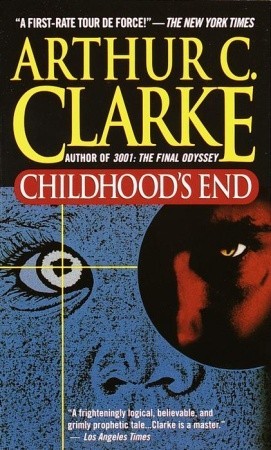
 What will happen when, if, humans make contact with an alien species has been the subject of lots of science fiction books, movies, TV shows, video games, and the like. There is a lot of room for creativity here. For one, how these aliens will look is up to the imagination. For another, what level of technology they have attained may vary. Finally, how both the aliens and humans will react to one another can range from hostile to friendly. In most such stories, alien contact ends in violence. Arthur C. Clarke takes the exact opposite route in Childhood's End. Contact with aliens ends in peace on Earth rather than violence. This has implications itself, as Clarke describes throughout the course of the novel, but the ending will leave you with more food for thought than most other alien invasion stories out there.
These aliens are named the Overlords, for they appear to be acting as lords over the human race. Once they arrive and hover in the skies, people find no reason for war or violence. Indeed, the Overlords intervene in nonviolent ways to help influence humans to stop fighting. In one instance, they take away sunlight from a region momentarily to show there are other means than violence to show one's power. Only one man has any contact whatsoever with the Overlords, and his name is Stormgren, Secetary-General of the United Nations. Every now and then he rides up in the Overlord ship and speaks to Karellen, known to humans as the Supervisor. Stormgren never sees Karellen or any of the Overlords, but he trusts Karellen's purpose. There are small groups of people who rebel against the Overlords in their small ways, and one of the major complaints is that the Overlords do not show themselves. Karellen satisfies them by saying humans will get to see the Overlords in fifty years. A small satisfaction, but he says humans aren't yet ready to see them. Once they do reveal themselves, Karellen's rationale makes perfect sense.
The book jumps ahead in time, when people have flying cars and some of the Overlords freely mingle with certain humans and share technology. Two important characters are George and his wife Jean. At a party of a wealthy eccentric named Rupert they meet an Overlord named Rashaverak, who is reading Rupert's library of books on the paranormal. Why he is studying the paranormal becomes apparent only at the end. Rupert pulls out a Ouija board with mixed reactions from his guests. Rupert's brother-in-law, Jan, is purely a scientist at heart, but on a whim he asks the location of the Overlord's planet's star, and the Ouija board spells it out. The significance of these details become known only much later into the novel.
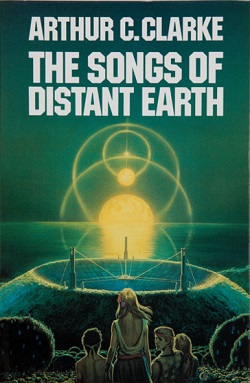
Like Clarke's Songs from a Distant Earth, the science is fascinating, but the human drama: not so much. While Clarke doesn't make any of his characters overtly atheist, they seem to view human sexual relations as being open to multiple partners. This is apparent as George ogles Rupert's beautiful new wife and seems to have an inkling that a relation with her is possible, not that it ever comes down to that. The female characters play minor roles when compared to the males. Although at one point Rashaverak confides with Karellen that Jean might be the most important person on the planet, the events at the end contradict that statement and it doesn't come to fruition. When the story focuses on any human characters, it's on the male ones, and even the Overlords, though sexless, seem male.
It's the bigger ideas that make this novel such an interesting read. While the Overlords do bring peace, that peace comes at a cost. Humans have no need to create art anymore, and life has grown dull. The Overlords act as a Big Brother entity, sometimes intervening when humans are misbehaving, and sometimes, such as when one country launches a nuclear missile at an Overlord ship, they do nothing, which is just as effective. The psychological toll is immense. People always wonder if the Overlords will do anything in reaction to bad behavior. It's almost as though the Overlords are god-like beings, or at the very least a manifestation of Santa Clause, but their presence is both felt and seen with inconclusive evidence.
The goal of the book is to learn of the Overlords' purpose, and the book provides some red herrings so that you might think you know what will happen in the end, but it's pretty unlikely you will guess correctly. The conclusion is fascinating and terrifying all at once. Clarke puts readers in a position to wonder about the future and what it would mean for humanity to be placed in the role it finds itself at the end of this novel. True, the ending will also require some suspension of disbelief, as Clarke treads off the path of his more realistic sci-fi elements, but even Clarke admits in the introduction of the book that this is a work of fiction and what happens does not necessarily reflect his own views. If you can look past some of the silliness, you will find an intriguing novel with fascinating ideas and an ending that is hard to stop pondering long after you finish reading the novel.