Friday, June 8, 2012

Book Beginnings: A Game of Thrones


Every Friday Rose City Reader hosts Book Beginnings on Fridays. What you do is share the opening line(s) of the book you are currently reading and briefly discuss what you think about the opening line or the book or whatever else inspires you. Make sure to share your entry with Rose City Reader and in my comments below.

Here's my book beginning:


" 'We should start back,' Gared urged as the woods began to grow dark around them. 'The wildlings are dead.' "

-A Game of Thrones, by George R.R. Martin

An ominous opening. I'm a little more than 150 pages into the book and I'm enjoying it so far. There are a lot of characters and a lot of events, but I think I've got a grasp on most of it now.

Thursday, June 7, 2012

Cat Among the Pigeons, by Agatha Christie (1959)

This is my first experience with Agatha Christie. Mystery is not a genre I read a lot of, but Christie is so well-known I thought I'd give it a shot. Many novels do have elements of mystery in them, of course, particularly in hiding certain plot points or motivations until the end, so I am familiar with the conventions. I find that mystery, like many other things in life, is at its best before everything is revealed. Monster movies are always scarier when you don't see the monster than when you do. Cat Among the Pigeons is no different. I think it has a satisfying reveal, but Christie cheats a little to throw us off track.

When a murder happens at an illustrious all-girl's school, Meadowbank, Inspector Kelsey is just as puzzled as the headmistress, Miss Bulstrode, about who would commit murder at such a place, and why. The reader knows a little bit more about the circumstances leading up to the motivation for murder, having to do with a revolution in Ramat and the death of Ramat's crown prince. The prince's valuable jewels were smuggled into the school with his most trusted advisor's niece, unknown to her. However, somebody else must have known. Was it one of the mistresses: Miss Rich, Madame Blanche, Miss Vansittart, Miss Johnson, or Miss Chadwick? Was it the secretary, Ann Shapland, one of the servants, or a student? Added to the mix is Miss Bulstrode's consideration to retire and hand off her headmistress position, a gardener who is a little more than he says he is, and a young princess who was in line to wed the recently deceased crown prince of Ramat. This is a lot to consider, and it'll be up to Hercule Poirot to clear it all up.

Overall an enjoyable book. I like Christie's writing style. She sprinkles plenty of wit and humor throughout her storytelling. There is a general feeling amongst the characters that there is a cat among the pigeons. Somebody doesn't belong, but nobody can put their finger on who. The reader will have their guesses, of course, based on evidence and hunches. Christie throws out plenty of red herrings, and it's our job to try and see past these distractions. I had an idea of who the murderer was, but I was proved wrong. At first I was okay with this, but as Christie revealed more details I felt like she cheated. Something happens that leads us off the trail of the killer, and while there is motivation behind this something that happens, it is nonetheless difficult to believe it would happen. I will leave this vague so as not to spoil anything for you.

Other than this, there was plenty to enjoy. The description of the workings of Meadowbank were fun to read, as was getting to know the key characters like Miss Bulstrode, who seems to amaze everybody, even the narrator. The introduction of Hercule Poirot feels random, but I guess it is necessary to solve the mystery. The early scenes in Ramat were also effective. There's a brief moment of interesting political discussion that took me off guard. The prince of Ramat can't understand why his people want to rebel against him. He wants to enact welfare programs to help his people, where his father was a murderous tyrant. Yet they want to oust the nice one. He's hurt and bewildered by these developments. It's as though his people aren't ready for a progressive leader just yet. The prince is left wondering the same thing as Miss Bulsrode - why murder at all?

Wednesday, June 6, 2012

WWW Wednesdays

WWW Wednesdays is a meme hosted by Should Be Reading. What you do is answer the following three questions:

What are you currently reading?


A Game of Thrones, by George R.R. Martin. I decided to see what the hype was for myself. So far it's pretty good, though I'm having troubles keeping up with all of the characters. This one will probably take me a little while to get through.

What did you recently finish reading?


The Gammage Cup, by Carol Kendall, was an entertaining, whimsical fantasy tale written in the late 1950s, and it deals with themes of individuality and conformity, or groupthink (i.e. Communism).

What do you think you'll read next?


I'll probably take a break from A Game of Thrones to quickly read The Perks of Being a Wallflower, but Stephen Chbosky. A friend of mine recommended it, and it's also coming out as a movie with Emma Watson (Hermione). 

Tuesday, June 5, 2012

The Hunger Games, by Suzanne Collins (2008)

"I have almost reached the regrettable conclusion that the Negro's great stumbling block in his stride toward freedom is not the White Citizen's Counciler or the Ku Klux Klanner, but the white moderate, who is more devoted to "order" than to justice; who prefers a negative peace which is the absence of tension to a positive peace which is the presence of justice..."

-Martin Luther King, Jr. in his "Letter from a Birmingham Jail"

I started reading The Hunger Games with the expectation that I would like it. I had heard some positive things, and the premise sounded intriguing. From the moment I started the book, though, I realized it was going to be difficult for me to fall in love with it, and the further I got in the less I enjoyed it. I didn't dislike it because it is popular, I just didn't find it engaging.

In a dystopic United States, the Capital rules over 12 Districts (the 13th was destroyed following a failed revolution), and to keep its power over these districts the Capital hosts what is called the Hunger Games. Each district gives up two tributes, aged between 12 and 18, to participate in these games. These tributes are either chosen in a lottery or they may volunteer themselves. The point of the game is to be the last person surviving. The winner brings home food and wealth for their district until the next game.

The story takes place from the point of view of Katniss Everdeen, whose father died in a mining accident and whose mother has become useless. Jennifer Lawrence plays Katniss in the movie, which is ironic, because in her first big role, Winter's Bone, she plays the same character in a realistic story. Katniss hunts with her only friend, Gale, and makes all the sacrifices she can to ensure her younger sister, Primrose, is not selected to be in the games. However, this is not enough. Primrose is selected in the lottery and Katniss immediately volunteers in her place. Going with her as tribute is Peeta, the baker's son, who likes Katniss, though she doesn't know it. From here begins their training and then the games themselves.

The story is, technically, well-written, but its style is not very engaging. Katniss, as the narrative voice, is too apathetic. She doesn't show compassion towards others, except maybe her sister, and even that is evident only in her decision to take her place in the games. Her sole focus is in hunting and surviving. She's very narrow-minded. She never seems to consider the broader scope of the society she lives in. Human history provides many examples of people in harsh conditions who consider how to make life better not only for themselves but for others. Consider slavery. Frederick Douglass learned to read and write while enslaved, and escaping wasn't enough for him. He fought to free all of the slaves. Katniss instead chooses to tolerate her life and hope that neither she nor her sister get selected to participate in the games. It never once crosses her mind to try and do something proactive.

Of course, readers of the novel understand that Collins is not endorsing a society that makes use of child violence for entertainment. I've heard and read many discussions of people saying how horrible the slaughter is, but this discussion does not happen within the novel. The viewpoints of the characters are not discussed, not even in the sense that many of us talk about the violence in our large cities. The problem with the violence is that it plays out more like a Hollywood action movie, which serves the goal of making it exciting rather than a condemnation of violence. These teenagers fight one another more like action heroes/villains and cold-blooded, experienced assassins than frightened, inexperienced teens. The novel's message would have been more effective had Collins instilled the sense of terror of battle, or a sense that these teenagers are being forced to kill when none of them want to. And with an exception of one character, the deaths are not seen as tragic, but as one less obstacle in the way of Katniss winning. In Howard Fast's The Hessian, grown men prepare to ambush a troop of Hessian soldiers. As they wait for the Hessians to arrive, they shiver with fear that they'll die. And when the ambush is an overwhelming success, they grow sick at the sight and smell of death. That level of humanity is missing here.

What also struck me was the lack of emotion during the lottery process. Where are the mothers and fathers crying out in agony, fighting desperately for their children? Why aren't the teens themselves overwhelmed with fear? They all accept their fate like sheep. Nobody fights for their own survival, or the survival of loved ones. They simply accept their fates. This is why I included the Martin Luther King quote at the start of this review. The people of Panem accept a negative peace in order to avoid tension rather than a positive peace. I can't help but think of King's condemnation of those who silently watch and do nothing, believing that justice will prevail eventually but feeling no need to fight for it. The novel views Katniss as a strong female character, but she doesn't fight except when her own survival depends on it. To me that's cowardice. And it's short-sighted. She's no stronger than her mother because she's just as mute when it comes to her society. She would rather tolerate her life than fight to make it better for her and her people. Her only form of rebellion is to say, I refuse to have any children. That's good for her, but what about the generations to come?

At one point in the novel, Gale wonders what would happen if everybody refused to watch the games. This is an interesting question, but it's the wrong one. The right question to ask would be, what if the tributes refused to fight?

Sunday, June 3, 2012

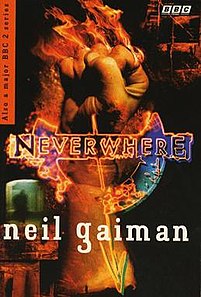
Neverwhere, by Neil Gaiman (1996)

Neverwhere was simultaneously a novel and TV series
I've seen a trend in the two Gaiman novels I have read so far (and I have seen Stardust so I know it's true in that story as well) of parallel fantasy worlds concealed within the real world of London, and even the world as a whole. Those who reside in this fantasy world are very much aware of those in the real world, but those in the real world have no clue about the fantasy world, and if they do become aware of it, they cease to exist in the real world. This isn't entirely original, I know, and anybody can point to Harry Potter as another story that uses this trope, though some of the details are different, but Gaiman makes it feel fresh. He has very quickly become one of my favorite authors.

The story centers around Richard Mayhew, who moves to London for a boring desk job. He is engaged to Jessica, a beautiful, stuck-up woman with connections to very wealthy men. Richard can hardly believe he's with such a beautiful woman, and it never occurs to him he might be happier without her. However, one night as the couple rushes to meet with one of her wealthy bosses for dinner, they stumble upon a woman who appears out of thin air, lying on the sidewalk and bleeding. Jessica seems more annoyed than distressed by this person, and when Richard decides to carry her to his apartment (the woman requested not to be taken to a hospital), it's no surprise later when he receives a call from Jessica breaking off their engagement. This will turn out to be the least of his worries.

The woman he carried to his apartment is called Door, and she comes from London Below. She can speak with rats and has the ability to open doors, even those not meant to be opened. She was chased and injured by Mister Croup and Mister Vandemar, two sadistic assassins, not unlike the man Jack from The Graveyard Book. Richard becomes involved by seeking the aid of the Marquis de Carabas, a very quirky and shady, but resourceful character. When Door finally returns to London Below, Richard thinks his life will go back to normal, minus Jessica. However, when he wakes up the next day, it is as though he doesn't exist. People ignore him, somebody else has taken his office, and his apartment is up for lease, a fact he learns while in the bathtub, naked. He realizes he has no choice but to seek out Door in London Below.

This gives an idea of the main plot, but there are also tons of side plots, and I don't have the time or space to talk about all of them. Just know that a huntress becomes involved, as well as rat-speakers, a floating market, an angel, an underground labyrinth protected by a monstrous boar, and a king's court hidden within a subway train car. Also, Door's own story is crucial.

Gaiman writes with a good deal of wit and humor. He carefully unfolds new plot points to keep things interesting, and his characters are all well-developed. The villains, Mister Croup and Mister Vandemar, centuries old, provide humorous banter as well as suspense. They have an appetite for things inanimate as well as living. Richard's inability to cope with his new surroundings sets up some funny situations, but it also makes the reader sympathetic towards him. Door is a strong heroine, and one of those interesting ones. It seems too often that Hollywood equates strong women with action heroes, rather than strength in character, and in return any semblance of personality is gone. I take as a recent example the movie Mirror, Mirror, where Snow White becomes an excellent swordswoman, but she's a very dull character. Gaiman makes Door a strong heroine without sacrificing her personality or turning her into an action hero.

In fact, Gaiman wisely avoids making this into an action extravaganza. Richard, Door, and the Marquis must use their wits rather than their muscle to defeat Mister Croup and Mister Vandemar, who have the ability to move with superhuman speed. How the story unfolds and resolves reveals Gaiman's superior sense of storytelling. Gaiman also uses his fantasy as social critique. London Below is reminiscent of impoverished areas in large cities of developed countries. The more fortunate of us prefer to pretend these areas simply don't exist. And in today's post-9/11 world the novel takes on new meanings as well, particularly in its conclusion. The film, The Hurt Locker, brings a new perspective to Gaiman's conclusion, and those familiar with it will know what I mean.

Once you've entered this world, there's no going back.

Friday, June 1, 2012

The Pearl, by John Steinbeck (1947)

John Steinbeck's classic novella, The Pearl, is a tale about the tragic consequences one family faces in achieving the American Dream. For many people, this dream consists of acquiring wealth, and perhaps even fame. The recent craze over the Mega Millions lottery that was going for over $500 million is proof. People dream of the kinds of things they could do with that much money. Or we dream of fame through means of acting, singing, or writing a novel. I've encountered many teens in an urban school setting who believe school doesn't matter because they'll be rich one day due to their imagined singing talent. This dream isn't critically analyzed, and these teens fail to realize that failure is more common than success, and success, anyway, doesn't always get you where you want.

Kino and Juana come from a village of pearl divers in Mexico. They have an infant child named Coyotito. The story opens up to a serene sunrise, where Juana cooks breakfast and Kino sits in the sand and waits. The novel opens very slowly, lulling the reader into a hypnotic daze, and then with a shocking suddenness, a scorpion appears, crawling towards the baby. Kino squashes it, but not before it stings Coyotito. Kino and Juana take their child into town to the doctor, but he has no compassion or patience for people who can pay him only with seashells.

Kino and Juana have no choice but to hope the venom won't spread, as Juana sucked it out as best as she could, and they go in their canoe to dive for pearls. They hope to find a pearl valuable enough to pay for the doctor. As Kino hunts for oysters, Juana sings the Song of the Pearl, and their wishes are soon answered. Kino discovers a magnificent pearl, the Pearl of the World, and they take it back to the village. With the money they can get from the pearl, Kino and Juana can get married, buy clothes, and afford an education for Coyotito. Their future path has been laid before them. Their neighbors and friends, and soon the whole town, learns about the Pearl of the World, and everyone is dreaming of what they will buy with its wealth, though it belongs to Kino and Juana. This pearl represents the dreams of everyone.

Everything quickly goes wrong. The doctor comes to their hut and plays a mean trick to make Kino and Juana believe he has cured their child of the poison, and then he gives them the bill. In the night, somebody tries to steal it and Kino has to fight off the intruder. And when they try to sell it, the pearl buyers act as though the pearl is worthless and they low-ball Kino, which angers him. Things escalate even beyond this, but I will leave the rest for you to discover.

Elements of this story may sound familiar to you. We hear how lottery winners spend or loan out all of their money in a matter of years and fall into deep depressions. We also see the consequences of fame through celebrity gossip that paints the famous in a negative light. People grow envious of the success of others and seem to find joy in seeing them topple over. Britney Spears was a beloved singer until she got married for a brief time, and Christina Aguilera had a brief stint as a dirty girl that will not go away in the public eye, despite some beautiful music she has written since. And she's put on weight, celebrity gossipers are quick to point out. There are too many premature deaths: Amy Winehouse, Heath Ledger, Chris Farley, Michael Jackson. One has to wonder what toll fame and success takes on those who achieve it.

Steinbeck sees wealth as a corrupting force. He believes in the goodness of impoverished people, like Kino and Juana. They would have been happier had they not found the pearl. I don't think Steinbeck is discouraging people from dreaming, but providing a warning that achieving your dream won't fix all that ails you. In fact, it might even make things worse.

Book Beginnings: The Gammage Cup


Every Friday Rose City Reader hosts Book Beginnings on Fridays. What you do is share the opening line(s) of the book you are currently reading and briefly discuss what you think about the opening line or the book or whatever else inspires you. Make sure to share your entry with Rose City Reader and in my comments below.

Here's my Book Beginning:


"In the long far off
Of the land Outside
Brave Minnipins lived
And some of them died."

- The Gammage Cup, by Carol Kendall

I haven't started this one yet, but it opens up with a poem written by the character, Gummy, about the Minnipins. The opening line is the first stanza of the poem. I'm intrigued by the opening, though I can only say it is about a race of people called Minnipins. It's also interesting to note that one of the characters in the novel is named Muggles...