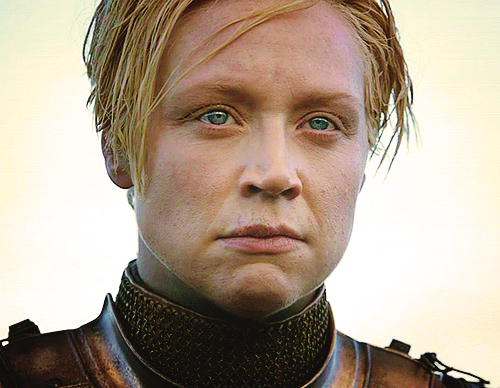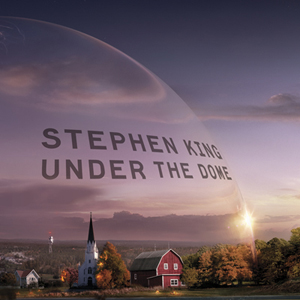
Stephen King's ambitious Under the Dome plays out almost like a science fiction version of George R. R. Martin's A Game of Thrones series (and indeed it inspired a TV show as well). While geographically it's much more confined than Martin's epic, it boasts a nearly equal cast of characters. King's novel is longer than any of Martin's novels in the GoT series, but it's a quicker read because it's much faster-paced. While Under the Dome lacks in the character development category, it has an engaging, gripping story that at times transported me completely into its world.
Like Martin's A Game of Thrones series, the opening of Under the Dome will have you scrambling back and forth trying to figure out who's who and where's where. King tells the tale from many different perspectives, which means that by page 80 you've advanced no farther than the dome just dropping (it first drops on page 3), but you've seen it drop from almost every angle possible. The parallel structure of the story is most obvious at the start. First a woodchuck gets sliced in two, and then the story moves backwards very briefly to show a small airplane crash into the dome at the exact same moment the poor woodchuck meets its fate (for dramatic effect, it's a cow in the show), and so on. What happens is probably well-known by now. A forcefield-like dome surrounds the small town of Chester's Mill (population two thousand or so). Many animals die, people included. The dome is invisible, which creates a driving hazard, but it emits a static shock when you get close and touch it. Only once, however. Once the dome drops, all us helpless readers can do is watch and see how people react under this bizarrely (impossible) intriguing scenario.
Summarizing the plot will be impossible, as there are so many characters who want to achieve conflicting goals that it would take far too many words to give you a good idea of what's going on. So I will give you an idea of some of the main characters stuck inside said dome. There is Dale Barbara (aka Barbie), an ex-army captain and now short-order cook at Sweetbriar Rose. Barbie was just leaving Chester's Mill when the dome said otherwise. Barbie had gotten in a fight the night before with the son of the town's most powerful man, Jim Rennie. Rennie is the town's second selectman Andy Sanders, but he's the real muscle behind the town's leadership. This political situation invokes the Bush-Cheney era of American presidents, with Bush viewed as a dummy and Cheney as the brains. However, just as Cheney needed the charismatic Bush to achieve power, Rennie needs the charismatic Sanders. Rennie's son, Junior, is a psychopath. When we first meet him he is strangling Angie McCain. Junior has problems. There is also Julia Shumway, editor of the town's newspaper, the Democrat, and perhaps a romantic love interest for our hero, Barbie. Lester Coggins is a reverend with about just as many problems as Junior. Rusty Everett is a young physician's assistant, husband to police officer Linda and father of two daughters. Colonel Cox is the town's one outside contact who attempts (impossibly) to establish order inside. Romeo Burpee owns the town's largest wholesale store. Joe McClatchey is a computer geek who sees the dome incident as a government experiment and organizes a protest. Duke Perkins is the sheriff, and his unfortunate early demise (pacemaker explodes near the dome) paves the way for Rennie to achieve near-unlimited power.
This covers many of the main characters, but there are so many more. One of the problems with the characters is lack of dimension. Barbie is your typical good guy hero, and King's attempt to add some depth to him later feels like an afterthought. Rennie, on the other hand, is pure evil. His only motivation is power at any cost. I prefer the version of Rennie portrayed on the television show. That Rennie genuinely seems to love the town, and he actually helps the people out. However, flat characters are not always necessary for a good story. Charles Dickens was often accused of writing flat characters, yet he is one of the greatest novelists ever to live. The main problem I had with the characters, though, is that their decisions seemed to come at the whim of the plot rather than their own intellects. Too often the good guys do stupid things, such as decide to have a "chat" with the bad guy alone, that helps make Rennie's rise to power that much easier.
Thematically, King runs the gamut. The drive for power is a major theme. Chester's Mill does not, once we see its workings, seem like an ordinary small town (some crazy stuff is going on there, with one too many messed up people). However, it is apparent that if it weren't for the power-hungry Rennie, the town's operations would run much more smoothly under the dome. The townspeople want things to go well and they want to help one another. People instinctively know the right decisions to make. Barbie sees the wisdom in rationing Sweetbriar Rose's meal times. Shop owners see no use in rationing their own goods, not yet. However, Rennie has no care about wisdom. He sees an opportunity to gain power and to make a good name for himself once the whole dome thing blows over. One of the motivating factors behind Rennie's power grab is that he can get away with it. He has stuffed the police force with men loyal to him (and too stupid to question him). The dome also serves to his advantage because nobody on the outside can stop him. Chester's Mill, in a sense, becomes a separate nation from the United States, one that doesn't have to bow to the laws of Constitution. When put in such a situation, the majority of people will want to do the right thing, but it's the powerful minority that will abuse their power.
King's novel is politically-charged. He seems concerned with a radical movement within out politics, and I think it's safe to say his target is the Tea Party movement. Chester's Mill serves as a microcosm of the United States, and perhaps even the world, as a whole. The question King seems to pose is, what happens when a radical minority within our government decides to start making bad decisions for the rest of us? This radical minority can be a force that galvanizes the people because it's fresh and energetic, and some people will believe even the most irrational words to come from its speakers. King's villains take advantage of this fact in this very frightening scenario by enforcing irrational laws against the better wisdom of the majority of the people. Today's rabid political climate makes the situations in King's novel more believable. As much as I wanted to tell myself Rennie's actions were unrealistic, I could think to real life examples that told me otherwise. And if those individuals who lead our more radical political parties were to be trapped inside a dome like this, there's no doubt they would behave in a similar way.
There's also the importance of the human condition, particularly how it interacts with the environment. As the town is now enclosed in its very own atmosphere, the effects of pollution become much more apparent. With people still driving their cars and using propane to fire up their generators, the dome quickly becomes cluttered with the resulting pollution. Eventually people see a hazy sunset through a filter of pollution and they become afraid of what it means. The human condition goes hand in hand with this environmental problem. At one point we find animals who have committed suicide, likely due to the drastic and frightening change in environment. Eventually we also find humans doing the same thing. Humans and animals aren't so different after all. The last fifty pages contain some of the novel's most powerful passages, as great tragedy strikes and we see people at their most vulnerable, trying their best to survive and to ensure the survival of others. There are images that may stay with me for the rest of my life.
The story itself is very well-told, sometimes funny and sometimes thrilling. At spots it was difficult to put down. At other spots, such as when a dog hears a dead person speak, it was characteristic silly Stephen King. You'll get a good dose of King's slang, the types of words you don't usually hear in real conversation, but still have a poetic touch to them. You'll also recognize some of King's tropes, such as villains who suffer some unseen ailment: Junior suffers horrible migraines and Rennie suffers the occasional arrhythmia. The most unfortunate trope is the discovery of the origin of the dome. Anyone familiar with King can probably guess fairly early on what elements will come into play later, though I will say King handles it far better than I expected. There's currently a TV show, airing on CBS. I've watched the first two episodes and am amazed at just how different the show is from the book. This isn't a bad thing. It means I will get a different experience from both. One major difference I noted, however, is that the television show avoids the topic of religion almost completely, whereas religion plays a key role in the novel. What that tells me is books are much braver than television shows.
Thursday, July 11, 2013
Friday, July 5, 2013
Review: A Feast for Crows, by George R. R. Martin
A year later, I finally got back into George R. R. Martin's massive fantasy series, A Song of Fire and Ice (usually referred to as A Game of Thrones). Due to the complexity of the plot and the world Martin has created, it was tricky getting back into the series after such a delay, so I can only imagine how difficult it was for fans who waited five years after the third book, A Storm of Swords, came out. Based on many reviews I've seen for the book, it seems this is where readers have begun to grow unhappy with the series. Perhaps it's because they were so upset about the long wait. Or maybe it's due to the fact that the series' most popular characters, Tyrion, Dany, and Jon Snow, are all MIA. There's also the problem that Martin takes up a few unclear plot threads that, by the novel's end, lead seemingly nowhere. These are legitimate gripes, but it's important to evaluate the book as it is and not as it should have been. Here you should find that A Feast of Crows, though uneven at times, is just as addictive as its predecessors.
***Spoiler Alert! If you have not read the first three book in the series, I would not recommend reading past this point.***
Wars in the previous books have left the Seven Kingdoms in shambles, but chaos and death are perfect conditions for crows to thrive in. Bands of outlaws have taken to raping, killing, and stealing. Some small groups such as the Ironmen have decided to make an attempt to fill the leadership void left from the death of several kings. Many have become more devout in their religion, and a group called the Sparrows has risen to cleanse the lands of corruption. Events in the previous book left the Lannisters as the lone bearer of power, though not without adversaries. It was the deaths of two characters in particular who have given cause for crows to feast.
While Robb Stark's surprise execution during the Red Wedding did away with the Lannisters' harshest opposition, Tywin Lannister murder by his own son, Tyrion, harmed the stability of the Lannister hold on the throne. However, it fits perfectly into the as yet unknown plans of the Tyrells, who saw to the poisoning of Joffrey, and now have a much younger, more malleable Lannister in Tommen to wed the twice-widowed Margaery. However, Cersei, as queen regent, has hopes of making herself the greatest ruler who ever lived. For Cersei alone this book is worth reading. She's a crazed, egotistical, paranoid woman who believes herself a goddess. She will do anything to hold onto the reins of power and knows how to use her sex appeal to win the obedience of certain men. Her paranoia, however, guides her decisions more than her wisdom. Against the good advice of those close to her, Cersei quickly removes as much Tyrell influence as possible, and as the second-most powerful family in the realm, you can probably see that's not a good idea. Cersei comes up with scheme upon scheme as though she can't have enough of the drink of power, and the desire to see how this scheming pans out makes the book difficult to put down.
Brienne is the third major character, and her parts are much better than you might expect. In the previous two novels, Brienne was accused of killing Renly, though his death was the work of Melisandre's black magic, and she later escorted the prisoner Jaime to King's Landing, through a roundabout way, on Catelyn Stark's command. The end of book three found Jaime sending Brienne on a mission to seek out and return Sansa, who disappeared after Joffrey's fateful wedding. Brienne, in previous books, was a bit of a dull character who spent much of the time sulking. On one hand I do sympathize with her for being a woman who does not fit in with the traditional ideals of a woman. Men tease her about her ugly looks and they don't believe it's right for a woman to take up the sword, but very few of those men would stand a chance against her in battle. Perhaps it was unfair for readers to see her from behind the eyes of Jaime in the third book, as he hurled insult after insult at her, but her character is much improved when seeing things from her point of view. One of the reasons I enjoyed her part is because she's the only character who truly gets to set off on an adventure, one with an unknown ending. That said, though, her finale is disappointing, leaving the reader in a cliffhanger.
Martin also gives the reader a look at characters we have not yet been acquainted with. Three Greyjoys each have a chapter or two. Aeron Damphair, Balon Greyjoy's youngest brother and a priest, starts the book off. The religions of the drowned men is a strange one. Priests perform an extreme form of baptism where men are drowned and then resuscitated, and it is Aeron's opinion that a man is no good if he has never been drowned. In the third book we learned that Balon Greyjoy, one of the many kings, died from falling off a bridge. At issue is who should be crowned king next. Euron "Crow's Eye" Greyjoy, the oldest brother behind Balon, is on a return voyage to claim the throne, as Theon is assumed dead, but Aeron wants the next oldest brother, Victarion, to become king because he is a godly man. Asha, Theon's sister, also has a strong claim to the throne, but she's a woman. The Greyjoy passages were much more interesting than I imagined. Aeron summons what is called a kingsmoot, which is a semi-democratic meeting to elect the next king. The Iron Islanders are a perfect example of the "crows" who feast on the remains of the bloody war of the five kings.
We also meet some of the Martells, people from Dorne. Here I had to consult the back of the book and the map several times to situate myself. If you will remember, the Dornish people hail from south of King's Landing. Prince Oberyn Martell, the Red Viper, visited King's Landing for Joffrey's wedding in order to win the head of Ser Gregor Clegane as justice for the death of Elia Martell, wife of the late King Aerys. Prince Oberyn had his chance when he championed for Tyrion, who was accused of murdering Joffrey, but in the fight with Ser Gregor the two killed one another (Ser Gregor's death much longer lasting and more painful). In Oberyn's stead rules Prince Doran, but Oberyn's bastard-born daughters, the Sand sisters, have been clamoring for rebellion. The Dornish sections, unfortunately, are a little scattered and confused. First we meet Areo Hotah, the massive bodyguard for the young prince betrothed to Myrcella Lannister, and then we see Arys Oakheart, the kingsguard sworn to protect Myrcella, and finally we stick with Arianne Martell, daughter of Doran and heir to Dorne. Some of this is interesting, but part of me wonders whether Martin would have been better off without it, and the revelations at the end aren't particularly earth-shattering.
Of course, there are still other characters. Samwell is the fourth major character, sent on a quest to take Gilly and her child to the Tarly home, while he remains in Oldtown to study to become a maester. I've always liked Sam, and I also like the choice of actors to play him and Gilly in the HBO show. His portions of the novel are a little slow and not as interesting as some of the others, but I still enjoyed them. I hope the best for Sam's fate in the series. Arya and Sansa play very small roles. Sansa's parts are rather good, as we get to see behind the scenes of Petyr Baelish's schemes and plots. Arya's parts, unfortunately, are not so good. When we last saw her, she left the Hound and headed for a ship to take her to Braavos, where she could find Jaqen. When we see her in this book, it's unclear what she's doing. Having heard a little bit regarding what happens in book five, I can see now what is she's up to, but Martin doesn't make it particularly clear in book four. Perhaps this is deliberate, but it doesn't do much to wash the bitter taste in the reader's mouth following her strange conclusion in this book.
What makes these books so great is the human factor. These novels are about human failures and the frailty of human success. Many of the characters have some major flaw, defect, pain, or weakness. Brienne is a woman with the build and looks of a man. Tyrion is a dwarf. Bran is a cripple. Jaime is a warrior without his sword hand. Sam is fat. Prince Doran has terrible gout. These are men and women who are unable to mask their vulnerabilities, but must work that much harder to make up for them in the novel's cruel world. Pain comes much more often than not. Almost all of the characters are strongly driven to achieve some goal, which makes it that much more disappointing when they come upon a powerful force working against them. The end goal of this series is that somebody will be crowned king/queen of the Seven Kingdoms, and maybe more. Only one person (or two) can achieve this goal, which means that most of the characters in the series are doomed to failure, and that's just a part of human life. We will fall in love with characters and root for them, but only one can win, and it can't always be the one you're rooting for.
While there is certainly a little unevenness in A Feast for Crow's story, Martin's accomplishment in this series is astounding. He has done the incredible feat of juggling a massive assortment of complex characters and intertwining them in a fantastic story. Part of my own feelings of disappointment lie in the fact that the book had to end. There's also the fact that I really wanted to know where Tyrion ran off to, and I want to see Daenerys continue to kick ass, and I'm very curious to see how Jon Snow handles his new Lord Commander position. At least book five is already out. My main concern is that by the time Martin finally releases book six I will have forgotten so much I'll need to keep turning to the map and the character list every five sentences. Nonetheless, the imagination of the author who wrote these books is phenomenal.
***Spoiler Alert! If you have not read the first three book in the series, I would not recommend reading past this point.***
Wars in the previous books have left the Seven Kingdoms in shambles, but chaos and death are perfect conditions for crows to thrive in. Bands of outlaws have taken to raping, killing, and stealing. Some small groups such as the Ironmen have decided to make an attempt to fill the leadership void left from the death of several kings. Many have become more devout in their religion, and a group called the Sparrows has risen to cleanse the lands of corruption. Events in the previous book left the Lannisters as the lone bearer of power, though not without adversaries. It was the deaths of two characters in particular who have given cause for crows to feast.
While Robb Stark's surprise execution during the Red Wedding did away with the Lannisters' harshest opposition, Tywin Lannister murder by his own son, Tyrion, harmed the stability of the Lannister hold on the throne. However, it fits perfectly into the as yet unknown plans of the Tyrells, who saw to the poisoning of Joffrey, and now have a much younger, more malleable Lannister in Tommen to wed the twice-widowed Margaery. However, Cersei, as queen regent, has hopes of making herself the greatest ruler who ever lived. For Cersei alone this book is worth reading. She's a crazed, egotistical, paranoid woman who believes herself a goddess. She will do anything to hold onto the reins of power and knows how to use her sex appeal to win the obedience of certain men. Her paranoia, however, guides her decisions more than her wisdom. Against the good advice of those close to her, Cersei quickly removes as much Tyrell influence as possible, and as the second-most powerful family in the realm, you can probably see that's not a good idea. Cersei comes up with scheme upon scheme as though she can't have enough of the drink of power, and the desire to see how this scheming pans out makes the book difficult to put down.
Jaime makes a return from the third book, much humbled since losing his prized sword-fighting hand. He was the one who released Tyrion from prison and set in forth the events that led to his father's death. But Jaime has also grown suspicious of Cersei since Tyrion told her she'd been sleeping with Osmund Kettleback and their cousin Lancel (and maybe Moon Boy for all Tyrion knew). These words haunt Jaime. Regardless, it's clear that without his sword hand Cersei has become less attracted to him, and she grows upset with him when he begins to counsel her on how foolish her schemes are. As such, Cersei sends him along on a quest to get him out of her hair. Jaime's parts are welcome, as they give us insights into King's Landing from a more observant point of view, and then later let us see some of what's happening outside King's Landing. He also delivers the funniest line in the whole novel ("This must have been an uncommonly sinful horse"), which is certainly welcome in a book where humor is in such short supply.
Brienne is the third major character, and her parts are much better than you might expect. In the previous two novels, Brienne was accused of killing Renly, though his death was the work of Melisandre's black magic, and she later escorted the prisoner Jaime to King's Landing, through a roundabout way, on Catelyn Stark's command. The end of book three found Jaime sending Brienne on a mission to seek out and return Sansa, who disappeared after Joffrey's fateful wedding. Brienne, in previous books, was a bit of a dull character who spent much of the time sulking. On one hand I do sympathize with her for being a woman who does not fit in with the traditional ideals of a woman. Men tease her about her ugly looks and they don't believe it's right for a woman to take up the sword, but very few of those men would stand a chance against her in battle. Perhaps it was unfair for readers to see her from behind the eyes of Jaime in the third book, as he hurled insult after insult at her, but her character is much improved when seeing things from her point of view. One of the reasons I enjoyed her part is because she's the only character who truly gets to set off on an adventure, one with an unknown ending. That said, though, her finale is disappointing, leaving the reader in a cliffhanger.
We also meet some of the Martells, people from Dorne. Here I had to consult the back of the book and the map several times to situate myself. If you will remember, the Dornish people hail from south of King's Landing. Prince Oberyn Martell, the Red Viper, visited King's Landing for Joffrey's wedding in order to win the head of Ser Gregor Clegane as justice for the death of Elia Martell, wife of the late King Aerys. Prince Oberyn had his chance when he championed for Tyrion, who was accused of murdering Joffrey, but in the fight with Ser Gregor the two killed one another (Ser Gregor's death much longer lasting and more painful). In Oberyn's stead rules Prince Doran, but Oberyn's bastard-born daughters, the Sand sisters, have been clamoring for rebellion. The Dornish sections, unfortunately, are a little scattered and confused. First we meet Areo Hotah, the massive bodyguard for the young prince betrothed to Myrcella Lannister, and then we see Arys Oakheart, the kingsguard sworn to protect Myrcella, and finally we stick with Arianne Martell, daughter of Doran and heir to Dorne. Some of this is interesting, but part of me wonders whether Martin would have been better off without it, and the revelations at the end aren't particularly earth-shattering.
Of course, there are still other characters. Samwell is the fourth major character, sent on a quest to take Gilly and her child to the Tarly home, while he remains in Oldtown to study to become a maester. I've always liked Sam, and I also like the choice of actors to play him and Gilly in the HBO show. His portions of the novel are a little slow and not as interesting as some of the others, but I still enjoyed them. I hope the best for Sam's fate in the series. Arya and Sansa play very small roles. Sansa's parts are rather good, as we get to see behind the scenes of Petyr Baelish's schemes and plots. Arya's parts, unfortunately, are not so good. When we last saw her, she left the Hound and headed for a ship to take her to Braavos, where she could find Jaqen. When we see her in this book, it's unclear what she's doing. Having heard a little bit regarding what happens in book five, I can see now what is she's up to, but Martin doesn't make it particularly clear in book four. Perhaps this is deliberate, but it doesn't do much to wash the bitter taste in the reader's mouth following her strange conclusion in this book.
What makes these books so great is the human factor. These novels are about human failures and the frailty of human success. Many of the characters have some major flaw, defect, pain, or weakness. Brienne is a woman with the build and looks of a man. Tyrion is a dwarf. Bran is a cripple. Jaime is a warrior without his sword hand. Sam is fat. Prince Doran has terrible gout. These are men and women who are unable to mask their vulnerabilities, but must work that much harder to make up for them in the novel's cruel world. Pain comes much more often than not. Almost all of the characters are strongly driven to achieve some goal, which makes it that much more disappointing when they come upon a powerful force working against them. The end goal of this series is that somebody will be crowned king/queen of the Seven Kingdoms, and maybe more. Only one person (or two) can achieve this goal, which means that most of the characters in the series are doomed to failure, and that's just a part of human life. We will fall in love with characters and root for them, but only one can win, and it can't always be the one you're rooting for.
While there is certainly a little unevenness in A Feast for Crow's story, Martin's accomplishment in this series is astounding. He has done the incredible feat of juggling a massive assortment of complex characters and intertwining them in a fantastic story. Part of my own feelings of disappointment lie in the fact that the book had to end. There's also the fact that I really wanted to know where Tyrion ran off to, and I want to see Daenerys continue to kick ass, and I'm very curious to see how Jon Snow handles his new Lord Commander position. At least book five is already out. My main concern is that by the time Martin finally releases book six I will have forgotten so much I'll need to keep turning to the map and the character list every five sentences. Nonetheless, the imagination of the author who wrote these books is phenomenal.
Saturday, June 15, 2013
Review: The Incredible Journey, by Sheila Burnford
The Hunter family, leaving on a nine-month trip to Europe, have left their beloved animals with their trusted friend, John Longridge. These animals, not named until the very end of the tale, are an old bull terrier, a young Labrador, and a Siamese cat (Disney decided to go with more popular and attractive animals for Homeward Bound). Burnford skips the requisite drama of the kids, teary-eyed, leaving their beloved pets behind, and she also does away with any tensions between the three pets. These animals have grown comfortable with their stay at Longridge's place. Except for the young Labrador. The Labrador, rather than being the goofy animal his counterpart is in Homeward Bound, plays the role of the leader. That's because in the animal kingdom it's not the old and frail who are the leaders, but the young and strong. On the day Longridge sets off for a lengthy fishing trip, the Labrador decides it's time to return home, and the other two follow along.
Life isn't so easy in the wild for these animals. This is especially apparent to the bull terrier early on, whose age slows him down. Amazingly, this pack of animals is attuned to the injuries and weaknesses of its members, and the Labrador leads them to a resting place when the older dog runs out of energy. This suggests animals do have a sense of empathy. Survival instinct would say to leave the old dog behind, but companionship tells these animals to behave differently. We also see this when the cat begins hunting in order to feed not just itself, but the weak old bull terrier as well. That the cat would do this for the dog is believable when you consider the number of little dead mice your own cat leaves for you on the front porch.
Burnford describes these animals with fondness. They aren't judgmental. They crave your attention and companionship. They can sense when you are feeling lonely. They can even protect you if need be. They also seem to sense that their family extends beyond just the humans, but one another. We see this in the way the animals feed each other and provide warmth at night. It's the cat whose perhaps the most impressive of the bunch. He scares off a full-grown bear, and at another point he must outwit a much more terrifying hunter than himself. The dogs have their own adventures as well, but excel the most when it comes to begging food off of the humans they come across on their journey.
The novel is a tribute to our beloved pets. They are attuned to their owners so much that they are able to travel one hundred miles through wilderness to return home. In order to survive their journey, they must depend on one another for sustenance and for comfort. These animals are not only loyal to their owners, but to one another as well. While these animals do travel on an incredible journey, Burnford provides just the right details to make it credible - and enjoyable.
Tuesday, June 11, 2013
Review: Adam Bede, by George Eliot
Adam Bede, George Eliot's first full-length novel, borders between traditional values and liberal attitudes regarding women (at least for its time). The novel features two young women who dream of something bigger than their prescribed course in life. For Dinah Morris, it is to be a Methodist preacher and live among the needy, much to the chagrin of her family. For Hetty Sorrel, it is to leave her farmer life and enter a higher class through marriage to a gentleman. Both women risk ridicule; the difference is that one woman's pursuit is much more noble than the other's. Watching the characters in the novel try to make a happy life for themselves, it becomes clear there is more social pressure placed on women to conform than on men.
There are four central characters in this sprawling narrative: Adam Bede, Hetty Sorrel, Arthur Donnithorne, and Dinah Morris. Adam Bede is an honest working man with a powerful build, a charismatic personality, a sometimes fiery temper, and a strong moral character based on the ethics of hard work. Adam is perhaps the most remarkable young man in the town of Hayslope. He is well-liked by everyone. He lives with his constantly complaining mother, his drunkard father, and his brother, Seth, who is in all regards an inferior version of himself: meek, smaller, and kinder - too kind. Adam could have his pick of any woman in the town, and he sets his eyes on the beautiful Hetty.
Hetty is a seventeen year old girl who lives with her aunt and uncle, the Poysers. She's not well-educated and always appears aloof, but she stands out because of her remarkable beauty. Adam's not the only one fond of her. There are several other suitors, but Adam is superior, at least among those in his own class. Hetty, however, does not love Adam, though she knows he loves her. She has dreams of moving into a higher social class, where she can look pretty all day and be admired for her beauty. Yes, she's shallow, but by the story's end she was the character I felt the most sympathy for, partly because she's so naive. In our modern world with our modern cultural thought, there should be nothing wrong with Hetty rising to a higher class if a man of higher social standing is willing to marry her. However, in this world of England in 1799, such a marriage would be seen as scandalous. As such, Hetty sees something more than mere flirtation in the attention she receives from the well-groomed Arthur Donnithorne, who is heir to the Chase, the estate overseeing Hayslope.
Arthur is the most respected, most liked man in the entire town. His father, the old squire, is cranky and stingy, and the people can't wait until he dies so Arthur can take over and make improvements to the town. Arthur prides himself on how well-liked he is, but this ego manifests itself in a friendly face. He is careful to wrong nobody. But this doesn't prevent him from falling falls in love with Hetty. It's difficult for a young man not to fall in love when a beautiful young woman appears so madly in love with him. Why this love is so wrong is because it's deceitful. Arthur, wanting to lead the life of a respectable gentleman, cannot marry a farmer's niece. His marriage must be with somebody of his social rank, not below it. Arthur continuously convinces himself their feelings for one another aren't very strong. It's just a little bit of flirtation. He tells himself again and again, "Tonight, tomorrow, I'll tell her this must stop." It's like when we tell ourselves that tomorrow we will start eating healthy, no more ice cream, but when tomorrow rolls around we convince ourselves that it's no harm to indulge just a little bit more. We always have tomorrow to do the right thing. For Arthur I do feel sympathy, because the world he lives in would not allow him to follow his heart in this case. Nonetheless, between the two, Hetty is more the victim because she risks losing everything.
The final major character to discuss is Dinah. Dinah serves as a foil to Hetty, and those who have some knowledge about Victorian literature (or even some modern romantic comedies), will be able to predict how the story ends based on this information alone. Dinah is remarkable in that she is a Methodist preacher, a position generally reserved for men. She has no desire to be married, but wishes to go off to the small town of Snowfield, where the people are poorer and more miserable than where she lives. Her aunt and uncle, again the Poysers, don't want her to leave, and her aunt begs that there are plenty of people who are miserable where they are. Dinah, though, wants to be with people who are more miserable and are in more need of her. To stay with the Poysers would mean Dinah is choosing her own material welfare over the spiritual welfare of a more needy people. Dinah is the one virtuous character without any faults. One could argue her desire to leave home to care for strangers is a fault, but I see it as a strength. She is choosing the terms of her life rather than allow society to make this choice for her.
The novel begins slowly, very slowly, being written in the verbose style of Victorian authors. Sometimes Eliot describes one too many pieces of furniture in a house, or one too many pieces of scenery. This is typical, and I see it as the author painting a scene with her words. Eliot, I admit, is a very effective painter of people and scenes. Characters are developed in full before things begin to happen to them. The reader gets to know each character very intimately, and we also get to know the narrator very well. This narrator is omniscient, though not objective. She passes judgments on characters and feels sympathy for them. In this day and age, such a writing style doesn't fly, thankfully. It's nice when the reader can make their own judgment of a person or action. However, Eliot is much more effective at developing characters using the omniscient narrator than many authors today are using a less knowing narrator.
After a slow start, momentum builds quickly. Some of the best scenes are the seduction of Arthur and Hetty. Most romance authors today fail to recreate the thrill of seduction the way Eliot does here. I felt just as giddy as the characters felt, though I knew what they were doing was wrong according to the values of this world. I also felt compassion for characters when things didn't go their way. Adam and Dinah may be the most perfect, most flawless of the characters, but my favorites were Arthur and Hetty, because it is more human to be flawed. It's clear the narrator loves her two "good" characters the most, but she still feels pity towards those two flawed lovers. Pity, however, is a condescending emotion, and it is Adam and Dinah who are the most rewarded.
In the afterword of the Signet Classics version of the novel, Regina Barreca argues that this novel belongs not to Adam Bede, but to Dinah and Hetty. I would agree, except that I believe this novel is more Hetty's than Dinah's. Dinah's fate is sealed early on, though nobody realizes it yet, because of her goodness. Hetty's troubles feel much more real, much more modern than Dinah's. It's true that Dinah chooses to assert her independence by choosing to live life her own way, but this assertion is cloaked in a very conservative disguise, since she is still serving under the one ultimate male: God. Hetty, sure, is selfish, but she dreams of a better life for her own sake. Her teenage mind grows tired at the prospect of living a life of toil, and can you blame her? She has the makings of a modern heroine. Disney princesses, such as Cinderella, Ariel, and Belle, all dream of bigger, better things than the simple, toilsome lives they lead. Perhaps it's true that Hetty has no larger aspirations than to be wealthy and comfortable, but it seems a tad unfair the way the novel punishes her for daring to dream of a life other than the traditional one prescribed for her.
Class mobility is impossible in this world, especially for women. There is an assumption about the natural differences between people of different classes. The narrator herself holds many prejudices towards the peasants, as she calls them, and can't help but point out when certain peasant feelings get the better of even the superior-minded Adam Bede. Those of higher social classes look upon the peasant class with either condescending pity, apathy, or disgust. They enjoy inviting peasants to lavish parties just to see how amazed they are at the sight of such a huge mansion and so much food. However, it seems that very few of the farmers dream of achieving a higher class. In fact, they frown at the thought. When Hetty puts a rose in her hair, given to her by Adam, Adam disapproves and explains that he dislikes when women decorate themselves with such ornaments. Today Adam would be seen as controlling, and I would say that may be true, yet Adam is a good man and he is only speaking based on the values of times long past. It is dangerous for Hetty to ornament herself because then she might soon see herself as too good for an artisan such as Adam. Adam's disapproval, then, is a protective instinct.
The novel is an extraordinary read. It doesn't measure up to Eliot's Middlemarch, but that is a novel leagues better than most anything ever written. Not only does it have an enjoyable story (mostly), but it's fun to dissect the cultural differences between this time and our time. Eliot, however, does describe a lot of universals, particularly in terms of human feeling, and that's why it's so valuable. And old as it is, the love triangle is a plot device loved by today's readers. That said, this is a novel whose story could not possibly play out in the same way today because the values that determine the story's direction come from a more traditional, less progressive era. Anyone who wants to read a great story, or anyone who loves Victorian literature, should set aside some time for Adam Bede - or any George Eliot, for that matter.
There are four central characters in this sprawling narrative: Adam Bede, Hetty Sorrel, Arthur Donnithorne, and Dinah Morris. Adam Bede is an honest working man with a powerful build, a charismatic personality, a sometimes fiery temper, and a strong moral character based on the ethics of hard work. Adam is perhaps the most remarkable young man in the town of Hayslope. He is well-liked by everyone. He lives with his constantly complaining mother, his drunkard father, and his brother, Seth, who is in all regards an inferior version of himself: meek, smaller, and kinder - too kind. Adam could have his pick of any woman in the town, and he sets his eyes on the beautiful Hetty.
Hetty is a seventeen year old girl who lives with her aunt and uncle, the Poysers. She's not well-educated and always appears aloof, but she stands out because of her remarkable beauty. Adam's not the only one fond of her. There are several other suitors, but Adam is superior, at least among those in his own class. Hetty, however, does not love Adam, though she knows he loves her. She has dreams of moving into a higher social class, where she can look pretty all day and be admired for her beauty. Yes, she's shallow, but by the story's end she was the character I felt the most sympathy for, partly because she's so naive. In our modern world with our modern cultural thought, there should be nothing wrong with Hetty rising to a higher class if a man of higher social standing is willing to marry her. However, in this world of England in 1799, such a marriage would be seen as scandalous. As such, Hetty sees something more than mere flirtation in the attention she receives from the well-groomed Arthur Donnithorne, who is heir to the Chase, the estate overseeing Hayslope.
Arthur is the most respected, most liked man in the entire town. His father, the old squire, is cranky and stingy, and the people can't wait until he dies so Arthur can take over and make improvements to the town. Arthur prides himself on how well-liked he is, but this ego manifests itself in a friendly face. He is careful to wrong nobody. But this doesn't prevent him from falling falls in love with Hetty. It's difficult for a young man not to fall in love when a beautiful young woman appears so madly in love with him. Why this love is so wrong is because it's deceitful. Arthur, wanting to lead the life of a respectable gentleman, cannot marry a farmer's niece. His marriage must be with somebody of his social rank, not below it. Arthur continuously convinces himself their feelings for one another aren't very strong. It's just a little bit of flirtation. He tells himself again and again, "Tonight, tomorrow, I'll tell her this must stop." It's like when we tell ourselves that tomorrow we will start eating healthy, no more ice cream, but when tomorrow rolls around we convince ourselves that it's no harm to indulge just a little bit more. We always have tomorrow to do the right thing. For Arthur I do feel sympathy, because the world he lives in would not allow him to follow his heart in this case. Nonetheless, between the two, Hetty is more the victim because she risks losing everything.
The final major character to discuss is Dinah. Dinah serves as a foil to Hetty, and those who have some knowledge about Victorian literature (or even some modern romantic comedies), will be able to predict how the story ends based on this information alone. Dinah is remarkable in that she is a Methodist preacher, a position generally reserved for men. She has no desire to be married, but wishes to go off to the small town of Snowfield, where the people are poorer and more miserable than where she lives. Her aunt and uncle, again the Poysers, don't want her to leave, and her aunt begs that there are plenty of people who are miserable where they are. Dinah, though, wants to be with people who are more miserable and are in more need of her. To stay with the Poysers would mean Dinah is choosing her own material welfare over the spiritual welfare of a more needy people. Dinah is the one virtuous character without any faults. One could argue her desire to leave home to care for strangers is a fault, but I see it as a strength. She is choosing the terms of her life rather than allow society to make this choice for her.
The novel begins slowly, very slowly, being written in the verbose style of Victorian authors. Sometimes Eliot describes one too many pieces of furniture in a house, or one too many pieces of scenery. This is typical, and I see it as the author painting a scene with her words. Eliot, I admit, is a very effective painter of people and scenes. Characters are developed in full before things begin to happen to them. The reader gets to know each character very intimately, and we also get to know the narrator very well. This narrator is omniscient, though not objective. She passes judgments on characters and feels sympathy for them. In this day and age, such a writing style doesn't fly, thankfully. It's nice when the reader can make their own judgment of a person or action. However, Eliot is much more effective at developing characters using the omniscient narrator than many authors today are using a less knowing narrator.
After a slow start, momentum builds quickly. Some of the best scenes are the seduction of Arthur and Hetty. Most romance authors today fail to recreate the thrill of seduction the way Eliot does here. I felt just as giddy as the characters felt, though I knew what they were doing was wrong according to the values of this world. I also felt compassion for characters when things didn't go their way. Adam and Dinah may be the most perfect, most flawless of the characters, but my favorites were Arthur and Hetty, because it is more human to be flawed. It's clear the narrator loves her two "good" characters the most, but she still feels pity towards those two flawed lovers. Pity, however, is a condescending emotion, and it is Adam and Dinah who are the most rewarded.
In the afterword of the Signet Classics version of the novel, Regina Barreca argues that this novel belongs not to Adam Bede, but to Dinah and Hetty. I would agree, except that I believe this novel is more Hetty's than Dinah's. Dinah's fate is sealed early on, though nobody realizes it yet, because of her goodness. Hetty's troubles feel much more real, much more modern than Dinah's. It's true that Dinah chooses to assert her independence by choosing to live life her own way, but this assertion is cloaked in a very conservative disguise, since she is still serving under the one ultimate male: God. Hetty, sure, is selfish, but she dreams of a better life for her own sake. Her teenage mind grows tired at the prospect of living a life of toil, and can you blame her? She has the makings of a modern heroine. Disney princesses, such as Cinderella, Ariel, and Belle, all dream of bigger, better things than the simple, toilsome lives they lead. Perhaps it's true that Hetty has no larger aspirations than to be wealthy and comfortable, but it seems a tad unfair the way the novel punishes her for daring to dream of a life other than the traditional one prescribed for her.
Class mobility is impossible in this world, especially for women. There is an assumption about the natural differences between people of different classes. The narrator herself holds many prejudices towards the peasants, as she calls them, and can't help but point out when certain peasant feelings get the better of even the superior-minded Adam Bede. Those of higher social classes look upon the peasant class with either condescending pity, apathy, or disgust. They enjoy inviting peasants to lavish parties just to see how amazed they are at the sight of such a huge mansion and so much food. However, it seems that very few of the farmers dream of achieving a higher class. In fact, they frown at the thought. When Hetty puts a rose in her hair, given to her by Adam, Adam disapproves and explains that he dislikes when women decorate themselves with such ornaments. Today Adam would be seen as controlling, and I would say that may be true, yet Adam is a good man and he is only speaking based on the values of times long past. It is dangerous for Hetty to ornament herself because then she might soon see herself as too good for an artisan such as Adam. Adam's disapproval, then, is a protective instinct.
The novel is an extraordinary read. It doesn't measure up to Eliot's Middlemarch, but that is a novel leagues better than most anything ever written. Not only does it have an enjoyable story (mostly), but it's fun to dissect the cultural differences between this time and our time. Eliot, however, does describe a lot of universals, particularly in terms of human feeling, and that's why it's so valuable. And old as it is, the love triangle is a plot device loved by today's readers. That said, this is a novel whose story could not possibly play out in the same way today because the values that determine the story's direction come from a more traditional, less progressive era. Anyone who wants to read a great story, or anyone who loves Victorian literature, should set aside some time for Adam Bede - or any George Eliot, for that matter.
Saturday, June 8, 2013
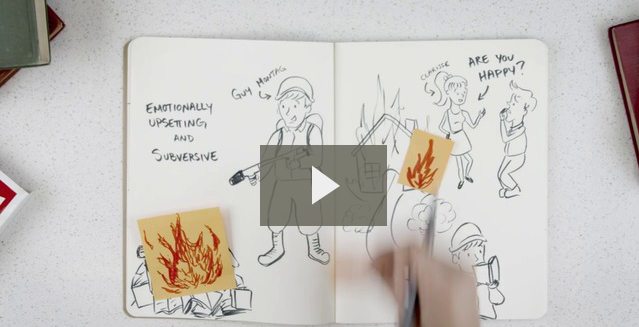
Guest Video Blog: Fahrenheit 451 Video by Jack Collins (Academic Earth)
The purpose is to provoke thought and discussion, so please feel free to add to the discussion on my blog here or at the following link where you can also watch the video:
http://academicearth.org/electives/tldr-fahrenheit-451/
I hope you enjoy this video as much as I did.
Sunday, June 2, 2013
Review: Wringer, by Jerry Spinelli
Wringer has two plots that merge together. Both revolve around the main character, nine-year old Palmer. Palmer's desire is to become initiated into a group of boys that include the obnoxious Beans, his sidekick Mutto, and the acquiescent Henry. Palmer's mother despises these boys and wishes Palmer would befriend the nice girl across the street, Dorothy. But moms just don't get it. Sure Beans treats Palmer like dirt and gives him a cruel nickname, Snots, but the important thing is to be a part of the group. The guys take Palmer to receive The Treatment from an older boy. This Treatment involves getting punched in the arm ten times, so that Palmer has a bruise that lasts a good week. Sure it's painful, but it's nothing compared to the satisfaction of being part of the "in" crowd. The bruise serves as a badge of honor. Now Beans, Mutto, and Henry are best friends of Palmer's.
The other storyline involves Pigeon Day at the annual Family Fest. Five thousand pigeons are captured for this event, for the purposes of being shot for sport. The person who shoots the most pigeons wins a golden pigeon trophy, one of which proudly sits on Palmer's fireplace mantel for the day his father won it. The shooting event raises lots of money for the park, and it serves as a great attraction, however, Palmer dreads this day every year. One part of the sport involves boys, aged ten, who run out to collect the bodies of the downed pigeons. If a pigeon is still alive, it's the job of these boys to wring its neck and kill it. One simple twist to put the bird out of its misery. Palmer has nightmares about the first day he witnessed this. Worse, it's expected that all ten-year-old boys will become wringers, and Palmer fears nothing more.
So things take an unexpected turn when a pigeon begins to visit Palmer's bedroom every day. This is when things begin to change for Palmer. He starts spending less time with his friends, because they are vicious pigeon-haters. In fact, Beans relishes the thought of becoming a wringer so much he tortures helpless animals in preparation. Palmer is afraid that if Beans knew about his new pet pigeon, Nipper, that would spell the end for the bird.
The story of friendship that Spinelli tells between the Palmer and Nipper is surprisingly effective. One usually doesn't attach sentimental feelings to a pigeon, which is usually referred to as a rat with wings, but Spinelli gives the bird personality. I have no doubts that there are kids who, after reading this novel, will want a pigeon for a pet. Spinelli inserts pigeon facts throughout the novel, facts that don't really enhance the story but help bring the bird to life. The way he describes Nipper's actions suggests Spinelli has a special fondness for pigeons. Such as the fact that they walk, where most small birds hop. Or the way they nod their heads as though they are the most agreeable creatures on the earth. Spinelli's description of Nipper reminded me of Herman Melville's discussion of whales in Moby-Dick, which are viewed with awe and affection. Spinelli paints the lowly pigeon as though it is just as grand as the magnificent whale.
The novel does begin to move in predictable fashion. Based on the plot elements I have shared, you can probably guess with a good degree of accuracy where the story heads. There are moments towards the end where the story moves very slow as it makes its trek towards its inevitable conclusion. Still, this is a very enjoyable book overall. It uses lots of humor and provides good insight into the thoughts and feelings of a nine-year-old boy. This book is a testament to how our love for an animal can cause us to grow as a person.
Thursday, May 30, 2013
Review: Maniac Magee, by Jerry Spinelli
Jerry Spinelli's Maniac Magee won the Newberry Medal in 1990, and I can imagine that the age group the award is aimed at, late elementary to early middle school, would get more of a kick out of the absurdly goofy scenarios in the story than I did. Reading as an adult, the book seems random and ungrounded, though I will admit it has heart.
At the age of three, Jeffrey Lionel Magee lost his parents. He lived with his uncle and aunt for some time, but their strict Catholic ways left him feeling stifled. So he ran away. Only, unlike other runaway stories, Jeffrey was never caught. In fact, he makes a name for himself in the town of Two Mills, which has a East End where blacks live and a West End where whites live. The name he makes for himself is Maniac Magee. His feats become part of the town's legends, and Spinelli playfully suggests we shouldn't believe all the stories we read about Maniac. This isn't a story, though, where the reader is supposed to guess reality from myth. That would be fruitless. Maniac's feats are as much fantasy as the setting the story takes place in.
Stories are told about Maniac's untiring ability to run endlessly. He can untie even the most difficult of knots. He is allergic to pizza. He also frog bunted an inside the park home run against the best pitcher in Two Mills. Yes, ridiculous. As a kid I can imagine I would have hooted with laughter. These stories seem to exist simply for the amusement of younger readers, but as this story is made up of random bits of such tales, it fails to feel cohesive.
The story deals with themes of homelessness and race. Maniac is known for fearlessly crossing the border between the West End and East End, which are divided on racial lines. Most residents from one end won't mingle with residents on the other end because of the racial tensions. Maniac does more than cross the border, however. He lives in the house of Amanda Beale, a black girl, long enough to become an honorary part of the family. Spending much of his life without a home or a place to learn about social constructs, Maniac doesn't understand the concept of racial tension. This suggests that people are not innately born with racial prejudice, but learn it. Living on the East End, Maniac does learn about racial prejudice, and it chases him away for a time.
Maniac's outsider status allows him to see things others can't. He realizes that households on the West End aren't terribly different from those on the East End. The Beale household is a normal home and there is a feeling of warmth and love. Maniac also experiences the same thing with a large white family that welcomes anybody to join for dinner. And where the white families all believe black households are trashy, Maniac spends a few weeks in a white household trashier than any he's seen on the East End. But because nobody crosses the border as Maniac does, nobody else knows how similar to two sides really are.
Unfortunately the novel doesn't do much with its themes, except maybe the theme of friendship and family. There are some touching moments, particularly when Maniac befriends an older man named Grayson. The novel is most enjoyable when Maniac settles down somewhere, but he's on the move so often the novel feels just as homeless as its title hero. Perhaps that's the point, and maybe I'm missing something. It's not that this is a bad novel, but it's one more geared for the kids than the adults.
At the age of three, Jeffrey Lionel Magee lost his parents. He lived with his uncle and aunt for some time, but their strict Catholic ways left him feeling stifled. So he ran away. Only, unlike other runaway stories, Jeffrey was never caught. In fact, he makes a name for himself in the town of Two Mills, which has a East End where blacks live and a West End where whites live. The name he makes for himself is Maniac Magee. His feats become part of the town's legends, and Spinelli playfully suggests we shouldn't believe all the stories we read about Maniac. This isn't a story, though, where the reader is supposed to guess reality from myth. That would be fruitless. Maniac's feats are as much fantasy as the setting the story takes place in.
Stories are told about Maniac's untiring ability to run endlessly. He can untie even the most difficult of knots. He is allergic to pizza. He also frog bunted an inside the park home run against the best pitcher in Two Mills. Yes, ridiculous. As a kid I can imagine I would have hooted with laughter. These stories seem to exist simply for the amusement of younger readers, but as this story is made up of random bits of such tales, it fails to feel cohesive.
The story deals with themes of homelessness and race. Maniac is known for fearlessly crossing the border between the West End and East End, which are divided on racial lines. Most residents from one end won't mingle with residents on the other end because of the racial tensions. Maniac does more than cross the border, however. He lives in the house of Amanda Beale, a black girl, long enough to become an honorary part of the family. Spending much of his life without a home or a place to learn about social constructs, Maniac doesn't understand the concept of racial tension. This suggests that people are not innately born with racial prejudice, but learn it. Living on the East End, Maniac does learn about racial prejudice, and it chases him away for a time.
Maniac's outsider status allows him to see things others can't. He realizes that households on the West End aren't terribly different from those on the East End. The Beale household is a normal home and there is a feeling of warmth and love. Maniac also experiences the same thing with a large white family that welcomes anybody to join for dinner. And where the white families all believe black households are trashy, Maniac spends a few weeks in a white household trashier than any he's seen on the East End. But because nobody crosses the border as Maniac does, nobody else knows how similar to two sides really are.
Unfortunately the novel doesn't do much with its themes, except maybe the theme of friendship and family. There are some touching moments, particularly when Maniac befriends an older man named Grayson. The novel is most enjoyable when Maniac settles down somewhere, but he's on the move so often the novel feels just as homeless as its title hero. Perhaps that's the point, and maybe I'm missing something. It's not that this is a bad novel, but it's one more geared for the kids than the adults.
Subscribe to:
Posts (Atom)