Saturday, January 4, 2014

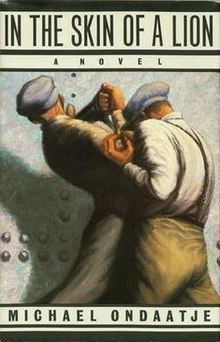
Review: In the Skin of a Lion, by Michael Ondaatje

In the Skin of a Lion is a novel that only a narrow audience - those who value poetic prose above all else - will enjoy. It's a novel with very little structure, loose and random plot threads, questionable motivation, and a lack of compelling character development. Time passes quickly and then slowly. The story follows a character randomly only to drop him. There's a feeling that Michael Ondaatje wrote this with great purpose, dabbling a little bit in logging, in dynamite, in romance, in bridge building, in falling nuns, in communism, in terrorism, and a little bit of everything else, but by the end I couldn't help but feel a sense of purposelessness. And maybe that is part of Ondaatje's goal, to show a character attempting to make meaning where none can be found. Or maybe I just don't get it. That's possible; the story didn't intrigue me enough to make that attempt.

The story begins from the perspective of Patrick Lewis as a boy in Canada. He lives with his father, who finds work in livestock and then in logging, where he specializes in dynamite. Some of these early scenes are intriguing in the way they capture the life of a poor family working in extreme cold condition. Ondaatje's eye for detail provide great insight into a cultural world that very few belong to. We feel how difficult life must be, day to day, as loggers are under constant danger of being swept underneath logs floating in the river and drowning. Patrick's father in particular faces danger every time he must clear a log jam with dynamite. There's also the cold. Michigan gets cold, but I doubt it gets as cold as in Patrick's Canada.

Then the novel switches to a bridge builder named Nicholas Temelcoff, a fellow who seems at peace with life, having an innate ability to climb and swing beneath the bridge in the dark. Again, we get a sense of the hard daily labor a man must face. Yet this man, as well as Patrick's father, seems to be a master of his craft. These two approach their work, and their lives, with a contentment, yet it would be difficult to say they are truly happy.

Time passes quickly and we run into Patrick again, chasing after some missing millionaire and falling in love with the millionaire's mistress. This is where things get wonky. First of all, the novel takes us away from Patrick for a fairly extensive amount of time, and then it returns us to him much older. Second of all, too many questions pop up about his new circumstances (how he is able to seduce an actress?) that make the story less believable. Also, why should we care about all of this? Patrick is the least interesting of the novel's characters. He feels more like a blank slate than a fully-fleshed out person. Things happen to him. He does things, sometimes extreme things, only because Ondaatje wills him to do so. Motivation be damned. Bizarre things happen that make the story difficult to believe. Whenever I became enchanted with a character or with a description of a character's working life details, the story would go back to dull Patrick and the strangeness surrounding him.

Had the novel been about Temelcoff or even the thief, Caravaggio, who appears much later, it would have been much more enjoyable. Watching them at work at their craft was a lot of fun. Watching Patrick struggle to attain an identity felt too choppy, especially since the novel does break to show the lives of these other two more fascinating characters. Those who fall in love with the poetic quality of writing will likely enjoy this novel. Those who need a little bit more in terms of story will have trouble finding the motivation to continue reading.

Monday, December 30, 2013

Review: The Curious Incident of the Dog in the Night-Time, by Mark Haddon

The Curious Incident of the Dog in the Night-Time is a novel about how people attempt to cope in a cold, harsh world. Don't let the fact that the main character has autism fool you into thinking this is a novel about autism. Author Mark Haddon has admitted to doing little research on autism for the novel. What the novel gives us is a different perspective on life, through the eyes of Christopher Boone, whose condition serves as a sort of tunnel vision lens, yet allows him to see things most people fail to notice. He lives by a set of rules that help him cope with the irrational and chaotic nature of the world. Of course, we all live by some set of rules, some set of guiding principles that allow us to do the same. What makes Christopher different is that while most of us learn to accept the irrationality of life, Christopher is doomed not to.

Christopher likes to interact only with a small set of people. At school he talks with his school mentor, Siobhan, about things he doesn't understand. He lives alone with his father ever since the death of his mother. His mother's death has made him more acquainted with his neighbor, Mrs. Shears, who helps his father out. His routine begins to change, only slightly, when he comes upon Mrs. Shears' dead poodle, stabbed with a garden fork. After an unpleasant encounter with a police officer who dares to touch him, Christopher decides to do some detective work and solve the mystery of the poodle's murder.

Becoming a detective means leaving his safe shell and stepping out of his way to ask people questions. Christopher doesn't much like talking to people because he doesn't understand body language. In fact, Christopher doesn't like a lot of things. He doesn't like the color yellow. It's a bad day when he spots four yellow cars in a row on his way to school. Conversely, he loves the color red, which means that sighting four red cars in a row means it will be a good day. He also doesn't like it when people use facial expressions to communicate because he doesn't know what they mean. He hates the use of metaphor because it confuses him. What Christopher does love is math. He is very logical and will probably be a very successful mathematician. The chapters are numbered by prime numbers rather than in direct sequence. Haddon is so good at convincing us that Christopher exists that it made me wonder whether Christopher is a version of himself, to some extent.

The novel revolves only loosely around the death of Mrs. Shears' poodle because the story, as told in the first person from Christopher's perspective, goes off on numerous tangents. These tangents are often amusing or revealing in some way, and they help explore the mindset of Christopher as well as what he values. Other things that are more important than the death of the poodle happen, but the poodle's murder is significant because it makes Christopher step outside his comfort zone. He appears to be the perfect sleuth, capable of sticking to the facts and not letting his imagination spoil his investigation. He considers all possibilities and eliminates the improbable ones. He even fancies himself a sort of Sherlock Holmes and talks extensively about some of the Holmes novels (as a warning, if you have not read Hound of the Baskervilles, Christopher shamelessly spoils the ending). Yet Christopher lacks an important tool to be a good detective - social recognition. What would be an obvious solution to this investigation for most observers is overlooked by Christopher because he, ironically, fails to put two and two together.

Some have compared Christopher Boone to Holden Caulfield of Catcher in the Rye, and I can see the resemblance. Caulfield, like Christopher, has a narrow view of the world. Where Caulfield sees everyone as phonies, Christopher seems to regard others as intellectually inferior. Both novels make use of the unreliable narrator, in that a reader not making full use of their critical reading skills might be mistaken in believing they are meant to adopt the narrator's viewpoint. However, with Christopher things are made more challenging by the fact that he is an intellectually gifted individual. You may find yourself with a nagging doubt or suspicion about something Christopher hasn't perceived, yet Christopher's undeniable logical intelligence will have you second-guessing yourself.

In Catcher in the Rye, one of the defining moments of how Holden views himself is when he likens himself as a rescuer of children, saving them from running off the edge of a cliff. He believes he holds the key to truth in a world of phonies, yet the reader sees otherwise. Christopher has a similar moment when he compares the way he sees the world to how others see the world. When most people gaze at a field and are asked to describe it, they may mention there were cows and a house and other details, all vaguely described. Christopher, however, will go so far as to tell you how many cows were there and how many had black spots and how many had brown spots and then how many spots each one had. He believes his way is superior, even though Siobhan admits this level of detail would be overwhelming to most. What Christopher misses out on, however, is the beauty of such a field. He takes it all in and simply plugs it into his mathematical brain.

Though the novel is written from Christopher's point of view, and though the reader has plenty of reason to sympathize with him, the character with which I made the greatest emotional connection was the father. The two most poignant moments in the novel involve him. We can sympathize with Christopher because he does suffer, yet his emotional state can be difficult to grasp. This novel does an excellent job of putting readers in the perspective of somebody with autism. However, I kept putting myself in the shoes of Christopher's father, thinking about just how difficult life would be to have to raise a child like Christopher. I mentioned in the first paragraph that the novel is about trying to cope in a difficult world. From Christopher's perspective, we see, in a peripheral way, how his own parents have attempted to cope with raising an autistic child. Raising a child is hard enough, but raising a child who emotionally does not develop the way most people do, who throws violent tantrums when things don't happen a certain way, is a trying experience. Christopher's father is a rare person who is able to do this with love, care, and patience. Not everybody is able to handle the difficulties life throws at them as he does.

The novel is very entertaining, with lots of laugh out loud moments and plenty other thoughtful ones. Christopher dives into all sorts of tangential subjects, but always from his fascinating perspective. The only parts I object to are some repetitive action scenes toward the end, where less detail may have been better. Yet, at the same time, Mark Haddon follows through with the logical impulses of his narrator. It's amazing the way Haddon is able to keep up Christopher's performance, including all the little details that go along with being Christopher. Haddon writes with such a precise style that Christopher is able to come to life as a person all his own. And when we root for Christopher to achieve his goals, we're rooting for an imperfect person to be successful in a difficult world, because if there's hope for Christopher, there's hope for any of us.

Monday, December 23, 2013

Review: My Sister Lives on the Mantelpiece, by Annabel Pitcher

In the United States, the word terrorism brings to mind the 9/11 bombings of the World Trade Center and the Pentagon. Though the United States does not face acts of terror on a daily basis, as those of some nations do, the psychological toll from this attack still resonates today. Almost anybody in our modern world should be able to relate to Annabel Pitcher's debut novel, My Sister Lives on the Mantelpiece, where the attack (fictional) occurs in England's Trafalgar Square. Pitcher aims the novel at a younger audience by making her main character a boy who was too young to have felt this tragedy deeply. This makes her novel a good place for young teens to contemplate the emotional impact of a terrorist attack on its survivors, yet it doesn't quite have the depth to move adult audiences.

The main character, Jamie, lives with his father and his sister, Jasmine, whose twin, Rose, was killed by a bomb five years before. Since that time, Jamie's mother left the family for a man named Nigel, and Jasmine dyed her hair purple and began to dress as a goth. His father has turned into a raging alcoholic and quit his job, which makes one wonder how he ended up with custody of the kids. What sort of mother would let her children live with a man like him? Jamie was five when the attack happened, so he doesn't remember it very well. He also doesn't remember Rose. To him it's just an eccentricity that his father keeps an urn containing her ashes on the mantelpiece, and it's an annual tradition to head out to the water and contemplate dumping the urn's contents.

Jamie's family moves to a new town, out of London, where Jamie must now attend a new school. This is a christian school, so it's a little surprising that one of the students is a Muslim girl named Sunya. Sunya instantly becomes an object of fascination to Jamie. He is curious, not about her garb, but because his father has developed an intense hatred of Muslims since Rose's death. He makes daily visits to anti-Muslim websites and believes all Muslims are insane suicide bombers at heart. So it's distressing to Jamie that Sunya takes an immediate interest in him, yet her sunny personality eventually wins him over.

This serves as the main plot, but there are several subplots, including Jamie's and Jasmine's struggle to take care of themselves while their father spends his days passed out or vomiting in the toilet. There's conflict when Jasmine introduces her new boyfriend, of the green-haired, spiky mohawk variety. And Jamie obsesses over the day his mother will finally pay him a visit, as she has promised. Multiple subplots are fine, but their downside is that they stretch the story too thin and none of the plot points are strongly developed.

Pitcher does a nice job of writing from the perspective of a ten-year-old boy. The writing is crisp, in the unsophisticated voice of a young boy. Sometimes the sentences flow breathlessly, as the narrator keeps them alive by adding another "and" to the end. This isn't necessarily how ten-year-olds talk, but it is accurate about how they write. Periods are sometimes forgotten, or the problem is that kids haven't quite grasped the concept of a sentence just yet. Sometimes this writing grows repetitive, with too many sentences having the same breathless structure, yet it's never dull.

Memory is another area Pitcher gets right. Too many stories, both in books and the movies, provide characters with photographic memories. These teenagers or adults remember everything, but the reality of memories is that they fade over time. That Jamie barely remembers his sister is understandable, and it's believable that his grief for her is almost non-existent. Perhaps Pitcher does go a little far in portraying Jamie's amnesia, though, when you consider how traumatic the event was. Most faded memories tend to be of everyday sorts of things, but when a bomb explodes right in front of you and blows your sister to smithereens, that's a memory that will have very vivid indentations on your mind. This is just an example of how Pitcher tends to deaden the emotional impact of her story, and it seems to be a trend followed by many young adult novels.

Another problem is Pitcher's tendency to portray other characters and issues as one-dimensional. Jamie's father's alcoholism seems less realistic than hyperbolic. His mother's abandonment is hard to believe considering what a loving family they were before the bombing. Sunya is often unrealistically, if not eerily, bubbly. You have your standard classroom bully who acts like an angel in front of the teacher, and the teacher who seems to hate most children. The plot goes into odd places later because Pitcher doesn't take the time to fully develop any one scenario. The only characters who have any sort of depth are Jamie and Jasmine, yet even there you'll find a strong note of melancholy and not much else.

As a novel aimed at young adults, the above-mentioned problems aren't quite so bad. There is some value to be had for young teens, and parents can take relief in the fact that the bomb violence as described in the novel is artfully, not graphically, portrayed. More than likely girls will enjoy this more than boys. Not to say Pitcher unsuccessfully writes from the perspective of a boy, but Jamie has a feminine feel, such that I was unaware he was a boy until his name, James, was mentioned. There's also the element of romance between Jamie and the Muslim girl, Sunya, that will leave boys less inclined to read this than girls. Throughout the entire novel, the only friends Jamie has are girls: his sister Jasmine and Sunya. The only boyish thing Jamie does is participate in soccer in a brief episode. It's unfortunate the novel goes the route of romance because the age of the two characters involved makes this unlikely. Not that the romance involves any making out, but it does involve the desire to hold hands and for Jamie to catch a glimpse of Sunya's hair underneath her hijab. To make matters worse, the romance is predictable and lacks spark.

The novel feels much more episodic than cohesive, and those episodes use predictable story arcs. The romance plot, for example, has Jamie's feelings for Sunya bounce between love and hate several times throughout the course of the novel. One moment he wants nothing to do with her, then he craves her attention, and then he remembers that Muslims killed his sister and ignores her, and so on. It grows irritating after a while. Random plot threads dominate the bulk of the work, involving the aforementioned soccer game with all of the usual elements involved in that kind of story line; an inevitable encounter between Jamie's father and a Muslim, which blows up in unrealistic, poorly-written fashion; Jasmine's new boyfriend and what her father thinks of him; Jamie desperately awaiting his mother to finally visit (seriously, what is wrong with that woman?); and an audition for Britain's Got Talent. This seems like a lot to happen to a ten-year-old in such a short span of time, but it wouldn't be so bad if it was done with more cheer or more originality.

Friday, December 20, 2013

Review: Unaccustomed Earth, by Jhumpa Lahiri

Unaccustomed Earth is not only the title of Jhumpa Lahiri's second collection of short stories, but the theme of this work and perhaps her entire canon of work. For a woman born in London to Indian immigrants and spending most of her life growing up in the United States, the theme is appropriate. Her characters seem heavily drawn from her own experiences, all of them American born with Indian parents (usually born in India and raised in the United States). This sets up plenty of room for culture clash, not just between different nationalities but also between different generations and the two sexes. Lahiri's themes are largely universal because everyone deals with culture clash in some fashion, large or small, and everyone at some point in their lives must tread upon unaccustomed earth.

This 320+ page collection features eight mostly powerful stories that deal with characters finding themselves on new ground. While they are rather long for short stories, they rarely fail to captivate. "Unaccustomed Earth" starts the collection, a story about an Indian-American woman named Ruma, her widowed father, and her young son. The story spans a week, but it provides a lengthy glimpse into the lives of both major characters, including the heartbreaking details of the death of Ruma's mother. Her death sends both Ruma and her father into unaccustomed earth emotionally, though it's her father who makes a new man of himself, while Ruma can't seem to reconcile this change. The dual perspectives lend this story a lot of weight, and the story is particularly effective in portraying the love Ruma's father develops for his grandson, Akash. This story may be the collection's best, based on how intimately it lets the reader into the lives of these characters.

In "Unaccustomed Earth" there is a trope found in several other stories: a distant husband and father. Ruma's father was emotionally aloof from family life, and only the death of his wife changes him, as he suddenly realizes the dreams she is no longer able to accomplish. The trope of the distant father then grows into one of a father who learns to care. This trope appears as well in "Hell-Heaven," seen in the husband who agreed to an arranged marriage only for the sake of convenience, which leaves an emotional vacuum in his wife's life. "Only Goodness" has a father who keeps his mouth shut about his son's delinquent behavior until something needs to be said. And in "Nobody's Business," a woman is engaged in a long distance relationship with a man who wants their relationship as private as possible. "Unaccustomed Earth" has a second man, Ruma's American husband, whose only presence in the entire story is by phone. This distance (though stern with expectations) shapes the personalities and ambitions of the characters in these stories.

Many of Lahiri's characters are very similar. Her female characters are largely successful and ambitious, taking up prestigious, well-paying careers and starting up small families. The material success of these characters seems to come effortlessly, a PhD earned in the matter of a few sentences, but the emotional success of Lahiri's characters is less certain. No matter how wealthy, there are matters beyond one's control that shape their emotional states. My favorite story, "Only Goodness," is the only one with a character whose problems prevent him from entering this material success. The story is told from the perspective of Sudha, but it's her younger brother, Rahul, who becomes an alcoholic and drops out of college. Sudha's successes are continuously paralleled with Rahul's struggles, and seeing Sudha watch her brother descend into such depths is heartbreaking.

"Only Goodness" is one of several stories where the story's perspective character is not the one where the major conflict revolves around. It's Rahul the reader cheers for and wants to see do well, though we may sympathize with Sudha's feelings. Similarly, the main conflict in "Hell-Heaven" revolves around the perspective character's mother, and in "Nobody's Business" a college student finds himself interested in his new, and beautiful, roommate, who is clearly having some relationship troubles. Then again, this is not all that uncommon in stories. The intrigue in The Great Gatsby revolves around Gatsby, though the story is told from the perspective of Nick Carraway. And in Hitchcock's Rear Window, a crippled James Stewart imagines plots unfolding in his backyard as he spends his days watching his neighbors. Sometimes the source of greatest conflict happens to others and not to us, but it always has some affect upon us.

"A Choice of Accommodations" and "Nobody's Business" both feature male protagonists (the collection is split evenly between male and female protagonists), and each one is about the main character's fascination with a woman who is just out of his reach. In "Choice" Amit is a married man who has agreed to attend the wedding of a woman he had a large crush on in college. His wife harbors some jealousy over this woman, and despite his assurances otherwise he fantasizes about some sexual encounter with her. Paul, in "Nobody's Business," is perhaps the college version of Amit, though maybe more nerdy, with an infatuation with the new woman in his life, Sang, whose boyfriend wants very little to do with her friends. "Choice" works by looking nostalgically at youth, the regrets of sexual encounters that didn't happen, and it also ends on the collection's most climactic note. I liked "Nobody's Business" better because I relate more to the college student, and his troubles feel more real because they are not about a distant past.

"Hell-Heaven" is the only story that doesn't work. Told in the first person from the young girl, Usha, the story fails to provide a strong sense of her character. The central action is between her mother and the man her mother falls in love with, Pranab. The story never succeeds in engaging the reader with any character, except maybe the friendly Pranab. When Usha begins describing sexual feelings towards other men, it feels like a distraction from the main action, and when Usha's mother makes a startling reveal at the end, it doesn't feel like it was earned. Fortunately this story occurs early, and so its memories become buried in the wealth of the rest of the stories.

Unaccustomed Earth ends with three stories about the lives of two characters, Hema and Kaushik. The first story, "Once in a Lifetime," takes place when Hema was a young girl, and Kaushik's family lived with her family for several months. "Year's End" switches to Kaushik's perspective when he's a little older and shows the impact of his mother's death on himself and his family. Kaushik, an aloof wanderer, wants nothing to do with his new stepfamily at first, and ultimately his feelings lead him to becoming a traveling photographer for the New York Times. "Going Ashore" alternates between Hema and Kaushik, as both are approaching middle age, both with successful careers, and both inevitably wandering into one another. Of these three stories, the second and last are the best. Lahiri avoids pinholing her writing into a genre, such as romance. The romance is largely glossed over, and the final story doesn't end the way you might think, or want.

The only problem I have with Lahiri's writing is her heavy use of exposition. Interpreter of Maladies was an excellent collection of short stories, but I struggled to enjoy her first novel, The Namesake, because her use of exposition watered the story down too much. The stories here are longer than in her first collection, and sometimes the exposition feels like too much. Writers are always given advice to show, not tell, but exposition is largely a style of telling. Lahiri tells us endlessly about many details, large and small, about her characters. It's as though her character notes have been transposed onto the final product, and sometimes the reader doesn't get to discover details so much as be told them, which has less of an impact otherwise.

However, Lahiri writes superb exposition, and if one were to learn how to write exposition, she would be a perfect model. She still manages to evoke strong feelings through her expository passages, and slows down now and then to show some action, usually very strongly written. Lahiri has an attention to detail that is surprising. She notes all the little things a person might feel, and this makes her work feel true to life. Her characters feel real, and her plot works out as one might expect in real life, not always with surprises, though not necessarily predictably. The best writers always manage to contradict the conventional wisdom of how to write, and Lahiri does that by successfully evoking strong emotion through a style whose job is to tell, not show. Lahiri does not always uses exposition successfully, but her stories are so powerful and feel so evocative, that it doesn't seem to matter how she tells them. Her words are simply magic.
Sunday, September 1, 2013

Review: Horns, by Joe Hill

If Joe Hill is hoping to take the reins of horror from his father, Stephen King, then Horns looks like a pretty good bid for that spot. That's not to say Hill is a copy cat of his father. He demonstrates a writing style and voice all his own, though with the occasional flourish his father might provide. Hill writes with a voice more terse, a little more dry, than his father's, but also with the occasional comical remark that's so surprisingly funny you might find yourself laughing out loud. Where Hill truly shines is in his character development and the pacing of his story. He slowly, carefully reveals exciting new developments to his plot, to the changes in his main character. It's a shame that the conclusion turns out to be your usual hero/villain showdown, with all of the cliches it. However, almost everything leading up to those final moments is sublime.

Ignatius Perrish wakes up to the worst hangover of his life. It's so bad, in fact, he has sprouted devil horns on his head. Not only that, but people begin behaving oddly around him. The receptionist at the doctor's office discloses that she wants to scream at a woman whose child is misbehaving in the waiting room. When Ig sits next to this woman, she touches his arm and he suddenly sees all of her bad deeds. Then she unabashedly tells him of her desire to kick her daughter in the ass, literally. What Ig, and the reader, gradually begin to realize is that with these horns comes a supernatural power that causes people to want to act out their darkest desires, but only if Ig grants them permission. He can't even hold a normal conversation with his parents or brother. This is even more terrifying when you discover certain details about his past.

I won't reveal too much, because there's a surprise early on I don't want to spoil. The novel gradually feeds us information about Ig's past life. We learn that his girlfriend, perhaps even soul mate, Merrin, was raped and murdered just the past year, and the entire town thinks Ig committed the crime. But the case never went to trial because of a fire that destroyed DNA evidence. With his new powers, Ig learns things from people, awful things that have to do with what they think of him. He goes to his church to see if Father Mould can help, only to learn the pastor believes Ig should hang himself. Also, Father Mould has been having an affair with Merrin's mother. Ig becomes wary about meeting other people because of these terrible revelations. At the same time, he finds it thrilling to take revenge on those who speak so cruelly about him, forcing them to act out on their dark desires in ways that hurt them.

Part of what makes the novel work so well is the complexity of its main characters. Ig is the good guy in that he has enough of a conscience to deny most people to act out on their dark desires. Yet he's still human. He can't help but act on his baser desires for revenge and power because it excites him. There's something cathartic about his ability to do something evil and get away with it. Even the novel's villain has complexities. This is important to bring up because it's one area where King struggled (or maybe didn't care so much). Most of  King's heroes and villains are one-dimensional characters (with varying degrees of effectiveness) who tend to act predictably. A King hero has only minor flaws, while a King villain has absolutely no redeeming qualities. Hill, on the other hand, aims for more human complexities.

When I say Hill's writing style is dry, I don't mean it as a criticism. His voice is mostly straight forward, get to the point, with the occasional parenthetical quip. His humor is told dryly, though often to hilarious effect. Hill's writing is also witty, without being obvious or showy. One example of his wit is the novel's title. Horns most obviously refers to the pair of horns growing from Ig's head. Yet we also learn that Ig's father made his fortune playing horns, and his brother Terry has also made his fortune doing the same, while Ig's asthma prevented him from following suit. Horns, then, may symbolize the past and/or missed opportunities.

Hill is at his most thought-provoking when discussing religion. He twists themes of good and evil on their head by positing the devil as the good guy. Ig is, after all, an incarnation of the devil, yet he is repulsed by the dark secrets people reveal to him and forbids most from acting on them. In a sense, then, the devil serves as a moral authority above those who feel the influence of his horns. Hill relishes in the idea that God and the devil are partners more than they are adversaries. The devil punishes sinners, and if God wants sinners punished, aren't the two on the same side? Ig comes to a lot of interesting, and sometimes funny, conclusions regarding religion that some may find controversial, but the open-minded will enjoy pondering.

For the most part, the novel's pacing is superb. The way Hill slowly reveals Ig's powers is exciting. Here is an author who knows the virtues of patient plotting. The story begins in the middle of the action, with Ig discovering his horns, and then it goes backwards so the reader can learn more about the major players and events that give the present more significance. The rest of the novel goes back and forth between the past and present until the reader has a near complete picture of Ig's relationship to Merrin and others, as well as what happened the fateful night Merrin was killed. A few of the flashback chapters were superfluous. This is especially true regarding the villain. Explaining why a character becomes a villain tends to ruin the magic of the story. Some people are just evil, no explanation needed.

The real disappointment I have is with the ending. It devolves into your usual action showdown, involving a battered hero and a villain who takes a breather to explain everything. Worst of all, this happens twice. People complain about the way King ends his books, and sometimes he does end them in bizarre fashion, but I prefer non-traditional sorts of endings. The ending to The Dead Zone was excellent, and it made sense. According to King, Hill helped change the ending to 11/22/63, which I thought had a disappointing ending because it playing things safe. Plenty of people will be happy with the ending to Horns, I'm sure, because it's comfortable in its use of recognizable tropes. I feel like it's an insult to the care Hill put in the rest of his story. Nonetheless he shows remarkable talent. I look forward to seeing Daniel Radcliffe star in the title role of the movie. I also look forward to reading more of Joe Hill's work, as I'm sure he will be a mainstay for a long, long time.

Tuesday, August 27, 2013

Review: Reap the Whirlwind, by Robert Sells

Imagine the horror of discovering a $7000 charge to your bank account for porn you never purchased. Your first thought might be what your girlfriend will think. Your second thought would be to call the porn company to remove the charge. However, as Whit Emerson, main character of Reap the Whirlwind, soon discovers someone did a very convincing job of making it appear he did purchase that porn. This someone, as it turns out, is a self-aware computer system, called Hal, that has access to anything and everything internet-related. What Robert Sells' novel is concerned with is society's reliance on computers for just about everything. It shares themes with Terminator, in that humans have unwittingly created the next being to conquer the Earth, as well as the movie Eagle Eye, which shares a lot of similarities. While Sells' second novel has some horrifying passages, the story moves far too quickly to have a chance to develop its characters or situation, and that's a shame.

The above mentioned Whit Emerson is a successful young freelance writer. He has a beautiful, but cold-hearted, girlfriend who enjoys sex but not affection. On the day Whit finds the porn charges to his bank account, his life takes a very fast nosedive. He loses his job and several close friends have either died or turned up missing. Then he becomes a fugitive when he's charged with heinous and false crimes. All of this has something to do with machines, and it seems that somebody, or something, doesn't want Whit to publish his article about how people are becoming too addicted to computers. He realizes his only chance of survival is to flee.

The novel also follows Jimmy Northup, a detective who's been tracking down a bank thief. This plot seems unconnected at first, but its purpose is to introduce a character who will come in handy later. Other characters to join the fray are an old buddy of Whit's, named Steve, who is a computer genius; Steve's sister, Mary, whose personality is the exact opposite of Whit's girlfriend; and the biggest computer expert of them all, Little Lion, who turns out to be different than you will imagine. Many plot details are predictable, such as the girl situation. When there are only two young women in the story, and one is a cold-hearted bitch, it's pretty obvious who the hero will end up with. Also, while Whit is clearly the protagonist early on, the story shifts its protagonist label to Jimmy about halfway through. This is tricky because it is Whit we are rooting for early on, but he becomes lost in the clutter of characters who pop up later on.

Sells has some very effective passages. The way the computer system, Hal, dispatches of Whit's boss by providing him an incorrect reading of his insulin level is terrifying enough. But when two paramedics continue to administer more insulin at the recommendation of the ambulance computer, that brings the terror to a new level. Sells does an excellent job of showing just how much people view computers as an authority. When one of the paramedics expresses doubt, the other tells him that he's not a doctor, so what does he know? Sells also toys with our trust of machines in other ways, such as when it turns out Hal somehow has the ability to mimic other people by phone. We know that machines are capable of some form of rationalization. Just look at Watson, on Jeopardy, who demolished his two human opponents. Sells wants to take a look at what could happen if a machine is capable of evil.

The problem is, this idea is not developed to its fullest. The perspective of the book is self-contained to a handful of human perspectives who try to hide from anything internet-based. So we don't have a chance to see what Hal is capable of, except toying with hospital readings and hacking surveillance cameras. Also, Hal seems to have access to much more than he should. He has access to anything on the internet, but at times he seems to know exactly what Whit is going to do, such as who he is going to call and why, when Whit has only spoken his intention out loud and in person. Does Hal have ears? The novel also takes for granted our gullibility as it relates to computers. We live in an age of skepticism, and when a computer does something that goes against our experience or knowledge, people are likely to believe the computer has made an error. This is especially true of trained paramedics in the situation mentioned above.

The novel plays out like an action flick more than a speculative piece of fiction. Events happen far too quickly, new people make an entrance without much background, and nothing is developed as much as it should be. The characters are thin and seem to act more so as the plot requires than out of their own character traits. Character behavior also changes on a whim. For example, Jimmy, the middle-aged detective, acts like a child by belching and banging on a piano during an important meeting. This seems unbecoming of a master detective, and it also serves to mask the severity of the situation. Sometimes the characters forget to take the situation seriously, so it's easy for the reader to forget as well.

The novel has compelling ideas and brings up important questions, yet I wish it had slowed down enough to develop its characters and situations. There were moments I was terrified and I wish Sells was able to keep that terror going. Robert Sells has some talent, and I wish him the best of luck with his next book.

I received a copy of this book from the author in return for an honest review.

Monday, August 19, 2013

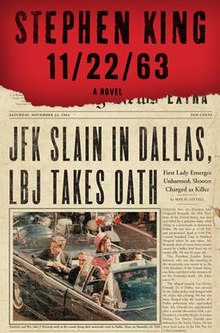
Review: 11/22/63, by Stephen King

11/22/63 poses itself as a novel about a man who seeks to prevent the assassination of John F. Kennedy, but I think it would be more accurate to call it "Memoirs of a Time-Traveler who just so Happens to Attempt to Thwart a Major Assassination." Stephen King did extensive research for this novel, not just on Lee Harvey Oswald, but also on the time period itself. This is not your usual time travel story where the hero transports directly to the event he hopes to thwart. Jake Epping, the story's main character, instead arrives five years before the assassination, no closer. In order to pass the time, Jake, aka George Amberson, makes a new life for himself. In return, the science fiction plays second fiddle to George's teaching career and romance life. The book certainly has its gripping moments, and a pretty good romance thrown in the mix, yet somehow it is at its least compelling when dealing with JFK and Oswald.

Jake Epping is a thirty-five year old English teacher from Maine. He enjoys his job, particularly his adult education class, where he reads the harrowing story of the school janitor, Harry Dunning, who witnessed his father murder his whole family. Now enter Al Templeton, the owner of a restaurant whose burgers are so cheap customers suspect the meat consists of roadkill and stray cats. One day Al seeks Jake in order to tell him a story so unbelievable he first has Jake experience it himself. In a pantry in Al's Diner exists a wormhole to September of 1958. You may stay there as long as you like (though you will age just the same) but when you come back to the present (whatever may constitute the "present" when time travel is possible) only two minutes will have passed. Al wants Jake to finish a job that lung cancer prevented him from finishing: to stop Lee Harvey Oswald from assassinating John F. Kennedy.

The consequences of time travel and of changing history is discussed in great detail. A good portion of the early parts of the book are devoted to a discussion about the consequences of time travel. Jake even asks, apparently hoping to show Al how bad of an idea it all is, what would happen if you kill your own grandfather. To this, a bewildered Al hilariously answers, "Why the fuck would you do that?" Al has already confirmed that changing events in that version of the past does affect the present he and Jake belong to, thus removing the possibility of a parallel universe. However Jake is not satisfied with the minor change Al makes and wants to know what will happen if you save a life - say, Harry Dunning's entire family. It is this that decides Jake's mind. He will go. Al sets up an identity for him as George Amberson, a man mysteriously working in real estate and having sports knowledge that will help him win some large bets. While Al recommends laying low and not getting involved with anyone, George sees no reason why he can't find a job to fill up his time.

Here we come to the second plot, which is arguably the main plot, a romance between George and the sexy school librarian, Sadie Dunhill. Of course, George has no desire to form a romantic connection at first, but when your first meeting involves accidentally copping a feel while saving the clumsy Miss Dunhill from an embarrassing fall, that's destiny. Besides, love is timeless. While I enjoyed Jake's and Al's conversations about time travel and the possible implications in saving the life of JFK, King's story is at its best when covering the life of George Amberson in the small town of Jodie, Texas, as a school teacher and the man of Sadie's dreams. The problems involved in this romance are obvious. George is a man with literally no past and a mission that will, sooner or later, conflict with this romance. The romance is giddy and joyful as well as heartbreaking.

Though Jake Epping is a thirty-five year old from the year 2009, he has an old soul. This is one of the disappointments in the novel. Jake is right at home in the late '50s, early '60s. King could have had some fun with Jake's culture shock, yet he conveniently avoids the issue. Jake is a man with fifty years worth of knowledge that nobody else could possibly have, yet King loses any opportunity to have fun with this. When Jake does slip up, it's to sing "Honky Tonk Woman" by the Rolling Stones, which isn't that far off. King lost a golden opportunity for Jake to sing "Enter Sandman" or "Bawitdaba," at least something radically different from what was played in the '50s and '60s. But Jake's tastes in pop culture seem to follow more closely to King's than those of a modern young man. His knowledge of obscure '50s pop culture suggests King forgets it wasn't Jake who did extensive research into the era. This lack of culture shock comes as a surprise, since King handled it so well, and to hilarious effect, in The Drawing of the Three, when his gunslinger Roland finds himself in a world completely unlike his own. Perhaps King wants to say something about the adaptability of people, but I also think he takes this adaptability for granted. People thrown into an unfamiliar world don't adapt so easily.


The novel is at its weakest when Oswald is in the picture. King spends a good deal of time having George listen in on conversations between Oswald and others that add nothing of value to the story. The main reason for listening in on these conversations is for Jake to make sure that Oswald did not have an accomplice. Today, there are still plenty of unanswered questions surrounding the assassination of JFK. King did some heavy research, though it seems the authors he chose were heavily biased towards Oswald as the lone shooter, when there is compelling evidence to suggest a second and still plenty of files not released to the public that could shed more light on the issue. Still, that's not the point. For his novel, King does need to swing one way or the other, and Oswald as the lone shooter is the most likely theory. When it comes to speculation, King chooses the simplest routes. Even Oswald is little more than a one-dimensional villain: vile, cruel, a bore who loves to talk on and on about communism, and a wife beater. He has absolutely no personality and does not feel like a real person.

Character development has never been King's strong suit. He does a good job of providing characters with colorful dialogue and putting them in interesting scenarios, but mostly his characters strike one-note chords. This is only problematic because these characters engage in predictable, robotic fashion when certain events arise. George is reminiscent to King's more likable and sympathetic hero, Johnny Smith, in The Dead Zone. Both characters have a secret knowledge which harms them in some way. However, where George's secret knowledge harms him only physically (aging), Johnny's secret damages him both psychologically and physically. George has little psychological or emotional investment in what he is doing, and perhaps that is why King decides to add the romance plot. George is a nice guy who wants to do the right thing, which is a fine quality to have, but it makes for a less compelling hero.

The ending of the novel is sadly predictable. I won't spoil it except to say that King had all kinds of options at his disposal, but seems to have lost interest in true science fiction speculation. He throws in elements of fantasy that serve to help him take an easier, safer route. For history buffs this is a disappointment. Despite a novel whose title and premise promises speculation, King fails to deliver. Not to say I wouldn't recommend the novel, especially if you are a King fan. There are plenty of engaging moments and the book is well-written and easy to follow. 800+ pages is a bit much for the story King wants to tell, but there are plenty of effective moments within those pages. Read and enjoy, but prepare to speculate on the matters at hand on your own.