Friday, July 11, 2014

Review: The Long Walk, by Stephen King

Stephen King's The Long Walk is a dystopia unlike any I have encountered, much different from Orwell's model in 1984, which establishes a dystopian world, explains how it is governed, and puts readers in the perspective of somebody hoping to change things for the better. King does not set aside additional time to explain the history of this world and how it came to be, and that is a wise decision. We get hints, through conversations, of what happened - Germany won World War II and attacked the U.S. - but nothing about how the world came to be what it is. This seems about right. What we have is a bunch of kids trapped in society and following its rules, whether they like them or not. Too often characters in dystopias seem pulled from our world rather than stuck in their own. And King does an excellent job of sucking us in his perverse little world as well.

Ray Garraty has been selected (we think) for participation in the Long Walk, a sort of national event that is probably on the scale of the Super Bowl. Garraty may have had a choice not to participate, and we only know this because his mother is begging him not to go through with it. He ignores her. Why should she have a problem with it? It's just a test of endurance, seeing who can walk the longest without taking more than a two minute break. Contestants can't walk slower than four miles per hour, and if they do for too long they will receive a warning. You receive three warnings maximum. After that you get a ticket. This ticket, innocent as it may sound, is a bullet fired from a gun.

Also participating are 100 other teenagers, all male. The Major presides over it. He grows chummy with an arrogant kid named Olson, who everyone immediately dislikes. The game isn't just physical, but it's also psychological. A kid who looks chummy with the Major makes everyone else feel inferior. Along with Garraty there is McVries, Stebbins, Baker, Barkovitch, Collie Parker, and Scramm, just to name some of the major players. Most of these characters might be considered friends to Garraty, but in this game friendship has its drawbacks. You can't grow too attached to anybody because eventually he will die, unless he beats you, in which case you die. On the other hand, going on the walk with no friends can sap your sanity.

At the end of the Long Walk, the sole winner wins the grand prize of everything they could want for the rest of their lives. At odds of 1 in 100, that's much better than trying to win the multi-million dollar jackpot. But the odds of dying are much higher, at 99 in 100. Everyone who dies before you simultaneously makes you feel sick and relieved. You know the next bullet could be for you, but at least you're one person closer to winning it all.

The physical terror and the psychological terror go hand-in-hand. After walking for many miles, Garraty, along with the others, begins feeling strange pains in his feet and legs. Somebody develops a leg cramp and can't walk the required four miles per hour. He buys the first ticket, screaming that it isn't fair because he had a leg cramp. The guards that follow along show no emotion as they pull the trigger. Reality sets in as these once cocky teenagers realize they will probably die. Olson quickly loses his swagger as his body begins to wear down and he realizes he had no idea what he was in for. Kids go crazy, hallucinating, babbling bizarre words. Barkovitch takes joy in tormenting others, until he taunts somebody to the point of causing him to get his ticket. After that, McVries, who is Garraty's closest friend, stalks Barkovitch and calls him a murderer. Stebbins walks confidently at the back, going exactly the minimum speed. And then Scramm tells everyone he is favored to win it all, according to Vegas, at least until he develops a cold. On the Long Walk, as in real life, things outside of the teenagers' control brings them back down to earth.

As the walk goes on, Garraty and the rest of them begin to ask themselves, and each other, why they decided to do this. They knew what it was about, so why not pull out? They can't quite come up with an answer. It might have something to do with a fear of their oppressive government, one where people are policed by the Squads. Or it might have to do with the fame. Those who walk the Long Walk become legends. There's the story of the kid who bought his ticket at the starting line because he froze. There's stories about records that were broken. And there are plenty of fans. Right away Garraty finds people cheering his name, including a girl who goes there for the excitement of being fondled and french kissed by him, a story she will be able to share the rest of her life. By the time the novelty wears out, it's too late. The audience changes from this sexually enticing girl into a monstrosity called Crowd, a god that demands sacrifices from the game and can be satiated only by the emergence of a winner.

King originally wrote this as Richard Bachman, an alter ego he used to darker material than even King would dare to face. But in some ways, I find Bachman (in this case at least) to be much more forgiving of human flaws than King. Olson is the perfect example. At the start he is pegged the idiot jock type, the arrogant prick we are meant to hate. However, once Olson realizes his own shortcomings, the tone towards him changes, both from the other contestants and from the reader. We begin to like Olson, to root for him, and to feel sorry for him. The one exception, besides the expressionless soldiers, is Barkovitch. Barkovitch seems like a mad man from beginning to end, with only a small moment of humanity, and his fate is the most bizarre of them all. This attention to the humanity of all of its characters, the jerks and the nice guys, is what makes The Long Walk so engaging and so terrifying. If it was just about watching people walk until they collapsed, it would be a bore, but King also takes a look at what sort of effect this situation - walk or die - has on the minds and bodies of these teenagers.

A part of me wanted to try to see this novel as a metaphor, but I struggled to come up with what it is a metaphor about. Life is the obvious choice, but even this seems wrong. Life isn't really a race. People may die prematurely, they may develop philosophies on life as they begin to understand its true nature, but nobody comes out the victor. Plus, King isn't big on making his stories more than what they are. I see this as more of a satire on humanity's obsession with games. At the start of each chapter is a quote from a different game (including one from football's own Vince Lombardi). This helps establish a real-world connection to King's book. Ever since the beginning of time, people have flocked to watch and participate in games - from Christians being thrown to the lions in ancient Rome to people signing up to participate in Survivor in modern America. King's fear is that if something is made into a game, there won't be a lack of people to participate or to spectate. Even a game as sick and sadistic as the Long Walk, where teenagers are killed pointlessly, and even the winner (if there is one) is likely to suffer irreparable damage.

This is among King's best works. Only he can make a 350 page story about kids who do nothing but walk and talk and die interesting. The outcome seems inevitable, yet like the teens who continue on just to see how long they can last, in the hopes of winning, we also go on, in fascination, to see just how King will end it all. And the ending is just right.

Tuesday, July 1, 2014

Review: The Woman in White, by Wilkie Collins

Wilkie Collins' The Woman in White is considered to be (perhaps) the first in two genres: the mystery novel and the sensation novel. Written in 1860, it also seems to be progressive in other ways. The novel's use of many narrators is a practice that is more common today, but even so it has a unique flair, combining the epistolary novel with first person narrative. Collins' novel also portrays his outrage at the injustices inflicted upon women, something our society is still working on today. Yet in this regard, Collins still can't help but turn to the old stereotypes of women as the more frail and emotional sex, which are qualities that are very important in forwarding the plot. And yet this remains an excellent and unforgettable thriller.

The story begins from the perspective of Walter Hartright, who collects and compiles the many different perspectives that form the whole novel. As a young man in his twenties, Walter finds himself at a crossroads in his life. He is a drawing master, but hasn't had much drawing work for some time. That is, until his good friend Pesca discovers a wealthy family, the Fairlies, in need of a drawing master to teach the young women of Limmeridge house. Walter accepts. On the way to the house, he meets a strange young woman, dressed in white, who is fleeing from somebody. She mentions a fear of a baronet, and Hartright helps her make her getaway. Only afterward does he realize she has escaped an asylum, and he becomes concerned.

Limmeridge House is run by Frederick Fairlie, a man with a weak constitution, easily stressed by loud noises and light. He would rather be alone and free of all social obligations, except for his poor servants, who somehow manage to put up with his abuse. He is the uncle of the two young woman living there: Marian Halcombe and Laura Fairlie. Marian is the older one, a half-sister to Laura. When Hartright first meets her, he is awed by her womanly curves and body, but, unfortunately, when he arrives at her face he describes her as ugly. Ugly or not, she turns out to be one of the strongest characters of the novel, within the limits of her womanhood, of course. Being ugly, however, means she will not be the love interest for Walter. That distinction would fall to Laura, the pretty, yet frail, woman. It's a shame that the strongest woman in the novel must be made ugly, while the love interest to the hero must be made intellectually dull, but Collins knew what his audience wanted.

After this lengthy set-up, the main conflict of the plot begins to take hold, particularly when it is discovered that Laura is already engaged, under shady terms, to a baronet named Sir Percival Glyde. Walter assumes this must be the same baronet who spooked the woman in white he had met earlier, and he can't help but be suspicious of him. Later events serve to alternately heighten and shrink this suspicion. However, Laura feels duty-bound to enter marriage with Percival. The marriage brings in Percival's friend, Count Fosco, the most frightening character of all, whose love for sweets and little mice serve to mask something far more sinister. The events that unfold slowly turn the reader's rage from simmer to full boil as the men plot to exploit the power the law grants a man over his wife. What happens happens because Laura has less say over her own property than does her uncle and her husband.

Though Collins is certainly a champion of women's rights, he still betrays old-fashioned paternalistic attitudes towards women. It is not just the law that weakens the women in this novel, but their own inherent fortitude. In Victorian era novels, it's not uncommon for a woman to suddenly become so ill she is out of commission for many weeks, maybe months, at a time, unconscious. This illness does not have to come from any outside source, but often it comes as a result of some sudden shock. I'm not saying such a thing is impossible, but it's far too convenient that a healthy young woman should so easily fall ill, and that it should happen so often. Collins' contemporaries perhaps believed it was the nature of women to have a frail constitution. It also conveniently helps advance the plot in favor of the villains.

Laura is one of Collins' major flaws of the novel, as she lacks a distinct personality. It's easy to imagine Walter growing smitten by her good looks and her occasional blushes, but it's difficult to imagine him falling in love. She has no real ambition but to be pretty and she enhances her qualities of beauty by playing piano and drawing, but when push comes to shove, I would rather have a Marian Halcombe at my side, as she is a woman who you can rely on in a tough situation. At the same time that I don't care for Laura as a character, I do care for her as a person, and in this novel I think that's more important. Laura is at the heart of the conflict, anyway, though we never see anything from her perspective (and I also find it interesting that only one of the female perspectives does not come from a diary or letter, while none of the male perspectives do). Collins succeeds in making us care for her because most people have a hatred for injustice, especially if committed towards a kind, helpless person - in this case a young, pretty woman.

Collins also does an excellent job of making us suspect a character, and then later doubt our suspicions. This is partly because those characters we trust also doubt those suspicions, but it's also because we can't be sure whether to trust the judgment of the heroes and heroines of the story. Everything comes together nicely in the end and, except for one crazy revelation, there appears to be no cheating. The novel keeps you guessing for a long time, and even when you reach the point where you no longer need to guess, it reveals new information at every turn to keep the pace going. The mystery is revealed with painstaking detail, which adds some elements of excitement. Slower revelations are always more fun than fast revelations. If you learn something too quickly, there's nothing more to look forward to.

The ideas towards women in this novel aren't really all that backward, however, when you think about it. It's true that today we are used to women who can brandish a sword and swashbuckle with the rest of them, yet our modern movies and stories still have trouble allowing these women to handle their problems without the aid of a stronger, more capable man. Laura may be the victim, but it's a man, Walter who plays the hero, attempting to rescue her from a vile monster. I'm not trying to blame Collins; I'm just pointing out the attitudes that existed during the time he wrote this and were pervasive even in his own thoughts. Many of these attitudes still persist today, though we've gone a long ways (one hopes). Collins' views were, nonetheless, a step in the right direction. One should feel horror and rage at injustice towards a class of women (married) who have no rights. Collins successfully elicits these responses, and he rights a damn fine novel in the process.

Monday, June 30, 2014

Review: Pressed Pennies, by Steven Manchester

It's tough to find the conflict of a story compelling when it can be simply resolved by a grown-up conversation with the obstinate daughter: "Paige, I am dating another man who I love very much, and he is going to be a part of our lives. You're going to have to accept that." One's child should not be allowed to dictate the private life of her mother, and being a loving, caring parent does not mean one should give in to her child's every whim. That's the conflict at the heart of Pressed Pennies, by Steven Manchester, an otherwise very sweet romance. This romance has some of the features of a Nicholas Sparks story, featuring an attractive man and woman who fall deeply in love, but lacks the tragic features of Sparks. This isn't a bad thing. Sparks' stories tend to be way over the top. What they do (sometimes) feature, though, is a conflict that makes you worry the man and woman won't end up together and makes you want them to be together. Pressed Pennies is all sweet and its conclusion is inevitable from the start.

Abby Soares lives alone with her daughter, Paige. She recently divorced her alcoholic, good-for-nothing husband, though they still scream at each other over the phone and he forgets to pick up Paige on the weekends he has her. I think this is a good thing, for Paige's sake. Rick Giles lived a different sort of life. He became successful in his career, made a lot of money, married a good-looking woman, but began to grow disillusioned with the lack of love in his life - both his marriage and otherwise. His fat paycheck was no longer enough to sustain his happiness, and his wife saw this as a weakness. Like Abby, Rick is also recently divorced.

The connection these two have is more than just divorce. The two were high school sweethearts who separated when Rick had to move due to his family's poverty. They did not remain in contact and their lives drifted apart. Now, with Abby moved into a new neighborhood - his neighborhood - the two meet again at a neighborhood party and instantly reconnect. The memories rush back to them. The times of sweet joy and the time of sorrowful parting. They fall in love yet again, though it takes a long time for them to act on this love. For Rick, being with Abby at every possible moment is a no-brainer. He asks her out to dinner. But Abby has some reservations. Not about Rick, but about the fact she has an obligation to her daughter - and she promised her it would just be the two of them. This seemingly innocent promise dooms the romance to be put on hold far longer than necessary.

I won't say anymore about the plot, but I have no doubt that from these introductions to the plot you will guess correctly at the conflicts that come up and even how they are resolved. This is a shame because Manchester has some talents. It's rare that a story so sweet comes up, one without violence or gratuitous sex, without cynicism and with a genuine belief in the power of true love. Yet that's not enough. The story would have been more compelling if it wasn't so focused on Abby and Rick trying to make Paige happy. I can understand Paige being upset by her mom having a new boyfriend. What I understand less is why Abby allows her daughter's unhappiness to dictate her relationship with Rick. I find the novel's handling of this conflict difficult to forgive. Sure, it would have been a hard pill for Paige to swallow if her mom did the adult thing and told her daughter this is the way things are and if you don't like it, tough. What the novel does to Paige instead is far more cruel.

Manchester's writing style is very subdued, and I like that. It doesn't aim for flowery prose or quotable one-liners. Sometimes Manchester goes into a tad too much detail and has scenes whose importance is questionable (such as one where Paige and her friends ride their bike to a shop run by a cranky old man). The dialogue is mostly good too, and spot on. It doesn't feel forced and has an everyday quality to it. There are some moments when the dialogue comes off as less than believable, but it's the kind of dialogue that seems to be a struggle for more well-known authors, such as Stephen King. The kind of dialogue I'm referring to is spousal arguments. For whatever reason, an argument between a husband and wife, or of the ex variety, always comes off as phony, or over-the-top. Maybe this is really how we argue, in cliches, or maybe we just aren't good at reproducing such an argument. Yet Manchester's arguments come off more gracefully than others I've read, even if they do come down to shrill screaming.

This probably just isn't the genre for me, anyway. I like a good romance, but I prefer romances that are of the comedic variety rather than the serious ones. Romance should be fun. Man and woman should be making each other laugh because romance is all about being happy and making the other person happy. This is a romance of the serious, true love, soul mate variety, where passion is constantly talking about how much in love you are with the person across the table. And if that sounds like something you'd like, this book is right up your alley.

*I received a free copy of Pressed Pennies in exchange for an honest review.*

Wednesday, June 25, 2014

WWW Wednesdays (June 25, 2014)


WWW Wednesdays is a meme hosted by MizB at Should Be Reading. What you do is answer the following three questions:


What are you currently reading?


I've been juggling between John Green's The Fault in Our Stars and The Super Hugos Presented by Isaac Asimov. I'm more than halfway through The Fault in Our Stars now, and it's a very good book. There's a lot more humor than I expected. The dialogue reminds me of the wit displayed in Diablo Cody's screenplay for Juno. The Super Hugos is a collection of sci-fi short stories, though these are more like short novels. I've read George R. R. Martin's entertaining "Sandkings," Isaac Asimov's thought-provoking "The Bicentennial Man," and Barry B. Longyear's poignant "Enemy Mine." These are all excellent examples of sci-fi stories and I can't wait to read more.

What did you recently finish reading?


I most recently finished Stephen King's The Green Mile. This was my first go at the story (never seen the movie, either) and I think I rather enjoyed it. It has some of King's signature silliness, what with a mouse named Mr. Jingles and a urinary tract infection so gruesomely detailed, but it turns out to be a wonderful piece of magical realism.

What do you think you'll read next?


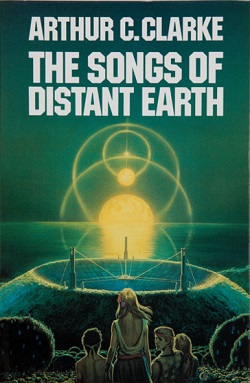
I'll probably stick with the sci-fi theme and read The Songs of Distant Earth by Arthur C. Clarke. I don't know much about it, but I have read one of Clarke's Space Odyssey books (it was a while ago) and he has a short story called "The Star" in The Super Hugos. We'll see how that goes.

Review: The Outsiders, by S.E. Hinton

There's an appeal to S.E. Hinton's The Outsiders that perhaps isn't much different from the tug teenagers today feel for redeemable bad boys such as Edward Cullen and the like. The difference is this story is told from the perspective of one such bad boy, Ponyboy, so we know he's not really a bad boy, just a kid stuck in the wrong circumstances and with the wrong people. There's an appeal, as well, to the fatalism of Romeo & Juliet and the doomed gang warfare of West Side Story. Some of these kids know better, though some don't, but they don't have an authority figure to guide them how to act better. Hinton's first novel has become a hit in middle school classroom precisely because it touches on things that is familiar to every teenager: cliques, fitting in, and friendship.

The story is told from the perspective of Ponyboy, who lives with his two older brothers: Sodapop and Darry (the only one their parents gave a normal name, I guess). Their parents passed away, so Darry is left to take care of the two, sacrificing a football scholarship to do so. Sodapop is charming, but he's dropped out of school and has no real hopes of moving up in the world, while Ponyboy has good grades and focuses on running track, but the lack of stability in his life is constantly threatening his future. These three are part of a group called the Greasers, kids who put grease in their hair and act real tough. Greaser is a term that is used both as a badge of honor and as an insult to character. Greasers are poor kids from broken homes or uncaring parents. Their natural enemies are the Socs, bored rich kids who like to spend their time tormenting hapless greasers.

The two groups often get into "rumbles," fights that usually involve fists, bloody noses, and battle scars that add to one's reputation as "tuff" (cool). Ponyboy is the youngest in his gang of greasers and feels uneasy because he has yet to prove himself. Others in the group include Dallas (Dally) Winston, a greaser who has actually killed someone; Two-Bits, the group clown; Johnny, a boy who'd grown timid the day a band of Socs nearly beat him to death; and Steve, Sodapop's best friend. One night, Ponyboy and Johnny befriend a Soc girl named Cherry, who is the girlfriend of a Soc, and they find that she isn't so bad. Cherry comes to the same conclusion about these two greaser boys. However, when Cherry's boyfriend discovers these greasers hanging out with his girlfriend, he decides to do something about it. I won't say what happens next, but that it turns the worlds of the greasers and the Socs upside down.

If Hinton has an overarching message, perhaps it's that people shouldn't be so quick to judge one another. The greasers are seen as bad boys, and as such they're looked down upon. Socs are able to get away with the mischief they do because everyone is quick to side with them and blame the greasers. Nobody wants to believe a rich kid is capable of societal harm. But the poor kids are easy targets. The Socs are the type of bullies who end up elected to political offices because they have money, while the greasers are the type to jump in and out of the prison system because they don't know any better. But each group has its flaws. The problem with the Socs is they lack compassion. In fact, they lack any feeling at all. It's as though their wealth has made life so easy they get bored. And just as Ishmael (from Moby-Dick) works off his boredom by knocking off people's hats, the Socs get into mischief by bullying those inferior to them. The greasers, on the other hand, have lots of passion, maybe too much. The two groups could learn a thing or two from one another if they stopped to talk to each other.

Hinton is also taking a look at what happens when there is no adult involvement in the lives of kids. The only guardian Ponyboy and Sodapop have is their 20-year-old brother, Darry, who's just a kid himself. He tries his best to make sure his brothers' lives will be set straight, but he lacks wisdom. He's hardly a replacement for lost parents, who wouldn't be involved in rumbles as Darry is. Johnny has both of his parents, but they don't care about him. He's constantly abused by his father and sometimes prefers skipping out on going home. As for the rest, it's clear there's very little boundaries to keep them on a straight path. The Socs we know even less about, but one can imagine their parents excusing the behavior of their sons with the usual "boys will be boys" line of thinking. The tragedy of Ponyboy's future may be that he will never have an adult role model to help him find a better life for himself. He may be doomed, like his brothers and friends, to be forever a greaser.

A lot of this might sound cliche, and it is, but it's wrapped up in an irresistible package of an irresistible plot. These are good kids, and it's easy to imagine young readers choosing favorite greasers. If this was written today, you'd have shirts saying "Team Ponyboy" and "Team Sodapop" and the like. To be fair, unlike some of the teeny bopper stories today, The Outsiders is engaging and entertaining, precisely because it makes us like some of these kids and gets us involved in their doomed adventures. Perhaps sometimes the story is a little unbelievable, tries a little too hard to jerk on the heartstrings, and uses a gangster dialect that can be grating on the nerves. This isn't a great story, but it's a good one, and it has heart. And that's important.

Tuesday, June 17, 2014

Review: The Elephant's Journey, by Jose Saramago

In 1551, an elephant named Solomon, as a gift from the king of Portugal to the archduke of Austria, traveled from Lisbon, Portugal to Vienna, Austria, crossing, in the meantime, Spain and Italy, also passing through the treacherous Alps. If you were to read about this event in a history book, that's probably the only information you will learn about it. The gifted Portuguese author, Jose Saramago, however, transforms the event into a 200 page novel. Most histories are impersonal stories that feature as heroes the rulers of a nation and clump the populace into one large mass that acts and thinks the same. Saramago protests against that type of history and instead dives into the human aspects. Here his main character, besides Solomon the elephant, is not King Joao III of Portugal, or Archduke Maximilian of Austria, but an Indian mahout, named Subhro, who is Solomon's keeper.

This is a history that is perhaps unknown by most, but especially by those in the United States, whose education on Portuguese and Austrian historical figures is very limited. It might seem odd to give, as a gift, an elephant, especially in a time when transporting such a creature over a long distance would have been very difficult. Yet the idea came from King Joao III, who was concerned that his wedding gift to Archduke Maximilian four years prior was insufficient, and now that Maximilian was about halfway between Lisbon and Vienna, in Valladolid, Spain, the king decided to consider a better gift. Thus the story of Solomon's travels begins, at the queen's suggestion, because the poor elephant has just been sitting around and doing nothing but eating for the two years since he had arrived from India.

Once the archduke accepts the gift, travel plans are made and strategies are plotted. The Portuguese, at the helm of an army captain, will take the elephant all the way to Valladolid, and from there the Austrians will take over. Taking care of the elephant is the job of Subhro, whose Indian identity provides him both with an air of mystique and an appearance of inferiority in the eyes of the Portuguese. Part of the difficulty of the journey, early on, was what pace the group should travel at. Those on horseback, such as the soldiers, would no doubt have the ability, and desire, to travel at a faster pace. However, Subhro, on his elephant, would have no choice but to move at the slow pace of the elephant, who also needed to rest for naps. Even slower were the oxen who carried Solomon's food and water. It was Subhro who keenly observed the slowest should set the pace so nobody would get separated, and that Solomon's needs should be put first, lest the group wanted to deal with an angry elephant.

What makes Saramago's tale so interesting is the day-to-day details he goes into, putting the reader into the event as though we, too, were traveling from Lisbon to Vienna. We listen to the conversations between Subhro and the commanding officer, who become good friends. We listen in on conversations between others who have no role to play in the story except to have been there at that moment. The little details Saramago notices helps bring everything to life. There are moments when the party stops at a town and the townspeople watch in awe as the only elephant they will ever see crosses their paths, and one can imagine that story being told to friends and children and grandchildren. In one instance, three men from a small town overhear Subhro describing the Hindu god, Ghanesh, who has an elephant head, and they mistakenly believe Solomon is God. When they tell their pastor, the pastor insists that the elephant is not God but has a demon inside it and decides to perform an exorcism. Such views seem narrow to us now, but the lives of these people were isolated and this was their reality.

Saramago has a tendency to go off on tangents, often referring to a phrase in his writing to cause readers to think about it in a new light. Sometimes these comments are self-referential, even self-deprecating, in order to bring your attention to the fact that you are reading a book that is from the point of view of another person and is not an objective work. Saramago particularly likes to talk about the trouble of writing and reading a history (this is particularly true in The History of the Siege of Lisbon). The trouble is, we don't really know what happened, so we should be wary of trusting every word written in history books. As an example, Jose Saramago isn't quite sure whether the Portuguese King Sebastian died on the first attack of a battle, or the second, or from an illness on the eve of battle. None of us were there, and records were less readily available then than now.

But Saramago revels in the fact that he is not a historian in the traditional sense, but a fiction writer. He uses liberties, for instance, in providing names for characters, and even in making up dialogues and getting into the minds of characters whose minds we have no access to because they left no journals behind. This helps provide a human touch, and in many ways shows just how little humanity has changed over the course of existence. For example, one can easily imagine a modern dialogue being carried in the same manner as one that happens in the book, when spectators debate whether or not the elephant, getting ready to ride on a boat, will either sink it or tumble over the rail because of his size. The imaginations of these people aren't much different from our own, when we make predictions about how things might go wrong. We also get into the mind of Subhro, who finds himself at odds with Archduke Maximilian, as he daydreams about rescuing the Archduchess in order to get back on good terms with the Archduke. Not only is Saramago making an astute observation about people, but he is also very cleverly putting us on a level playing field, so to speak, with these characters from over five hundred years ago.

Saramago writes in a style that I have gotten used to from reading many of his books, but that may be difficult for others to get into. He writes using long paragraphs, sometimes going on for pages, and uses punctuation by his own rules. Periods are scarce, and sometimes commas are used in their stead. He also fails to capitalize proper names, so Subhro is subhro, and even the king is king joao. Most interestingly of all is his style of writing dialogue. Not only does he not use quotes, which isn't that unusual of a practice, but he does not use paragraph breaks, which is pretty unusual. He separates speakers by using a comma at the end of the speaker's sentence, and then capitalizes the first word of the next speaker's sentence. This may cause you to have to re-read dialogue to make sure you don't get mixed up, but it actually flows fairly easily once you get the hang of it.

And it doesn't really matter how somebody writes as long as they are able to do so competently. And Saramago writes more than competently, but exceptionally. He writes with the intent of showing humanity in a positive light. He fails to see anyone as completely evil - even those who could be viewed as antagonists, such as Archduke Maximilian, have their redeeming qualities, and nobody in his stories is stupid. They are who they are, and everyone, even the lowest of the low, is a philosopher. In this case we also see that animals may not be so different. They, like us, want to survive and lead a happy life. Saramago never pretends to know what Solomon is thinking, and is always careful to point this out. Yet the animal does extraordinary things, for whatever reason. One of the most powerful moments I have ever read occurs when Solomon says goodbye to a group of porters by touching his trunk to their hands in a sort of handshake. These porters are so touched by Solomon's gesture that some of them burst into tears. It's as though Solomon, just like the author of the novel, wants to make sure these people don't go without realizing how appreciated they are. Perhaps we could all benefit by being a little more like Solomon. We are, after all, struggling to survive and to be happy in the same world as everyone else, high or low.

Monday, June 16, 2014

Review: Northanger Abbey, by Jane Austen

The main difference between the romantic comedies of today and the romance of Jane Austen is that in Jane Austen's romances the most scandalous (and most exciting) things happen to the side characters, not the main characters. Modern romances allow the hero and heroine to make a grievous error and still be forgiven. The scandals of Austen are a mark of shame that lasts forever. However, Austen's skills as a storyteller would put many modern romance writers to shame. Besides, some of us like to go back to a time where we imagine that the best of us had only minor flaws, such as "want of affection" now and then. I admire and enjoy Austen's Northanger Abbey, as I do most of her other stories I have read, yet I can't help but feel a certain boredom creeping in as the inevitable conclusion creeps upon two very nice, yet somewhat dull, characters.

Life has grown dull for Catherine Morland back home. She loves her family, but her home town offers no hopes of finding a good man to bring some excitement into her life. So when her neighbors, the Allens, offer to take her to Bath, Catherine jumps on the opportunity. Immediately her life begins to perk up. She meets a good friend in Isabella Thorpe, and takes a liking to the handsome and charming Henry Tilney, a clergyman of some wealth. Catherine is shocked to find her brother, James, is a good friend of the Thorpes, though she has no inkling of the obvious attraction between him and Isabella. Catherine is so caught up in her attraction to Henry that she also fails to notice that Isabella's brother, John, has taken a liking to her.

This sets up all the major characters (not including General Tilney, Henry's father, and Miss Tilney, Henry's sister), and the necessary elements for conflict. My own modern mind couldn't help but hope Austen would surprise us and turn John into some kind of underdog love interest for Catherine. I found the early passages with him to be very entertaining. I was rooting for him. But there came to be too many things against him. He comes from a poor family, for one, and no doubt was interested in her for her family's money. He swears, saying, "D---" every now and then. He doesn't handle his horse carriage very well, and one can imagine his road rage on today's roads, with heavy traffic and too many potholes. Worst of all, he hates literature. That last one is the nail in the coffin for John Thorpe. You know he has no chance when one of the most highlighted passages on the Kindle version is Austen's diatribe against authors whose heroines fail to care much about literature.

Besides, Henry is the novel's hero, as Austen's narrator calls him. Any suspense about what will happen is removed. Thus the major drama must revolve around the secondary characters. We wonder whether John is going to sabotage Catherine's chances to meet up with Henry. We also begin to realize the seedy side of Catherine's best friend, Isabella, who is fickle and hypocritical. Though Isabella claims she's the type of friend who will never leave her closest friends alone, she nonetheless finds every excuse to leave Catherine's side during the parties they attend, mostly to spend time with James. When the scandal happens, it is like the shock of hearing about such a scandal happening to someone you know, rather than the humiliation of being involved in that scandal yourself.

It's interesting to note the difference in values between the upper class world of Jane Austen and our own much more liberal values in middle class United States. Turn on a romantic comedy today and both the hero and heroine are having sex, sometimes lots of it and sometimes with other people. It's not uncommon for the source of scandal to originate from the hero or heroine, and this is often what leads to the break-up towards the end. However, we are able to forgive these faults. The hero and heroine get back together, one ashamed of their mistake, the other forgiving, though perhaps more cautious in their trust. Austen's hero and heroine can hardly fathom the idea of scandal. To invite flirtation from another man when you are engaged only in heart to another whose hand you have never even held is among the gravest of romantic sins.

That's not to say readers today won't feel the romantic sin any less, and that's because Austen is such a skilled writer. Northanger Abbey moves at a much quicker pace than any of her other books I have read. At times, particularly in the middle, it is gripping and very entertaining. Austen sets up a lot of potentially intense plot points, but unfortunately rushes through some of them or settles them in anticlimactic fashion. The story fizzles towards the end, as Catherine leaves Bath and goes to Northanger Abbey. Here, Catherine's imagination is awakened by the horror stories she reads, and she imagines some dark secret lurking within its walls. Austen sets up a mystery subplot, in order, it seems, to prevent her novel from going stale. It doesn't work. By this time, the conclusion is drawing closer to its inevitable end. When things do finally set in motion, they wrap up far too quickly, or perhaps just quickly enough to prevent things from dragging on too long.

Nonetheless, this is an excellent novel, and I'd say it's my third favorite Austen, behind Mansfield Park and Pride and Prejudice. Northanger Abbey's side characters are less entertaining than those of the former, and the central romance is weaker than in the latter. This is a book of highs and lows. It begins at a rather subdued pace before rushing, manically, into the ups and downs of Catherine's emotional states of ecstasy and disappointment and tedium, and then tumbling into the slow crawl of the finale. That seems to be the way of the romance genre, and not necessarily any fault with Austen. We are thrilled more by the chase than the catch. While Catherine's romance with Henry is less certain, yet so greatly desired, the story is all the more thrilling, particularly when coupled with Henry's unaccounted absence from a ball here and there, and John Thorpe's relentless pursuit of her heart. It's almost impossible to feel anything but disappointment when the thrill of the chase is over and what you knew was going to happen finally does happen. But it sure is fun.