"When you make a film, you leave an impression on the viewers, who serve as a kind of jury for your film. If you make your film predictable, they'll make up their minds about it long before it's over."
- Mr. Sawicki, Steve Harmon's film teacher
Watching the life of another human being is like watching a film. You only know what you see onscreen. We judge others based on initial impressions and appearances. For a young black teenager named Steve Harmon, who has been accused as being an accomplice to a murder, this becomes a scary reality as he realizes his fate lies in the hands of a jury of viewers who are trying to decide what kind of person he is and whether he is the kind of person capable of being part of a murder. Simply being black makes this an uphill battle for Steve, as news footage showing pictures and videos of young black men committing murder dominates the media and colors peoples' views of the black population. The prosecution knows this and uses it to their advantage. The goal is to convince the jury that Steve is a monster.
Monster is written from the perspective of Steve Harmon, who is writing it in the form of a movie script. There are voice overs, close-ups, medium shots, long shots, and so on. There's a cast of characters that includes Steve's lawyer, a woman named O'Brien; Steve's friend, also up for murder, James King; King's lawyer, Asa Briggs; the prosecutor, Petrocelli; Steve's mother and father and brother; Steve's film teacher, Mr. Sawicki; the judge, and so on. We see scenes of Steve's past. His interaction with his brother, his conversations with others in the neighborhood, including King. Interspersed amongst his screenplay are journal entries, where Steve searches within his soul to try to learn who he is. The trial has rattled his identity, especially as he realizes that everyone, including his own lawyer, including his own parents, believe that he is a monster.
The trial revolves around the death of a drugstore owner, a middle-aged black man whose own weapon was used against him. The place was robbed of the little bit of cash in the register and a few cartons of cigarettes, which were later sold to people who snitched to the police. Four people were involved. James was the one suspected to have pulled the trigger, while Steve was suspected to have been a lookout. He merely entered the store and left, and his silence was the signal that all was clear. Of course, Steve never admits to doing this. He doesn't want to write anything in his notebook that might indict him. There are indications things did happen the way they did, but the shooting was an accident. Steve perhaps found himself in a situation he didn't want to be in in the first place that went too far. And now he might face 25 years to life.
Though the novel never establishes whether Steve was actually involved in the crime, you can't help but hope the jury does not convict him. Steve is sensitive, and his time in prison would likely be awful. He contemplates suicide, but prisoners aren't allowed to have belts or shoelaces. Myers masterfully keeps the reader distant from Steve, by not allowing us into the events of that eventful day, while at the same time he puts us squarely in his shoes, facing his fears and feeling his isolation. This is especially apparent when Steve realizes that his father now looks at him differently, and when his own lawyer fails to develop any sort of bond with him - for her it's probably just a paycheck. At one point, a young black juror smiles at him, but when he returns her smile, she looks away as if remembering who he is, and we can understand Steve's despair.
Though I've only read three of Myers' novels now (and sadly he has passed away), I admire his experimentation with genre. Of the three books I have read, Fallen Angels was the only one that was a traditional narrative. Shooter is a multigenre work, a mix of diary entries, interviews, newspaper clippings, and police reports, all combined to create the whole story. Monster is a screenplay, though not strictly a screenplay, as it also has pictures and Steve's personal thoughts. While the screenplay portion feels distant, focusing solely on the trial, it's through the diary entries that the book is more intimate with Steve. This technique also keeps us distant from the other defendant, James King, who may or may not have done what he was accused of, but it seems likely he pushed Steve into doing something Steve didn't want to do.
People of privilege have trouble bringing themselves into the perspective of those who lack that same privilege. In the closing statements, the prosecutor, Petrocelli, says of James King, "If he had chosen priests and Boy Scouts as his companions, I'm sure we wouldn't be here today." The key word here is "chosen." Petrocelli believes James and Steve had this choice to make, probably because in her own experience this was a viable choice. It's easy to believe that you get to choose the people you associate with when you have the privilege to make that choice. But the reality is, even for those who do have a life of privilege, you don't necessarily choose who you associate with and you don't always choose where your life ends up taking you. Time and place are key. For Steve, being a young black man in a poor neighborhood, his choices are limited, as the likes of King prowl around and seek to use him for his own gains. Steve's choices are limited to incurring the wrath of the likes of King or doing as they bid and feeling accepted. Monster is one of those books that should be read by everyone, white or black, because it allows us to see from the perspective of a demonized young man like Steve Harmon and realize that he is not a monster.
Friday, June 19, 2015
Wednesday, June 17, 2015
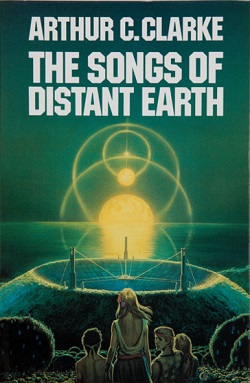
Review: The Songs of Distant Earth, by Arthur C. Clarke
With The Songs of Distant Earth, Arthur C. Clarke wanted to tell a realistic science fiction story about long distance space travel and interplanetary relations. It was written partly in reaction to the fantasy science fiction of Star Trek and Star Wars, which were both popular when Clarke wrote this. Star Trek and Star Wars are great entertainment, mainly because they have some excellent stories and enjoyable characters. The Songs of Distant Earth does not have a very engaging cast of characters, nor does it have a particularly engaging storyline. It's at its best, however, when it makes readers pause to think about such wonders as the realities of space travel or the terror of a helpless population facing inevitable destruction by the expanding sun. This isn't a despairing novel, however, but one of hope and faith in the adaptability of the human race.
In Clarke's fictional tale, 20th century scientists discover signals radiating from the sun that predict its demise by the year 4000. This didn't alarm most of humanity right away, but as time advanced nearer, people realized they needed to act more quickly. Scientists sought out planets that might sustain human life if conditioned just right. Seedships were sent out, commandeered by robots and stocked with all of the pertinent knowledge these new men and women would need to know in order to begin again. These planets were hundreds of years away, so humanity had to be patient to await the news of success. Meanwhile, scientists were frantically trying to figure out faster means of space travel and people were growing increasingly hedonistic, or increasingly religious, whichever suited their needs.
The planet of Thalassa was one such planet chosen for colonization, and with the exception of a tiny landmass, it was a perfect place. It was among the first, colonized in about 2900, and surviving still for 700 years due to its wise leaders and non-violent people. Population control measures were also necessary to reduce strain on the planet's resources. Among the Thalassans is Brant, an engineer who is frustrated that his fish traps keep getting sabotaged. Mirissa is his girlfriend, and she, it seems, is also the most knowledgeable Thalassan on the planet, having read most everything handed down from the mothership (where they originated). Mayor Waldron is a middle-aged lady who oversees South Island, and she also has a sexual appetite with a special interest in Brant.
One day this planet's peaceful operations are interrupted by the visitation of an alien ship. From this ship step two men who claim they have come from Earth. These men are Loren Lorenson, ship commander, and Moses Kaldor, ship ambassador. Apparently Earth did figure out how to create improved space travel using the quantum drive. The quantum drive uses the vacuum of space to propel it forward and can move for an unlimited amount of time. It can't approach the speed of light, just one-twenthieth of the speed of light, and that's one of the points Clarke wanted to make. People cannot approach the speed of light. That means no warp speed a la Star Trek or Star Wars. After 200 years of travel the ship, called the Magellan, arrives at Thalassa because it needs ice. Yes, ice. Ice is the best asteroid shield in space, but after 200 years of travel the crew of the Magellan are worried they don't have enough of a shield to make it to their destination, still 300 years away, of Sagan Two.
So the humans from Earth and the Thalassans socialize together as the Magellan does its work of making ice and raising it to form the ice shield, a two year process. This is where the novel becomes less compelling, broken into a series of mini-events, most of them unconnected. Loren and Mirissa of course fall in love, but Brant doesn't seem too upset about this. There's a discovery of some strange lobster creature in the sea, Mayor Waldron hitting on Loren, a mutiny aboard the Magellan, conversations between Moses and Mirissa about Earth, Mirissa's brother Kumar developing a close bond with Loren, and so on and so forth. The drama is hardly compelling and mostly boring. These people are way too nice. This is great
for the hopes for humanity's future, to be sure, but when I'm reading a novel I want a little more tension, conflict, and cohesion than this novel has to offer.
So while Clarke offers this up as a realistic version of those fantasy sci-fi blockbusters of Star Wars and Star Trek, it is hardly their equal. The story is very compelling for the first third, on and off compelling for the next third, and then dull for the last third. I can understand and appreciate a good sci-fi story that doesn't make use of lightsabers and phasers set to stun and amped-up action scenes. I can appreciate a good piece of speculative fiction, giving realistic thought to what could possibly happen to humanity in case the sun blew up. It's a frightening thought to see that everything mankind has created could just melt away, but there is some comfort in realizing that doesn't have to be the end. Mankind just might be able to continue on after all. There was a part of me, while reading this, that wanted to be among the crew of the Magellan, hibernating for hundreds of years and waking up to find myself in a whole new world, and that's how evocative this novel was when it came to its big ideas.
In Clarke's fictional tale, 20th century scientists discover signals radiating from the sun that predict its demise by the year 4000. This didn't alarm most of humanity right away, but as time advanced nearer, people realized they needed to act more quickly. Scientists sought out planets that might sustain human life if conditioned just right. Seedships were sent out, commandeered by robots and stocked with all of the pertinent knowledge these new men and women would need to know in order to begin again. These planets were hundreds of years away, so humanity had to be patient to await the news of success. Meanwhile, scientists were frantically trying to figure out faster means of space travel and people were growing increasingly hedonistic, or increasingly religious, whichever suited their needs.
The planet of Thalassa was one such planet chosen for colonization, and with the exception of a tiny landmass, it was a perfect place. It was among the first, colonized in about 2900, and surviving still for 700 years due to its wise leaders and non-violent people. Population control measures were also necessary to reduce strain on the planet's resources. Among the Thalassans is Brant, an engineer who is frustrated that his fish traps keep getting sabotaged. Mirissa is his girlfriend, and she, it seems, is also the most knowledgeable Thalassan on the planet, having read most everything handed down from the mothership (where they originated). Mayor Waldron is a middle-aged lady who oversees South Island, and she also has a sexual appetite with a special interest in Brant.
One day this planet's peaceful operations are interrupted by the visitation of an alien ship. From this ship step two men who claim they have come from Earth. These men are Loren Lorenson, ship commander, and Moses Kaldor, ship ambassador. Apparently Earth did figure out how to create improved space travel using the quantum drive. The quantum drive uses the vacuum of space to propel it forward and can move for an unlimited amount of time. It can't approach the speed of light, just one-twenthieth of the speed of light, and that's one of the points Clarke wanted to make. People cannot approach the speed of light. That means no warp speed a la Star Trek or Star Wars. After 200 years of travel the ship, called the Magellan, arrives at Thalassa because it needs ice. Yes, ice. Ice is the best asteroid shield in space, but after 200 years of travel the crew of the Magellan are worried they don't have enough of a shield to make it to their destination, still 300 years away, of Sagan Two.
So the humans from Earth and the Thalassans socialize together as the Magellan does its work of making ice and raising it to form the ice shield, a two year process. This is where the novel becomes less compelling, broken into a series of mini-events, most of them unconnected. Loren and Mirissa of course fall in love, but Brant doesn't seem too upset about this. There's a discovery of some strange lobster creature in the sea, Mayor Waldron hitting on Loren, a mutiny aboard the Magellan, conversations between Moses and Mirissa about Earth, Mirissa's brother Kumar developing a close bond with Loren, and so on and so forth. The drama is hardly compelling and mostly boring. These people are way too nice. This is great
for the hopes for humanity's future, to be sure, but when I'm reading a novel I want a little more tension, conflict, and cohesion than this novel has to offer.
So while Clarke offers this up as a realistic version of those fantasy sci-fi blockbusters of Star Wars and Star Trek, it is hardly their equal. The story is very compelling for the first third, on and off compelling for the next third, and then dull for the last third. I can understand and appreciate a good sci-fi story that doesn't make use of lightsabers and phasers set to stun and amped-up action scenes. I can appreciate a good piece of speculative fiction, giving realistic thought to what could possibly happen to humanity in case the sun blew up. It's a frightening thought to see that everything mankind has created could just melt away, but there is some comfort in realizing that doesn't have to be the end. Mankind just might be able to continue on after all. There was a part of me, while reading this, that wanted to be among the crew of the Magellan, hibernating for hundreds of years and waking up to find myself in a whole new world, and that's how evocative this novel was when it came to its big ideas.
Tuesday, June 16, 2015
Review: The Fault in Our Stars, by John Green
So many young adult romances these days are so serious and gloomy that it's refreshing when one comes along that is full of spirit and humor. And that's ironic in this case because the two main characters of The Fault in Our Stars have good reason to be gloomy. One has terminal cancer, and the other had his leg amputated in order to remove his cancer. Their early encounters with near-death has given Hazel Grace and Augustus Waters a jaded view on life, which shows in their witty humor. These kids aren't heroes or fighters, though that's what everyone calls them. They just happen to be dying from an anomaly of their bodies. Yet they learn how to enjoy the small things and to find love, which is important. This story, despite its subject matter, had me laughing for most of it. When it gets to the final stretch, when things grow predictably gloomy, I grew bored, but I can see the appeal to the many readers who have fallen in love with John Green's tale.
The story is told from the perspective of Hazel Grace, a sixteen year old girl who has lived past her life expectancy because of a miracle drug called Phalanxifor (which doesn't really exist). Her parents want her to be as happy as she can. So rather than mope about, she must attend support group meetings, where Patrick, the support group leader, talks about God and about how he (Patrick, not God) lost his testicles to survive cancer and how everything will be alright in the end. The kind of stuff that makes Hazel gag. Her only friend is Isaac, who is about to lose his eyes in order to (hopefully) defeat cancer, but one day a hot boy turns up named Augustus Waters. And the first thing Augustus does is stare at her. Stare and stare and stare, until she stares back. He asks her out, breaks past her defenses, and shows her V for Vendetta because she reminds him of Natalie Portman.
And so they continue to be friends, but definitely more than friends. They fall in love, but take awhile to admitting it. She doesn't want to hurt anybody because she knows she will die young. Augustus, or Gus, has already been hurt when his ex-girlfriend lost her battle to cancer (Hazel would hate to know I used that metaphor). Hazel eventually shares her favorite book, An Imperial Affliction, by Peter Van Houten (also made up), with Gus. This book becomes almost central to the conflict, as the two want to know how it ends. Van Houten, maddeningly, ended it too abruptly, and Hazel's one wish is to know how the characters' stories resolve.
The first two-thirds of this book are fantastic. Hazel is an intelligent, hilarious narrator, and the dialogues between her and Gus are full of energy and wit. Green has the courage to write teenage characters who are smart when so many other teenage characters in YA fiction try not to be so smart. The dialogue, I'll admit, is not entirely believable, but what matters is that the dialogue is lots of fun. It isn't aiming to be real. It's very much like Diablo Cody's Juno, another teenager who spoke with too much wit, but without which the movie wouldn't have been so fantastic. I laughed out loud a lot while reading this book, and it's not often a book allows me to do that.
But, of course, this is a book about cancer, and most any book about cancer has a part where you will cry. You will cry because the person with cancer dies, or you will cry because they overcome all odds and survive. Either way, there is that serious moment when things look bad, or when you just don't know what will happen, and that's no different for this book. The problem is, the book gets really dull. The last third loses much of its energy, inevitably, and while it never gets bad, Green does a lot of philosophical explaining, and none of it is particularly mind-blowing stuff. This last third of the book, more than the rest, is a meditation on life, on the fact that everyone is a part of this world for a brief amount of time, but some people are on it for an even briefer amount of time. The book grasps at an over-reaching philosophy on life's grand meaning, and ends up finding a new way to say something not all that new.
Not that I mean to bring a gloomy note to the end of my review. John Green is clearly a talented and very imaginative writer. What makes The Fault in Our Stars so enjoyable is that its sole mission is not to elevate these cancer kids to the status of heroes. The book's mission is to make them human, make them real, and make them into people you wouldn't mind having as a friend. These aren't gloomy kids seeking pity, or pitying themselves (not all the time, but everyone does that now and then). These are kids trying to enjoy life, to make it as normal as possible, which means getting frustrated with people who treat them like little saints. Despite its dances with death, The Fault in Our Stars has a rebellious joy for life, dancing in the face of the universe.
The story is told from the perspective of Hazel Grace, a sixteen year old girl who has lived past her life expectancy because of a miracle drug called Phalanxifor (which doesn't really exist). Her parents want her to be as happy as she can. So rather than mope about, she must attend support group meetings, where Patrick, the support group leader, talks about God and about how he (Patrick, not God) lost his testicles to survive cancer and how everything will be alright in the end. The kind of stuff that makes Hazel gag. Her only friend is Isaac, who is about to lose his eyes in order to (hopefully) defeat cancer, but one day a hot boy turns up named Augustus Waters. And the first thing Augustus does is stare at her. Stare and stare and stare, until she stares back. He asks her out, breaks past her defenses, and shows her V for Vendetta because she reminds him of Natalie Portman.
And so they continue to be friends, but definitely more than friends. They fall in love, but take awhile to admitting it. She doesn't want to hurt anybody because she knows she will die young. Augustus, or Gus, has already been hurt when his ex-girlfriend lost her battle to cancer (Hazel would hate to know I used that metaphor). Hazel eventually shares her favorite book, An Imperial Affliction, by Peter Van Houten (also made up), with Gus. This book becomes almost central to the conflict, as the two want to know how it ends. Van Houten, maddeningly, ended it too abruptly, and Hazel's one wish is to know how the characters' stories resolve.
The first two-thirds of this book are fantastic. Hazel is an intelligent, hilarious narrator, and the dialogues between her and Gus are full of energy and wit. Green has the courage to write teenage characters who are smart when so many other teenage characters in YA fiction try not to be so smart. The dialogue, I'll admit, is not entirely believable, but what matters is that the dialogue is lots of fun. It isn't aiming to be real. It's very much like Diablo Cody's Juno, another teenager who spoke with too much wit, but without which the movie wouldn't have been so fantastic. I laughed out loud a lot while reading this book, and it's not often a book allows me to do that.
But, of course, this is a book about cancer, and most any book about cancer has a part where you will cry. You will cry because the person with cancer dies, or you will cry because they overcome all odds and survive. Either way, there is that serious moment when things look bad, or when you just don't know what will happen, and that's no different for this book. The problem is, the book gets really dull. The last third loses much of its energy, inevitably, and while it never gets bad, Green does a lot of philosophical explaining, and none of it is particularly mind-blowing stuff. This last third of the book, more than the rest, is a meditation on life, on the fact that everyone is a part of this world for a brief amount of time, but some people are on it for an even briefer amount of time. The book grasps at an over-reaching philosophy on life's grand meaning, and ends up finding a new way to say something not all that new.
Not that I mean to bring a gloomy note to the end of my review. John Green is clearly a talented and very imaginative writer. What makes The Fault in Our Stars so enjoyable is that its sole mission is not to elevate these cancer kids to the status of heroes. The book's mission is to make them human, make them real, and make them into people you wouldn't mind having as a friend. These aren't gloomy kids seeking pity, or pitying themselves (not all the time, but everyone does that now and then). These are kids trying to enjoy life, to make it as normal as possible, which means getting frustrated with people who treat them like little saints. Despite its dances with death, The Fault in Our Stars has a rebellious joy for life, dancing in the face of the universe.
Monday, June 15, 2015
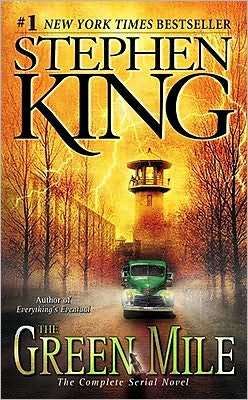
Review: The Green Mile, by Stephen King
Up front, The Green Mile feels like an unusual style for its author, Stephen King. It's a work of realism, not a work of horror, not a work of fantasy. Yet, the deeper you get into its story, the more you realize it still falls within King's whims. In this case, it's a work of magical realism. King's greatest invention is John Coffey, a simple-minded man with a supernatural power. He's a man who is much more complex and multi-faceted than he seems, and what he seems is a barely more talkative version of Hodor. That complexity isn't apparent until you climb deeper into the novel's depths, where there are plenty of surprises and shocks that more than make up for the slow climb. In some ways this is a silly novel, in other ways a marvelous, poignant tale, and in all ways it is quintessential Stephen King.
Paul Edgecombe is the main character of the story, the head prison guard at Cold Mountain Penitentiary, where those on death row wait until it is time to walk the Green Mile and meet "Old Sparky." Paul is writing this story from the vantage point of old age in a senior retirement home. He remembers fondly his friends Brutal, Dean, Harry, and the warden, Hal Moores. He remembers even more fondly his wife, Janice. There are also the prisoners whose executions he oversaw. But this cast of characters would not be complete without the Stephen King-esque villain of Percy Whitmore, a prison guard who only has this job because he has connections high up, and he is nasty in the more or less one-dimensional way a King villain is nasty.
John Coffey is the reason Paul has decided to write this "memoir" of what happened during those final months at Cold Mountain. Coffey is a giant of a black man, who always seems to have tears streaming down his eyes. He speaks and acts gently, though he looks as though he could tear somebody in half with ease. Coffey was sentenced to death for the murder of two small white girls, who he had in his arms when the police found him. He had them in his arms, crying, and repeating that he "couldn't help it." Absent DNA evidence, nothing could have proved him innocent of raping and killing those two girls. Yet, of course, we have the feeling he is innocent (I won't say whether he is or not, though most people know that answer by now). This sets up The Green Mile as a story similar, in small ways, to To Kill a Mockingbird, another story about a gentle, though large, black man accused of a crime he probably did not commit
Integral as he is, Coffey is sidetracked for much of the story. First there are two executions, one to let us know how the whole deal works, and another that has an impact on the main part of the story. This second is of a man named Delacroix, a Frenchman who killed several children. Yet this Frenchman is not portrayed as a vicious, vile man. He is a goofy, pitiful man who falls in love with a mouse, Mr. Jingles, and delights over the little tricks Mr. Jingles performs. Percy, from the start, hates Delacroix and attempts to kill the mouse. The prison guards, meanwhile, enjoy the company of Delacroix, but wish Percy was gone. Sometimes people on death row, no matter what they may have done, are more likable than those who supervise them.
Mr. Jingles is one example of the novel's silliness. Mr. Jingles is an important part of the story in the later bits, yet the attention the prison guards give him, the admiration they have for him, seems silly. Perhaps it's simply because life at Cold Mountain really is that dull. Also silly is the amount of detail King goes into describing Paul's apparently very painful urinary tract infection. We get detailed accounts of how Paul feels blazing pain when he pisses outside. Yet, I can't exactly fault King for these details. As unnecessary as the attention given to Mr. Jingles seems at the start, and unnecessary as the details of Paul's UTI feel when they happen, these things exist and happen for a reason in the book, and yes, it is necessary for Paul's UTI to be so painful. And that's part of the genius of the story, that it leaves no stones unturned and covers all of its bases.
This takes us to the magical realism aspect of the story: John Coffey. He is not just a normal man, as I said before, but a man with the power to heal. And we first see this when John heals Paul's UTI just as it is at its worst. But it's more than healing that Coffey does. He absorbs the evil right out of the illness and lets it die in the air. Illness in the novel is a form of evil. It transforms the wife of Warden Hal Moores, Melinda Moores, into a monster that spews venomous language in as mild a manner as possible. Melinda has a brain tumor, yet I doubt brain tumors really have the effect on most people that they do on Melinda. John's a savior to such people, yet his goodness is complicated in ways that the evils in the novel, such as Percy Whitmore and, later, Brad Dolan, are not complicated. That's King for you.
In the end the novel is gripping, entertaining, shocking, and touching. It's one of King's masterpieces because of its flaws. Being set at death row, its main character has plenty of time to meditate on death, and on life. These men, no matter what they did, are made human while on the walk of the green mile. This is when fear sets in, the fear that they will exist no more once they take their seat on Old Sparky. And with some of these men, it's sad to see them go, even though the reason they are there is because of some terrible crime committed. Or not committed. I'm not sure if King wrote this in a stance against capital punishment so much as it is a story about the joys, sorrows, and pains of life, and as a meditation on death. This story is just what it is - magical.
Paul Edgecombe is the main character of the story, the head prison guard at Cold Mountain Penitentiary, where those on death row wait until it is time to walk the Green Mile and meet "Old Sparky." Paul is writing this story from the vantage point of old age in a senior retirement home. He remembers fondly his friends Brutal, Dean, Harry, and the warden, Hal Moores. He remembers even more fondly his wife, Janice. There are also the prisoners whose executions he oversaw. But this cast of characters would not be complete without the Stephen King-esque villain of Percy Whitmore, a prison guard who only has this job because he has connections high up, and he is nasty in the more or less one-dimensional way a King villain is nasty.
John Coffey is the reason Paul has decided to write this "memoir" of what happened during those final months at Cold Mountain. Coffey is a giant of a black man, who always seems to have tears streaming down his eyes. He speaks and acts gently, though he looks as though he could tear somebody in half with ease. Coffey was sentenced to death for the murder of two small white girls, who he had in his arms when the police found him. He had them in his arms, crying, and repeating that he "couldn't help it." Absent DNA evidence, nothing could have proved him innocent of raping and killing those two girls. Yet, of course, we have the feeling he is innocent (I won't say whether he is or not, though most people know that answer by now). This sets up The Green Mile as a story similar, in small ways, to To Kill a Mockingbird, another story about a gentle, though large, black man accused of a crime he probably did not commit
Integral as he is, Coffey is sidetracked for much of the story. First there are two executions, one to let us know how the whole deal works, and another that has an impact on the main part of the story. This second is of a man named Delacroix, a Frenchman who killed several children. Yet this Frenchman is not portrayed as a vicious, vile man. He is a goofy, pitiful man who falls in love with a mouse, Mr. Jingles, and delights over the little tricks Mr. Jingles performs. Percy, from the start, hates Delacroix and attempts to kill the mouse. The prison guards, meanwhile, enjoy the company of Delacroix, but wish Percy was gone. Sometimes people on death row, no matter what they may have done, are more likable than those who supervise them.
Mr. Jingles is one example of the novel's silliness. Mr. Jingles is an important part of the story in the later bits, yet the attention the prison guards give him, the admiration they have for him, seems silly. Perhaps it's simply because life at Cold Mountain really is that dull. Also silly is the amount of detail King goes into describing Paul's apparently very painful urinary tract infection. We get detailed accounts of how Paul feels blazing pain when he pisses outside. Yet, I can't exactly fault King for these details. As unnecessary as the attention given to Mr. Jingles seems at the start, and unnecessary as the details of Paul's UTI feel when they happen, these things exist and happen for a reason in the book, and yes, it is necessary for Paul's UTI to be so painful. And that's part of the genius of the story, that it leaves no stones unturned and covers all of its bases.
This takes us to the magical realism aspect of the story: John Coffey. He is not just a normal man, as I said before, but a man with the power to heal. And we first see this when John heals Paul's UTI just as it is at its worst. But it's more than healing that Coffey does. He absorbs the evil right out of the illness and lets it die in the air. Illness in the novel is a form of evil. It transforms the wife of Warden Hal Moores, Melinda Moores, into a monster that spews venomous language in as mild a manner as possible. Melinda has a brain tumor, yet I doubt brain tumors really have the effect on most people that they do on Melinda. John's a savior to such people, yet his goodness is complicated in ways that the evils in the novel, such as Percy Whitmore and, later, Brad Dolan, are not complicated. That's King for you.
In the end the novel is gripping, entertaining, shocking, and touching. It's one of King's masterpieces because of its flaws. Being set at death row, its main character has plenty of time to meditate on death, and on life. These men, no matter what they did, are made human while on the walk of the green mile. This is when fear sets in, the fear that they will exist no more once they take their seat on Old Sparky. And with some of these men, it's sad to see them go, even though the reason they are there is because of some terrible crime committed. Or not committed. I'm not sure if King wrote this in a stance against capital punishment so much as it is a story about the joys, sorrows, and pains of life, and as a meditation on death. This story is just what it is - magical.
Friday, January 2, 2015
Review: The Picture of Dorian Gray, by Oscar Wilde
When The Picture of Dorian Gray came out in 1890, it wasn't very well received by critics. By now, its story has become famous. The late 19th century probably wasn't ready for the obvious homoerotic content. It's a novel focused on male beauty written in a world more comfortable with female beauty. The beautiful Dorian Gray is the object of fascination by many in this novel, but especially by the two major side characters: Basil Hallward and Henry Watton. Both admire his beauty, though for different reasons. Basil is a painter and sees him as the perfect model. Henry sees him as a blank slate to be filled with his own philosophical ideas. It is the combination of the admiration of both of these men that turns Dorian Gray into the monster he becomes.Basil Hallward, the painter, represents the artistic view of beauty. He wants to transform Dorian Gray's beautiful image into masterpieces of art. The only problem is his feelings for Dorian get in the way. He paints one portrait so well that he doesn't want to show it to the world. He confides to Henry that the painting had too much of himself in it. The world would know the painter had strong feelings for the subject, and to reveal these feelings would likely kill his career and reputation. Instead, he gives the portrait to Dorian to keep.
Lord Henry Watton, on the other hand, is a jovial pessimist. He takes great interest in Dorian as well, but because he sees Dorian as innocent and naive, a vessel to be filled with new ideas. Henry takes great joy in seeing those ideas change Dorian. Dorian, as we first meet him, seems little more than the empty shell, beautiful on the outside,that Henry imagines him. Until Henry suggests it, Dorian never considers the idea that beauty is not everlasting. It fades with time. Worst of all, it fades after a very brief amount of time. Dorian begins to wish that he could keep his beauty and that the painting Basil had drawn would age in his stead. Eventually, during a strange trip through a dark place, he gets his wish. Wilde never explains the magic behind this connection between Dorian and his painting, but he doesn't need to. Too many stories today make the mistake of wasting precious story time explaining how and why. It's a fantasy - that's all.
Society's obsession with beauty often blinds it to the flaws of the beautiful. That may be the point Wilde is making here. This isn't a mind-blowing idea, but Wilde's flairs of imagination are what make the story so exceptional. Dorian is idolized by his two closest friends. Henry in particular sees him as harmless. Others in society also obsess over him, but it's clear he has made some enemies. Not out of jealousy, not all of it, but because he has developed a corrupting influence. Acquaintances have killed themselves or had to drop out of higher society due to some scandal or other. No doubt many of Dorian's friends have grown addicted to drugs. Wilde describes much of this through rapid-fire exposition. One section of the novel goes on for a little too long, when Wilde describes all of the luxurious things Dorian has become obsessed over. Jewels and fashion, things of material beauty.
This is a novel with a wickedly fast pace due to Wilde's use of dialogue. His characters have quick wits, sometimes too quick, which helps the novel flow along at a brisk pace. When nobody is talking, we are usually in Dorian Gray's head, seeing his views change and watching him consider the consequences of his evil actions. The portrait does not shield him from his own soul, it turns out, and it's changes begin to make him fearful of himself. For a novel written over 120 years ago, this is very readable to modern audiences. It plays out much more like a play than a novel. Lord Henry's humorous wit is as much fun to read as seeing Dorian's evil ways spread. The novel's energy makes it feel fresh, so don't be so hesitant to dust off that old tome (or download the free Kindle version) and dig in. It makes for a very fun ride.
Tuesday, July 29, 2014
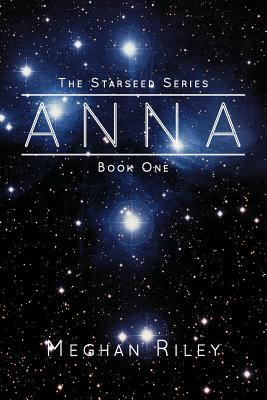
Review: Anna, by Meghan Riley
The biggest disappointment in reading Anna is that the story isn't quite what's advertised. The story, as suggested on the back cover, doesn't truly begin until the very end of the novel. There is a shadow man, yes, as the back cover titillatingly reveals, but he doesn't appear until 120 pages in, and even then it takes another 60 before Anna believes he is real. Really, what this novel is about is the life of a seemingly normal teenage girl named Anna who is only beginning to have somewhat weird things happen to her, but things that aren't so important as to make her forget about stuff like boys and the homecoming dance. And that's disappointing because this is a well-written book with better-developed characters than other, similar young adult novels, but its reluctance to get to the heart of its story will test the patience of its readers.Anna is in her last year of high school at East Bank, and she can't wait to be done. Her father was killed in Afghanistan four years ago, and since then she has dropped substantially in popularity. She has only one friend, Heather. Her family is poor - they only have one cell phone for the entire house, and they have no internet and no computer. Anna's mom works as a waitress, and Anna herself works at a jewelry store. Her brother, Michael, locks himself in his bedroom playing video games and he also hangs out with kids who are into some shady activities. Anna often has to babysit him when her mom has to work, which limits her own social activities. Not that she minds. She is a good student who spends her time at home doing homework. She's very bright. In fact, her dream job involves astrophysics.
If you'll notice, that above plot summary does not involve any shadow persons. It also does not contain information about the story's main contents - a love triangle. Anna has a crush on the high school's star quarterback, Steve McCormick. Yet, of course, he has no idea she exists. That is, until she bumps into him one day and knocks his books all over the hallway. In helping him gather his things, Anna accidentally grabs the copy of Steve's physics midterm that is due the next day and only discovers this while at home. Having no access to the internet and, thus, no way to facebook him, Anna's only choice is to complete his assignment for him. When Anna tells this to Steve the next day, he becomes smitten with her, suddenly realizing the beauty behind the nerdy nobody. He asks if she will tutor him in physics and she ecstatically agrees.
Yet another boy appears. Anna joins an astronomy club through the East Bank Community College, where she meets Jared, a student from rival Milford. Jared, like Steve, is tall, handsome, athletic. Only, he plays lacrosse instead of football. He is instantly attracted to her, though she is too naive to notice. While Steve is a nice guy, perhaps a little too nice for a star quarterback (he doesn't even have an ego), Jared is also nice, but he has a little more personality. He's much more flirtatious, giving Anna the nickname of Copernicus due to her apparent astronomy genius. It seems the stuff of dreams (and cliche) that a nerdy girl with low self-esteem becomes the love interest of the two most popular boys of their respective high schools.
Now, I've given three paragraphs for plot details, when I generally stick with just one or two, and that's because there is a lot going on in this book. And I haven't even gotten to the shadow man parts. The problem is, this novel suffers a glut of plot. Anna has boy trouble. She also has a freckle formation on her arm that is shaped just like the constellation Pleiades. Her friend Heather is upset that her mom is remarrying and that Anna is being a selfish friend who won't listen to her problems. Michael is playing too many video games, and he's also getting into drugs and stealing. Anna's crush, Steve, is giving her mixed signals, and it's unclear whether he still has feelings for his on-again, off-again girlfriend, Jessica. Anna's mom is constantly under stress. Anna's arm becomes itchy and develops boils. Oh, and a shadow man visits her bedroom but her mom assures her it's just sleep paralysis.
Meghan Riley has a very pleasant, refined writing style. It helps make the book read smoothly despite all the details and plot points she throws the reader's way. There are moments that will make you chuckle, and many readers will likely fall in love with the romantic guessing game of "Who Will Anna End Up With?" I was enjoying this book immensely for a good chunk of it. But then I began to grow impatient. I began to flip to the back cover to remind myself what got me interested in reading it in the first place. This is a supernatural romance story that fails to utilize its own unique identity. In Twilight, Bella falls in love with the vampire Edward, thus making up the entirety of the plot. In The Hunger Games, Katniss is enlisted in a free-for-all death match that involves one boyfriend inside and one outside. In Divergent, Tris finds herself fighting an oppressive ruler while trying to sneak in a date with her own boyfriend. Anna, the novel and the heroine, is much smarter than all three of these, yet Riley fails to exploit her novel's unique identity. In the end, it's a story about Anna worrying about homecoming dance, about whether Steve really likes her or if she should go with Jared, and during those non-fantasy elements, it's just ordinary.
Anna is a heroine who I think is needed in the genre. She is smart. She is ambitious. The two guys she has a crush on are both very nice. She does not have a violent streak or any hints of masochism. Anna feels very real, much more fleshed out than the heroines I mentioned above. I like Anna. Not many young heroines seem to have much of an interest in being smart, yet Anna has a passion for astrophysics. She even talks passionately about facts and figures, the sort of things that would bore Bella or Katniss or Tris. Anna is a brilliant creation by Meghan Riley.
Yet in the end I have a tough time recommending this book. Those who enjoy such books as The Hunger Games and Divergent will have trouble enjoying this because of a lack of action. And while Steve and Jared make for nice romantic figures, the lack of a darkness within them also makes them less exciting. Finally, those intrigued by the premise will be sorely disappointed, as I was, when it takes Riley 350 pages to finally arrive at what was promised, but by then you will be too drained from having read Anna's ordinary life adventures. Things happen so quickly at the end that several questions arise that go unanswered, but I can't pose them without ruining what happens (and one of them is HUGE). I may or may not continue with the series, but my concern is that the sequel will follow the same formula as this - waiting until the end before it makes any meaningful advances in its story. I really hope Riley begins diving into her story proper before then.
*I received a free copy of this book in exchange for an honest review.*
Wednesday, July 23, 2014
Review: Allegiant, by Veronica Roth
There will be obvious spoilers following for those who have not read the first two books in the series: Divergent and Insurgent.
The not-so-shocking conclusion to Insurgent revealed that Tris and everyone in her city have been part of an experiment to breed and weed out the purest of people. Now that the faction system has been destroyed, the city, of course, finds itself divided again into further factions. There are those who wish to keep the faction system alive. Still others, led by Tobias' mother, Evelyn, would like to run the city without any factions. And a third group, the Allegiant, run by Tobias' father, Marcus, and the previous leader of Amity, Johana Reyes, want to go to the outside world and see what's waiting for them. Obviously Tris and Tobias and Christina and Uriah and the old gang join this last group. The story has grown stale inside the city.
Outside the city they enter a secluded world where a select few smart people run the city experiment. The person in charge is named David. He is crippled and moves around in a wheelchair, but his powers of intellect are superior. Tris and Tobias have difficulties fathoming a world that, reader, you and I take for granted. The name Chicago means nothing to them, but it is the city they have grown up in. Yet this isn't the same United States we know. War has ravaged society. In response, an odd response, people were placed in experimental cities in order to, I guess, create a class of genetically pure humans who can rule society without violence and injustice. These would be the Divergent, except in a confusing twist, not all Divergent are genetically pure. Tris is, but Tobias is not. For Tobias, this is a complete shock.
Roth's villainizing of the intellectual-based faction, Erudite, has led to some criticism of her being anti-intellectual. There are exceptions to this, as Cara, Will's sister, comes from Erudite, and she's one of the good guys. But Roth turns this anti-intellectualism into anti-science in Allegiant. Outside the city, people are seen as genetically pure (GP) or genetically damaged (GD). Those who are genetically pure are seen as superior beings who can do no wrong, while the genetically damaged can't help their poor decisions. We find the GD grouped into giant slums, apparently treated poorly. Tobias is labeled GD and the effect is an instant ego crush. He dives into a depression, even before we readers fully understand what this label means. I still don't entirely understand it, either, even though Roth tirelessly explains it.
This latest development in the trilogy just feels like too much. None of the major plot developments are developed very well, and the story just jumps from one oppressive environment that the characters must rebel against to the next. And they waste no time rebelling against the most recent one. Right away, Roth's heroes dislike the way society is run outside the city, and they quickly make rash decisions that have serious consequences. Thought is only given to the now, not to the future, and no attempt is made at discussion. Those in charge don't listen anyway. This seems to reflect a skepticism and cynicism about the workings of our own society. Once Tris and the gang rebel against one oppressive system, the next one is just as oppressive, if not more so. The position of Tris is to destroy rather than create. What solution does she have to make a better system? None. For her and her friends, nothing is better than something.
Allegiant is unique from the other stories in that it is no longer told just from the perspective of Tris. Tobias also has a perspective, and the story alternates between the two. Unfortunately this is less intriguing than it should be. Roth provides no real depth to character in order to differentiate the two. At times, while reading, I forgot whose perspective I was reading from. Tris and Tobias both have identical world views, and only slightly separate problems. The same is true of other characters. They have no real personality, just one-dimensional character traits that are hardly compelling. This causes Roth's George R. R. Martin-esque penchant for killing off characters to have less of an impact. When Lynn dies at the end of Insurgent I had a hard time remembering who she was. More characters die in the third book. Or, I should say, more names die.
Roth is a young writer, and hopefully that means she will grow and develop in her craft. I'm afraid that, too often, young writers who earn success early on have no incentive to improve. Why improve when people will buy your books as they are? Characters need to be more than just names - they need to become people. A story should have focus. What are the goals, what are the obstacles? When Roth turns this into rebellion after rebellion, the cost is a lack of development and a lack of coherence. The ending has apparently upset a lot of people. I won't reveal it, but when I read the points readers have made, I have to agree. On the other hand, I admire Roth for sticking to her guns and not giving in to what readers would want. Readers are not always right (though in this case they are). Allegiant, unfortunately, is the weakest part of what has turned into a mediocre trilogy.
Subscribe to:
Posts (Atom)