Friday, June 26, 2015

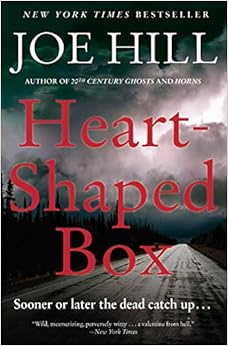
Review: Heart-Shaped Box, by Joe Hill

Joe Hill is nearly the spitting image of his father with Heart-Shaped Box, a ghostly thriller with the same sort of villains and dialogue Stephen King might have written. I've already read Horns, so I know Joe Hill has his own style, and I believe he will grow into an excellent horror writer with unique ideas. Heart-Shaped Box isn't quite as good as Horns, as it suffers from habits I'm worried could bog down some of Hill's later works. For one, Hill loves to give background information. He allows background information to take over the main plot where just a little bit of background information might have been more effective. It's a shame, too, because the novel has lots of promise at the start and even gets good again towards the end.

Judas Coyne, known as Jude, has retired from the heavy metal lifestyle after members of his band passed away due to one cause or another. Still filthy rich, Jude collects grotesque objects, such as a five-hundred-year-old peasant skull and a three-hundred-year-old confession signed by a witch. He also owns a video of a gang suffocating a couple (and it's this video that understandably precipitates his divorce). Jude even collects women and names them after states like Florida and Georgia. These women, like Jude, also love the grotesque, dressing in the Goth fashion of black hair, lipstick, and fingernails. Jude's obsession with grotesque objects eventually leads him to purchase a ghost.

Now, he doesn't directly purchase the ghost. He purchases a suit that belonged to the deceased. This suit is shipped to him in a heart-shaped box. His dogs, Angus and Bon, don't like it. His girlfriend, Georgia, doesn't like it either. Jude himself begins to dislike it when a creepy old man with a razor-sharp pendulum begins to make an appearance. Eventually, Jude's secretary, named Danny, drives himself to suicide, and it seems clear that this ghost is out to kill Jude and everyone he loves. Jude discovers that this ghost is the grandfather of Jude's troubled ex-girlfriend, Florida, who apparently committed suicide not long after Jude kicked him out. So the ghost is out for revenge, right?

The story goes back and forth between Jude and Georgia's escape from the ghost to background information about Jude's past, namely his relationship with Florida (the woman, not the state). It's not that this background is bad, per se, but it delves too far and takes on improvised characteristics, where revelations from the past help form plot points in the present. This seems lazy, the way that Jude suddenly remembers important things with perfect clarity. There is a lot of emotional power in what happens in the story, but the improvised feeling takes away the emotional impact from these events. Florida, anyway, is not the one we were following from the start. It is Jude and Georgia we care about, but their stories are sidelined. Hill had a similar problem with Horns, which has a terrific opening, but then stalls with a needlessly long background story.

Hill does write some powerful passages of horror. His description of the ghost, Craddock, is his best work in the whole story. Craddock is what makes the story interesting, since Jude and Georgia fail to have an intriguing personality despite their anti-social tendencies. When Craddock first appears, the imagery Hill uses is haunting. At that point I thought that I was in for a treat. Unfortunately, Hill never replicates that horror. There are some moments of fear for the lives of the main characters, and some moments of awful violence. But, as threatening as the ghost is, he disappears and reappears at the convenience of the plot. He is there, however, just enough to let us know this will end in death, his or theirs. At least something big is at stake.

In his first two novels, Hill displays a love of music. Heart-Shaped Box is devoted almost entirely to heavy metal/rock n' roll. The references to rock bands are everywhere. Jude's own name is an obvious reference to The Beatles (a band Ig in Horns loved a lot, and a band King also adores). Nirvana is another reference, and there is also mention of the Foo Fighters, Metallica, and others. It's disappointing this music doesn't have a very big impact on the plot. It seems that Hill missed an opportunity that his novel's title promised. Hill clearly wants to aim for something unique, but his heavy focus on background information grounds him in conventional plotting. His story is well-organized and it plods along slowly and deliberately, like a storyteller who wants to take his time and let the story live on as long as he can - just as Jude clings to life. These are the tells of a good storyteller, and I hope Hill has his breakout moment soon. It would be nice to have a new horror writer to look forward to for another generation.

Wednesday, June 24, 2015

Review: Time Cat, by Lloyd Alexander

Time Cat is Lloyd Alexander's tribute to the cat. Throughout the book, which covers many different places and periods of time, cats are worshiped, desired, and, in one case, feared. Cats teach people many different lessons, or they inspire them to do greater things, or they are simply admired for their beauty, grace, and playful nature. This is a book aimed at a young adult audience, combining the cuteness and desirability of the cat with a little bit of history. Alexander is keenly observant about the behavior of the cat, and the effect this behavior has on people, and his goal seems to get youths interested in history by showing them the universal appeal of the cat, no matter the time period.

Jason one day wishes he could speak to his cat, Gareth, and Gareth one-ups him: he tells the boy that he can visit. Visit? Essentially Gareth can travel through time. Jason, naturally, wants to see this, so Gareth promises to take him with him to a few places, with a warning that he will be unable to protect him from what might happen. The first place they go to isn't the time of dinosaurs, which I imagine would be the first place most kids Jason's age would want to go. No, first is Egypt, where cats are regarded as godly. Jason and Gareth are captured, as they will be many times throughout their adventures, and they learn that the pharaoh, Neter-Khet, has long wanted a cat companion. What he wants this cat to do is worship him. Jason (who through magic can understand and speak his language) informs Neter-Khet that cats do not worship. Cats do as they please. Neter-Khet gradually understands and learns to enjoy the small things about cat companionship - that there are few things so joyful as a cat purring on your lap, for example.

Gareth also takes Jason to Rome (55 B.C.), Britain, Ireland (411 A.D.), Japan (998 A.D.), along with Italy, Peru, and America, among some others, during important historical times. These stories don't focus on the political side of history, but rather on the human aspects: people merely trying to find joy or trying to escape hardship. Many of the plots focus on a leader who has been seeking the companionship of a cat. The Japanese emperor, a boy, has long wanted a cat. The captain of a Spanish army in Peru has ordered a cat from Spain and believes Gareth is it. Even Leonardo da Vinci shows up, and it is Gareth who inspires an early painting. Alexander makes these historical figures human by demonstrating their awe of cats. He also paints a small picture of the sort of habitats the people live in, describing the homes and even some of the hobbies of the people. The history may be skimpy, but at least young readers can connect with the people in these historical times as people and not as statistics.

Jason is a very important character, not just because he is the main character, but because he is both curious and intelligent. He never once compares the time or place he is in to the one that he has lived his entire life. He views it, rather, as a sort of vacation. Time Cat was written in 1963, so I can only imagine a modern equivalent, with a boy hooked to his smart phone and video games being sent on this journey. Would that boy react the same way as Jason, or would he be more like the boy in Willy Wonka, missing his technology? I imagine most people today would be reaching for their smart phones to capture pictures if they were in Jason's place, finding something to post to Instagram or Facebook. Jason, on the other hand, seems content to simply be a part of the experience. This in itself is a great lesson.

Tuesday, June 23, 2015

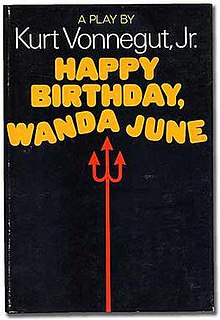
Review: Happy Birthday, Wanda June, by Kurt Vonnegut

Happy Birthday, Wanda June is Kurt Vonnegut's response to the uber-macho values of Ernest Hemingway, whose ideas of manliness involved killing animals for sport. This didn't just include Hemingway's fondness for bullfighting, whose goal is killing bulls as efficiently and elegantly as possible, but also Hemingway's hunting of exotic animals. Vonnegut wonders at the destructiveness of this sort of "heroic" manliness. It's the sort of thing that led to the United States dropping two atomic bombs on Japan. Vonnegut inserts his Hemingway caricature into a modern version of Odysseus, who returns home to a different sort of woman than the Greek hero did. Whether or not this is fair to Hemingway as a person, Vonnegut has nonetheless managed to write a witty, entertaining play, even if it does grow a little too preachy at the end.

Penelope Ryan's husband, Harold Ryan, went on a safari and has been missing for eight years. His son, Paul, was four when Harold left, but Paul worships the father he wished he'd had. Many people, in fact, worship Harold Ryan. That's because Harold is a war hero, having killed hundreds of Nazis, some with his bare hands. The killing didn't stop with the war, however. Harold loved to hunt, but after eight years he had been long assumed dead. Penelope finds herself with two suitors chasing after her: Herb Shuttle, a vacuum salesman who dreams of being Harold, and Dr. Norbert Woodly, who opposes violence of any kind and despises the hunting trophies that still litter the Ryan household. Unlike Homer's Penelope, Vonnegut's Penelope encourages both men, alternating between dates with each one. Paul hates them both, but he hates it even more that nobody seems to care it's his father's birthday.

But then Harold makes his return, along with his friend, Colonel Looseleaf Harper, who is haunted by his decision to drop the first atomic bomb. He just goes along with what others tell him, including Harold. Harold believes that when he returns home, everything will return to normal. And if his wife is a bit hesitant in her enthusiasm, well that's nothing a trip to the bedroom won't cure. In this he is sadly mistaken. Even his son is uncertain of what to make of him. Harold seems to despise his own son, believing him not to be manly enough. He even shoos Paul outside in order to get a chance to be alone with Penelope, but Penelope locks Harold out of the bedroom. She's had a college education and she's gotten different ideas of her husband now. Heroes are the type of people, she says to him, who hate home and try to stay away as often as possible, but when they are home they make "awful messes." That's exactly what Harold Ryan does.

Wanda June is also a character in the play. She's a ghost of a ten-year-old girl who was struck and killed by an ice cream truck. So it goes. She's in the play because Shuttle, wanting to appease Paul's anger over people ignoring his father's birthday, buys a birthday cake. This one was on sale because the little girl's parents didn't pick it up. Wanda June is a ghost in heaven, and heaven is such a great place because people can do anything there. She befriends Major Siegfried von Konigswald, a Nazi officer who is also known as the Beast of Yugoslavia. The Major was killed by Harold Ryan. But he and Wanda June say you shouldn't be mad at people who kill you. In fact, it's so great to be up in heaven that people should kill each other more often. This is obviously satire aimed at the likes of Harold Ryan, who believes that being killed in battle is an honor. It's not, Penelope counters, because being killed means you no longer exist. To the Harold Ryans of the world, dying means going to a heaven where you can play shuffleboard all you want and tornadoes will bounce you around but never hurt you. It's a grand place, so nobody should be upset over a little bit of killing.

Harold Ryan truly is a piece of work. He's the most interesting part of the play because he's such a monster. He has a manliness that's tough not to admire, but a personality that's easy to hate. He treats others with derision. He tells his wife to make breakfast without an ounce of gratitude and toys with the emotions of his son. Nobody is good enough for him. There's a part of Hemingway's own work that Vonnegut seems to be reflecting in Harold Ryan. Hemingway is critical, in his prose, of those who don't fit in with his ideals of manliness, which is hardly anybody. Just think of Robert Cohn, from The Sun Also Rises, and the hatred poured on him by the main character. Harold Ryan is the behind the scenes manly man, who drives several wives to drink themselves to an early grave and is now struggling to keep his current wife in his good graces. Vonnegut's values tend to match our own modern values of gender, where men have a growing role in raising the child and taking care of the home and even, God forbid, cooking and doing laundry. Gasp!

The one problem with the play that I have is its turn into moralizing and explaining at the end. There's a verbal showdown between Woodly and Harold where Woodly explains who Harold is and Harold, unbelievingly, sees himself in a new light, as though the conceited man the audience has grown to hate could be so easily swayed. Not that I am going to ruin what happens, as it isn't quite so predictable as you think. While I do agree with Vonnegut's message, the delivery is too direct. His depiction of Wanda June in heaven is effective because of its subtlety, and Vonnegut should have stuck with subtlety rather than pointedly stating his play's overarching "message." Yet I would still highly recommend this play. It has plenty of moments of witty humor and plenty more moments of tension-filled dialogue. Besides, people should read more, no matter what it is, because then there would be more peace and less killing. Dr. Norbert Woodly would love that.

Monday, June 22, 2015

Review: The Atlantis Gene, by A. G. Riddle

A. G. Riddle's The Atlantis Gene is one of those rare indie success stories in the book publishing world, a first time author whose book just exploded in sales out of nowhere. And now the movie rights have been picked up by CBS. Pretty cool. The biggest reason it's such a success, I would guess, is that it's actually pretty good. It touches on improbable conspiracy theories, blends history with adventure, creates a semi-romance that has some chemistry, and fires it all off in rapid-fire chapters. Sure it's uneven - the mark of a new writer - but the parts that work greatly outweigh those that don't. And while many readers will probably scoff at the use of 9/11 conspiracy, it's difficult to deny the draw of the apocalyptic plot. Riddle disarms his readers with his intensive research while simultaneously making eyes roll with improbable action - and that's all part of the book's charm.

The story rotates between many, many perspectives, but the two main characters are David Vale and Kate Warner. David Vale is an operative within a secret organization called Clocktower. Clocktower has been corrupted, however, by an even larger corporation called Immari, which hides its dirty work behind the veil of some of its many branches, such as research and security. Both of these organizations have branches all around the world, thus the novel's initial setting of Jakarta, Indonesia. Kate Warner is a researcher for Immari. Her research involves finding a cure for autism, and Jakarta's massive population and lax regulations make it an ideal place to do this research. Riddle sets up lab testing on human beings as a lesser of two evils. Autistic children in Jakarta are treated like prison inmates (at least as far as Riddle portrays it), so Kate and her fellow researchers see themselves as doing good. Little does Kate know that her employers have other ideas for her research. Two autistic children from Kate's lab are kidnapped, setting in motion Immari's evil plot.

The early parts of the novel make use of lots of action. David is a very skilled operative, evading Immari and rescuing Kate from their clutches - twice. Blended with this is a lot of talk about the early evolution of mankind. A volcanic eruption on the island of Java, what is deemed the Toba Catastrophe, nearly wiped out the homo sapiens species. For some reason this catastrophe also triggered an evolutionary response that led homo sapiens to drive the other human species to extinction. The trigger of this evolutionary response is at the heart of Riddle's story. Of course, Riddle is not on a scientific mission to solve the mystery/theory of the Toba Catastrophe. He is merely using it as a plot point. The villains in the novel, Dorian Sloane and Mallory Craig, seem to have a good idea of what caused it - a species called the Atlanteans, whose city was submerged in water tens of thousands of years ago.

What's at stake is humanity itself. Immari, we learn, is leading a terrorist attack called the Toba Protocol, which is meant to wipe out most of humanity in order to trigger another evolutionary response. A lot of things that happen in this book will make you cringe and roll your eyes. David explains how Immari is an organization that is tens of thousands of years old and that they were behind the 9/11 attacks instead of Al-Qaeda. Right. David and Kate will fight off hordes of trained soldiers. David will get shot, a lot. There's also a secret weapon shaped like a bell that melts people. The first half of this book is pretty laughable, but it's also hard to put down. But it's the second half that gets surprisingly good. While the events that happen aren't probable, they are, at least, believable. Plus, Riddle does a great job of tying up plot threads and enlightening readers on why things happen way they do.

Riddle's novel will likely remind you of Dan Brown's Da Vinci Code, with its secret societies and improbable conspiracies. His writing style is reminiscent of Dean Koontz, whose novels move so fast you almost don't have time to stop and think. Most of Riddle's chapters end in a flash, and news reports ingeniously fill in some exposition. As fast-paced as the novel is, there are parts that get heavily bogged down in detail and action. This is true at the start and in the middle. Surprisingly it's the discovery of a diary that helps turn the novel from a mediocre work to something better. The novel introduces a new perspective, from 1918, and a new narrative, one that is much more believable and compelling than the main narrative. Yet, this narrative helps elevate the main narrative (that is, after some silly action scenes involving hot air balloons). As more and more mysteries are unlocked, the novel grows more and more compelling. And then you reach the end. Yes, this book is silly, ridiculous, and at times just plain unrealistic, but it's also a lot of fun.

Saturday, June 20, 2015

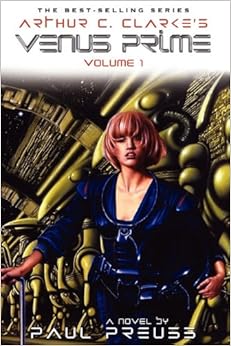
Review: Arthur C. Clarke's Venus Prime Volume One, by Paul Preuss

Venus Prime Volume One is a science fiction thriller/crime drama that borrows so many elements from other genres that it feels disjointed, but that doesn't make it any less intense, philosophical, or intriguing. The author, Paul Preusss borrows heavily from an Arthur C. Clarke short story called "Breaking Strain," and the rest of the stories in the Venus Prime series similarly borrow from Clarke's fiction. The idea behind Clarke's original stories was to imagine human life on Venus, and in writing his stories he discovered challenges he had not originally imagined. Venus, for one, is too hot for human life and it's covered in acid, so people would need to invent special technology to survive there. But there may be some good reasons for people to want to go there - particularly for resources. Preuss's version of Clarke's original stories is an admirable work because of what Preuss adds to it himself, particularly the character of Sparta.

The woman, Sparta, was part of a secret project that sought to enhance human beings using biotechnology. This project failed and Sparta's memory was wiped, but she has since been subject to experimentation and examination by the government agency that started the project. That is, until her doctor decides, out of a sudden act of compassion, to reawaken her memories (minus the past three years or so). She escapes in dramatic fashion by flying a helicopter. Despite her lengthy containment away from the public, she seems to know exactly what to say and what to do to get what she wants. She is able to hack into any computer system using a USB-like device that extends from the tip of her finger. She is also able to break into a car in order to steal the sliver (credit card) from it and buy herself some food and other essentials.

After her escape the story turns to a plot with a wealthy woman named Sondra Sylvester who owns a mining corporation. She has purchased some robots capable of mining on the surface of Venus and wants them shipped there as soon as possible. The trouble is, the next ship to depart, the Star Queen, is still under repairs and the owners are scrambling to get it ready in time. Meanwhile, Sylvester is enjoying her time with her immature, but apparently alluring, partner, Nancybeth. She also has her eyes on a book, a one-of-a-kind item that is only the second-known copy to exist. It's called The Seven Pillars of Wisdom and is worth a good fortune. However, Sylvester is outbid by an old lover, which, frankly, pisses her off. The book becomes entwined in the plot when it is placed on the Star Queen in time for the voyage to Venus.

This stretch of plot is lengthy, and less interesting than Sparta's, and for some time I wondered if Preuss had forgotten about his star character. Fortunately, this is not the case. Sparta makes a life for herself and becomes involved in an investigation that, you might guess, is involved with the Star Queen. The second half of the book takes place on Venus, in Port Hesperus, though I won't reveal much what happens there, except that it turns into an intense police mystery, sort of a buddy cop kind of thing. It's easy to get lost in the details, but Sparta keeps things moving at a brisk pace, always several steps ahead of the audience - but even she makes her mistakes.

What starts out as a Bourne Identity-esque book, with a hero unsure of her identity but having no trouble with her enhanced training/powers, quickly turns into a business drama, and then a philosophical space thriller, and finally a mystery thriller. The best part of this is the third. This takes place on the Star Queen, where only two crew members were placed aboard, despite the customary rule of three. An accident happens, one that makes it impossible for the crew to survive the remainder of the trip. Preuss watches, with fascination, what these two men begin to think and how they behave. We see things from the perspective of the captain, Peter Grant, who makes assumptions about his crewmate, McNeil, that may or may not be wrong. Preuss wonders how a man, one who considers himself morally sound, would begin to act and think when his life is at stake. Two men, with the available oxygen supply, couldn't make the trip. But one - one would survive. How this plays out is intriguing.

But Sparta truly is the star of the show. Here is a woman who is a strong character, not just through technological enhancements, but through her confidence and her personality. It is fun to watch the way she asserts her authority over the case in Venus, making sure the man assigned to her, Viktor Proboda, knows she is in charge. Not that Proboda is your typical macho man; he realizes her competence and grows to admire her. Not only is Sparta competent in times of pressure, she is also very smart, much smarter than most everybody else. It's true she has some unfair advantages due to her tools and gifts, but the kinds of smarts she has come from more than enhanced technology. I enjoyed seeing Sparta's story unfold. She is the perfect sci-fi heroine, and she is the lead character of what has begun as an amazingly entertaining sci-fi series.

Friday, June 19, 2015

Review: Monster, by Walter Dean Myers

"When you make a film, you leave an impression on the viewers, who serve as a kind of jury for your film. If you make your film predictable, they'll make up their minds about it long before it's over."
- Mr. Sawicki, Steve Harmon's film teacher

Watching the life of another human being is like watching a film. You only know what you see onscreen. We judge others based on initial impressions and appearances. For a young black teenager named Steve Harmon, who has been accused as being an accomplice to a murder, this becomes a scary reality as he realizes his fate lies in the hands of a jury of viewers who are trying to decide what kind of person he is and whether he is the kind of person capable of being part of a murder. Simply being black makes this an uphill battle for Steve, as news footage showing pictures and videos of young black men committing murder dominates the media and colors peoples' views of the black population. The prosecution knows this and uses it to their advantage. The goal is to convince the jury that Steve is a monster.

Monster is written from the perspective of Steve Harmon, who is writing it in the form of a movie script. There are voice overs, close-ups, medium shots, long shots, and so on. There's a cast of characters that includes Steve's lawyer, a woman named O'Brien; Steve's friend, also up for murder, James King; King's lawyer, Asa Briggs; the prosecutor, Petrocelli; Steve's mother and father and brother; Steve's film teacher, Mr. Sawicki; the judge, and so on. We see scenes of Steve's past. His interaction with his brother, his conversations with others in the neighborhood, including King. Interspersed amongst his screenplay are journal entries, where Steve searches within his soul to try to learn who he is. The trial has rattled his identity, especially as he realizes that everyone, including his own lawyer, including his own parents, believe that he is a monster.

The trial revolves around the death of a drugstore owner, a middle-aged black man whose own weapon was used against him. The place was robbed of the little bit of cash in the register and a few cartons of cigarettes, which were later sold to people who snitched to the police. Four people were involved. James was the one suspected to have pulled the trigger, while Steve was suspected to have been a lookout. He merely entered the store and left, and his silence was the signal that all was clear. Of course, Steve never admits to doing this. He doesn't want to write anything in his notebook that might indict him. There are indications things did happen the way they did, but the shooting was an accident. Steve perhaps found himself in a situation he didn't want to be in in the first place that went too far. And now he might face 25 years to life.

Though the novel never establishes whether Steve was actually involved in the crime, you can't help but hope the jury does not convict him. Steve is sensitive, and his time in prison would likely be awful. He contemplates suicide, but prisoners aren't allowed to have belts or shoelaces. Myers masterfully keeps the reader distant from Steve, by not allowing us into the events of that eventful day, while at the same time he puts us squarely in his shoes, facing his fears and feeling his isolation. This is especially apparent when Steve realizes that his father now looks at him differently, and when his own lawyer fails to develop any sort of bond with him - for her it's probably just a paycheck. At one point, a young black juror smiles at him, but when he returns her smile, she looks away as if remembering who he is, and we can understand Steve's despair.

Though I've only read three of Myers' novels now (and sadly he has passed away), I admire his experimentation with genre. Of the three books I have read, Fallen Angels was the only one that was a traditional narrative. Shooter is a multigenre work, a mix of diary entries, interviews, newspaper clippings, and police reports, all combined to create the whole story. Monster is a screenplay, though not strictly a screenplay, as it also has pictures and Steve's personal thoughts. While the screenplay portion feels distant, focusing solely on the trial, it's through the diary entries that the book is more intimate with Steve. This technique also keeps us distant from the other defendant, James King, who may or may not have done what he was accused of, but it seems likely he pushed Steve into doing something Steve didn't want to do.

People of privilege have trouble bringing themselves into the perspective of those who lack that same privilege. In the closing statements, the prosecutor, Petrocelli, says of James King, "If he had chosen priests and Boy Scouts as his companions, I'm sure we wouldn't be here today." The key word here is "chosen." Petrocelli believes James and Steve had this choice to make, probably because in her own experience this was a viable choice. It's easy to believe that you get to choose the people you associate with when you have the privilege to make that choice. But the reality is, even for those who do have a life of privilege, you don't necessarily choose who you associate with and you don't always choose where your life ends up taking you. Time and place are key. For Steve, being a young black man in a poor neighborhood, his choices are limited, as the likes of King prowl around and seek to use him for his own gains. Steve's choices are limited to incurring the wrath of the likes of King or doing as they bid and feeling accepted. Monster is one of those books that should be read by everyone, white or black, because it allows us to see from the perspective of a demonized young man like Steve Harmon and realize that he is not a monster.

Wednesday, June 17, 2015

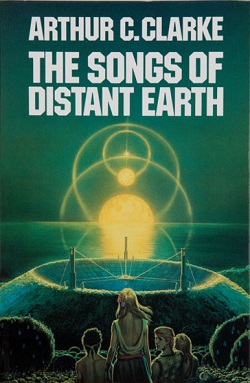
Review: The Songs of Distant Earth, by Arthur C. Clarke

With The Songs of Distant Earth, Arthur C. Clarke wanted to tell a realistic science fiction story about long distance space travel and interplanetary relations. It was written partly in reaction to the fantasy science fiction of Star Trek and Star Wars, which were both popular when Clarke wrote this. Star Trek and Star Wars are great entertainment, mainly because they have some excellent stories and enjoyable characters. The Songs of Distant Earth does not have a very engaging cast of characters, nor does it have a particularly engaging storyline. It's at its best, however, when it makes readers pause to think about such wonders as the realities of space travel or the terror of a helpless population facing inevitable destruction by the expanding sun. This isn't a despairing novel, however, but one of hope and faith in the adaptability of the human race.

In Clarke's fictional tale, 20th century scientists discover signals radiating from the sun that predict its demise by the year 4000. This didn't alarm most of humanity right away, but as time advanced nearer, people realized they needed to act more quickly. Scientists sought out planets that might sustain human life if conditioned just right. Seedships were sent out, commandeered by robots and stocked with all of the pertinent knowledge these new men and women would need to know in order to begin again. These planets were hundreds of years away, so humanity had to be patient to await the news of success. Meanwhile, scientists were frantically trying to figure out faster means of space travel and people were growing increasingly hedonistic, or increasingly religious, whichever suited their needs.

The planet of Thalassa was one such planet chosen for colonization, and with the exception of a tiny landmass, it was a perfect place. It was among the first, colonized in about 2900, and surviving still for 700 years due to its wise leaders and non-violent people. Population control measures were also necessary to reduce strain on the planet's resources. Among the Thalassans is Brant, an engineer who is frustrated that his fish traps keep getting sabotaged. Mirissa is his girlfriend, and she, it seems, is also the most knowledgeable Thalassan on the planet, having read most everything handed down from the mothership (where they originated). Mayor Waldron is a middle-aged lady who oversees South Island, and she also has a sexual appetite with a special interest in Brant.

One day this planet's peaceful operations are interrupted by the visitation of an alien ship. From this ship step two men who claim they have come from Earth. These men are Loren Lorenson, ship commander, and Moses Kaldor, ship ambassador. Apparently Earth did figure out how to create improved space travel using the quantum drive. The quantum drive uses the vacuum of space to propel it forward and can move for an unlimited amount of time. It can't approach the speed of light, just one-twenthieth of the speed of light, and that's one of the points Clarke wanted to make. People cannot approach the speed of light. That means no warp speed a la Star Trek or Star Wars. After 200 years of travel the ship, called the Magellan, arrives at Thalassa because it needs ice. Yes, ice. Ice is the best asteroid shield in space, but after 200 years of travel the crew of the Magellan are worried they don't have enough of a shield to make it to their destination, still 300 years away, of Sagan Two.

So the humans from Earth and the Thalassans socialize together as the Magellan does its work of making ice and raising it to form the ice shield, a two year process. This is where the novel becomes less compelling, broken into a series of mini-events, most of them unconnected. Loren and Mirissa of course fall in love, but Brant doesn't seem too upset about this. There's a discovery of some strange lobster creature in the sea, Mayor Waldron hitting on Loren, a mutiny aboard the Magellan, conversations between Moses and Mirissa about Earth, Mirissa's brother Kumar developing a close bond with Loren, and so on and so forth. The drama is hardly compelling and mostly boring. These people are way too nice. This is great
for the hopes for humanity's future, to be sure, but when I'm reading a novel I want a little more tension, conflict, and cohesion than this novel has to offer.

So while Clarke offers this up as a realistic version of those fantasy sci-fi blockbusters of Star Wars and Star Trek, it is hardly their equal. The story is very compelling for the first third, on and off compelling for the next third, and then dull for the last third. I can understand and appreciate a good sci-fi story that doesn't make use of lightsabers and phasers set to stun and amped-up action scenes. I can appreciate a good piece of speculative fiction, giving realistic thought to what could possibly happen to humanity in case the sun blew up. It's a frightening thought to see that everything mankind has created could just melt away, but there is some comfort in realizing that doesn't have to be the end. Mankind just might be able to continue on after all. There was a part of me, while reading this, that wanted to be among the crew of the Magellan, hibernating for hundreds of years and waking up to find myself in a whole new world, and that's how evocative this novel was when it came to its big ideas.