Monday, June 29, 2015

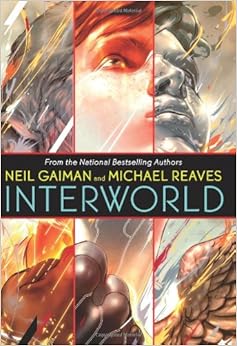
Review: Interworld, by Neil Gaiman and Michael Reaves

An interesting tidbit in the book's "Afterword" mentions that Interworld was originally planned as a television series in the mid-90s. That idea was scrapped however, as there was concern over the audience base, and the story was later written into a young adult novel in 2007 (and a now completed trilogy). That concern over the audience is legitimate, as authors Neil Gaiman and Michael Reaves can't seem to decide whether to aim this at a younger audience or an older audience. On one hand, the science behind the story is surprisingly complex. It's so complex that there were several passages that went way over my head, but those were the moments that intrigued me the most. On the other hand, the plot goes the usual way of young adult action stories, with paper-thin characters and an improbable showdown between the good guys and bad guys. If Gaiman and Reaves stuck with one or the other, they may have had something.

Gaiman fans may recall Neverworld as they read Interworld, as both stories are about a character who somehow has the ability to travel to parallel worlds. In Interworld, that character is Joey Harker, a high school student who has absolutely no sense of direction. That is, until he realizes he has the ability to Walk. Walking means to travel between the different parallel universes through a space called the In-Between. To Walk requires an innate ability to understand the In-Between, which Joey has. He doesn't realize this until the day of his social studies final exam, given by his teacher, Mr. Dimas, whose teaching methods seem questionable. The exam puts students into groups, blindfolds them, and sets them off into a random part of town, from which they must make their way back to school. Joey, of course, gets lost, and in his panic, he Walks.

During his Walking, Joey bumps into an armored stranger who wants him to follow him. Panicked yet again, Joey flees and Walks into another group of strangers who use magic to put him under their spell. This is when we learn who the first stranger is. His name is Jay, and it is his recorded journal entry that changes the novel from mundane young adult fiction into something much more interesting and complex. Joey Harker's ability to Walk is not his alone, or maybe it is, but also the infinite versions of Joey Harkers that exist in all of the parallel universes. Jay is one of these. These Joey Harkers have different names, all beginning with the letter J, and some are different sexes and others are different species (one has wings, one is like a werewolf, one is a cyborg), and all are different shapes and sizes. Joey, amongst all of these, is the plainest, but, oddly enough, plainness is usually what makes one a hero in stories like this.

Jay rescues Joey and, after some plot turns I won't reveal, gets him back to the home world, the Interworld, a base that floats from universe to universe, untrackable except by Walkers. Here we learn that the construct of the Altiverse (which contains the infinite universes that frequently pop up) is like a spectrum. Instead of our political spectrum of left and right (democrat and republican), the spectrum falls between magic and science. Some worlds are entirely magical, and these worlds produce persons who can use magic. The worlds based on science produce very sophisticated technology. Then there are worlds in between, that have a little of both. Our Earth would fall more in the science side, but close to the middle of the spectrum. This spectrum is important, because a balance must be kept. However, two organizations, HEX and Binary, fight to make the Altiverse fit squarely into only one side, science or magic. Interworld's job is to make sure the balance remains intact. Thus we have themes of not just science vs. spirituality, but the damage wrought by humanity's turn to extremes.

The story is peopled with many characters, though none are very complex. Just as is the case for many young adult adventure stories, most of the characters are just names with one character trait, and even Joey is paper-thin for a hero. It seems Gaiman could have made a much more interesting story out of one of the other versions of Joey, such as J/O, the cyborg with a Napoleon complex; or Jo, the winged girl; or Jakon, the werewolf girl; or Josef, the tanky kid whose version of Earth has a very strong gravity. The most interesting character of all is Hue, a mudluff, or a creature that resides in the In-Between. The In-Between is apparently peopled with mudluffs, who are supposedly dangerous, but Hue is the only one we meet, and he is hardly dangerous. Hue is a bubble-like creature who can change colors, which is how he communicates. He grows loyal to Joey and also serves as a plot device to move the story forward at several key moments. It's difficult to imagine the story working without Hue.

The main trouble with the story, however, is choosing its audience. It begins with the young adult audience in mind, with a kid worried about impressing a girl clearly not interested in him, and the usual teenage concerns written into such stories. Then the story grows more thematically complex, and it dives pretty deep into the science behind parallel universes, as Joey gets some schooling in Interworld, a la Harry Potter in Hogwarts. In this stretch there were moments of humor and moments of philosophy, and also a surprisingly touching moment involving Joey's mother. But then the story leaves behind the complexity and dives yet again into the young adult story formula. Not that I mean to degrade the young adult genre, but there are certain conventions some authors use that clearly mark a story as young adult, and those conventions are so predictable that it is difficult for adults to enjoy. That's where Interworld heads, which is a shame. I was beginning to feel that this was going to be another masterwork from Gaiman, but instead grew disappointed.

So who does this appeal to? Not to adults who would like something more from the plot, and not to teenagers who may grow bored with the lengthy passages dealing with the science. It's a very strange novel, in that regard, and makes me wish that authors didn't aim to make a story young adult, but trusted in the ability for young adults to enjoy a good story. Gaiman's Graveyard Book is aimed at young adults, but is written in such a way that adults can enjoy it as well. The misstep in Interworld is Gaiman and Reaves' belief that teenagers could be smart enough to understand or enjoy the science, but without realizing that teenagers that smart would also desire something more than the easy-to-predict storyline. This paradox makes it difficult for me to know who to recommend the novel to, except fans of Gaiman who are willing to read anything he writes.

Saturday, June 27, 2015

Review: Gone Girl, by Gillian Flynn


Gone Girl has been talked about so much that it's difficult to begin reading the book (or watching the movie) without having an inkling of what is going to happen. It is well-known, then, that the story has a twist, and for those with any semblance of prediction ability, the possibilities for the twist in the story are limited. When I began reading the story, I began with an idea of what this twist was and I was not surprised when it happened. What did surprise me was the boldness of the ending. I will try my best not to give away any details that reveal any twists, but the nature of the book makes it difficult to write about without making any future readers suspicious of what this twist may be. Regardless of whether you know the twist or not, this book is engaging and thrilling from beginning to end.

Nick and Amy Dunne wed five years ago, and it seemed like the perfect match. Both were good-looking, and both found each other exciting. Fast-forward five years, and things are much less than perfect. Nick comes home one day to find the front door wide open, furniture strewn about the house, and his wife missing. The police get involved and right away it's clear that Nick is the number one suspect. The husband is always the top suspect because murders are most often committed by those closest to the victim. Flynn expertly puts us in the perspective of Nick while keeping him at arm's length. We want to believe and trust him, but as events unfold, we clearly cannot trust him.

Meanwhile, the story shares Amy's perspective in the form of diary entries. The diaries begin at the start of the relationship and tell an exciting, happy time. As time unfolds, however, we see problems in the marriage. Nick skipping an anniversary dinner to have drinks with friends and then getting upset with Amy for her disappointment. Nick losing his job. Amy's insecurities with being the titular character of her parents' set of youth books called the Amazing Amy series. As the years go by, the relationship grows more and more miserable.

And yet, all I will say, is the novel is not about one unreliable narrator, but two. That's the nature of diary entries. We are getting the story from one person, and even in Amy's descriptions, one can't help but feel she isn't all she says she is. She says she tries her best to be the cool wife who won't disapprove of Nick coming home late, but she comes off, in some ways, as the passive aggressive wife who is upset by this but only communicates it through her silence. And Nick is caught up in lie after lie. Sure, he admits to the reader that he has lied, but he does not say what he has lied about. And perceptive readers will catch on to some information he is leaving out. He often seems fearful of being found out about something possibly incriminating, but he never says what it is, not even in the confidence of the reader, who can't possibly report that information to the police.

Then the novel drops its bombshell. When other novels lay out their big plot twists, it usually means the story is coming to an end. In this case, however, it is just the beginning. The novel doesn't slow down its momentum - it gains momentum. From this moment forward it challenges its readers in their values and their beliefs about what they think they know about missing persons and murder cases like this one. Do you trust what the media tells you? Do you trust the way the media portrays certain people? In most cases, we do trust the media. The media is a powerful, influential force, and it exerts its power by creating a narrative of events even if it doesn't have all of the facts. Rolling Stone magazine had the nation believing, for some time, that the University of Virginia allowed one of its fraternities to get away with gang rape, only for an investigation to later reveal that Rolling Stone hadn't done its fact-checking and the rape likely didn't happen. The gang rape was Rolling Stone's narrative, but it was a false narrative. Gone Girl makes us wonder whether there really is a way to objectively tell a story.

Gone Girl will make you think about issues of trust, of relationships (in particular marriage), of narratives, of the thin line between good and evil, of how media helps shape that line, and of so many things. Her novel may make you angry, and I honestly can't think of any reason somebody will be completely satisfied with the ending, though I don't mean this in a bad way. You will be challenged constantly. You will be thrilled and excited by the intense chess match that plays out. You will be amazed by the wits of its major characters. Ultimately you will be angry. I'm still reeling a little bit, but as with many inevitable things in life, you have no choice but to settle with the fact that evil is unavoidable, no matter how blatantly obvious it is.

Friday, June 26, 2015

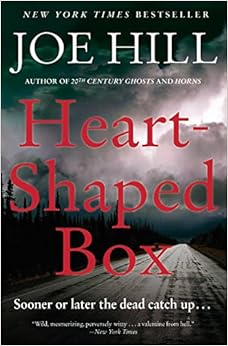
Review: Heart-Shaped Box, by Joe Hill

Joe Hill is nearly the spitting image of his father with Heart-Shaped Box, a ghostly thriller with the same sort of villains and dialogue Stephen King might have written. I've already read Horns, so I know Joe Hill has his own style, and I believe he will grow into an excellent horror writer with unique ideas. Heart-Shaped Box isn't quite as good as Horns, as it suffers from habits I'm worried could bog down some of Hill's later works. For one, Hill loves to give background information. He allows background information to take over the main plot where just a little bit of background information might have been more effective. It's a shame, too, because the novel has lots of promise at the start and even gets good again towards the end.

Judas Coyne, known as Jude, has retired from the heavy metal lifestyle after members of his band passed away due to one cause or another. Still filthy rich, Jude collects grotesque objects, such as a five-hundred-year-old peasant skull and a three-hundred-year-old confession signed by a witch. He also owns a video of a gang suffocating a couple (and it's this video that understandably precipitates his divorce). Jude even collects women and names them after states like Florida and Georgia. These women, like Jude, also love the grotesque, dressing in the Goth fashion of black hair, lipstick, and fingernails. Jude's obsession with grotesque objects eventually leads him to purchase a ghost.

Now, he doesn't directly purchase the ghost. He purchases a suit that belonged to the deceased. This suit is shipped to him in a heart-shaped box. His dogs, Angus and Bon, don't like it. His girlfriend, Georgia, doesn't like it either. Jude himself begins to dislike it when a creepy old man with a razor-sharp pendulum begins to make an appearance. Eventually, Jude's secretary, named Danny, drives himself to suicide, and it seems clear that this ghost is out to kill Jude and everyone he loves. Jude discovers that this ghost is the grandfather of Jude's troubled ex-girlfriend, Florida, who apparently committed suicide not long after Jude kicked him out. So the ghost is out for revenge, right?

The story goes back and forth between Jude and Georgia's escape from the ghost to background information about Jude's past, namely his relationship with Florida (the woman, not the state). It's not that this background is bad, per se, but it delves too far and takes on improvised characteristics, where revelations from the past help form plot points in the present. This seems lazy, the way that Jude suddenly remembers important things with perfect clarity. There is a lot of emotional power in what happens in the story, but the improvised feeling takes away the emotional impact from these events. Florida, anyway, is not the one we were following from the start. It is Jude and Georgia we care about, but their stories are sidelined. Hill had a similar problem with Horns, which has a terrific opening, but then stalls with a needlessly long background story.

Hill does write some powerful passages of horror. His description of the ghost, Craddock, is his best work in the whole story. Craddock is what makes the story interesting, since Jude and Georgia fail to have an intriguing personality despite their anti-social tendencies. When Craddock first appears, the imagery Hill uses is haunting. At that point I thought that I was in for a treat. Unfortunately, Hill never replicates that horror. There are some moments of fear for the lives of the main characters, and some moments of awful violence. But, as threatening as the ghost is, he disappears and reappears at the convenience of the plot. He is there, however, just enough to let us know this will end in death, his or theirs. At least something big is at stake.

In his first two novels, Hill displays a love of music. Heart-Shaped Box is devoted almost entirely to heavy metal/rock n' roll. The references to rock bands are everywhere. Jude's own name is an obvious reference to The Beatles (a band Ig in Horns loved a lot, and a band King also adores). Nirvana is another reference, and there is also mention of the Foo Fighters, Metallica, and others. It's disappointing this music doesn't have a very big impact on the plot. It seems that Hill missed an opportunity that his novel's title promised. Hill clearly wants to aim for something unique, but his heavy focus on background information grounds him in conventional plotting. His story is well-organized and it plods along slowly and deliberately, like a storyteller who wants to take his time and let the story live on as long as he can - just as Jude clings to life. These are the tells of a good storyteller, and I hope Hill has his breakout moment soon. It would be nice to have a new horror writer to look forward to for another generation.

Wednesday, June 24, 2015

Review: Time Cat, by Lloyd Alexander

Time Cat is Lloyd Alexander's tribute to the cat. Throughout the book, which covers many different places and periods of time, cats are worshiped, desired, and, in one case, feared. Cats teach people many different lessons, or they inspire them to do greater things, or they are simply admired for their beauty, grace, and playful nature. This is a book aimed at a young adult audience, combining the cuteness and desirability of the cat with a little bit of history. Alexander is keenly observant about the behavior of the cat, and the effect this behavior has on people, and his goal seems to get youths interested in history by showing them the universal appeal of the cat, no matter the time period.

Jason one day wishes he could speak to his cat, Gareth, and Gareth one-ups him: he tells the boy that he can visit. Visit? Essentially Gareth can travel through time. Jason, naturally, wants to see this, so Gareth promises to take him with him to a few places, with a warning that he will be unable to protect him from what might happen. The first place they go to isn't the time of dinosaurs, which I imagine would be the first place most kids Jason's age would want to go. No, first is Egypt, where cats are regarded as godly. Jason and Gareth are captured, as they will be many times throughout their adventures, and they learn that the pharaoh, Neter-Khet, has long wanted a cat companion. What he wants this cat to do is worship him. Jason (who through magic can understand and speak his language) informs Neter-Khet that cats do not worship. Cats do as they please. Neter-Khet gradually understands and learns to enjoy the small things about cat companionship - that there are few things so joyful as a cat purring on your lap, for example.

Gareth also takes Jason to Rome (55 B.C.), Britain, Ireland (411 A.D.), Japan (998 A.D.), along with Italy, Peru, and America, among some others, during important historical times. These stories don't focus on the political side of history, but rather on the human aspects: people merely trying to find joy or trying to escape hardship. Many of the plots focus on a leader who has been seeking the companionship of a cat. The Japanese emperor, a boy, has long wanted a cat. The captain of a Spanish army in Peru has ordered a cat from Spain and believes Gareth is it. Even Leonardo da Vinci shows up, and it is Gareth who inspires an early painting. Alexander makes these historical figures human by demonstrating their awe of cats. He also paints a small picture of the sort of habitats the people live in, describing the homes and even some of the hobbies of the people. The history may be skimpy, but at least young readers can connect with the people in these historical times as people and not as statistics.

Jason is a very important character, not just because he is the main character, but because he is both curious and intelligent. He never once compares the time or place he is in to the one that he has lived his entire life. He views it, rather, as a sort of vacation. Time Cat was written in 1963, so I can only imagine a modern equivalent, with a boy hooked to his smart phone and video games being sent on this journey. Would that boy react the same way as Jason, or would he be more like the boy in Willy Wonka, missing his technology? I imagine most people today would be reaching for their smart phones to capture pictures if they were in Jason's place, finding something to post to Instagram or Facebook. Jason, on the other hand, seems content to simply be a part of the experience. This in itself is a great lesson.

Tuesday, June 23, 2015

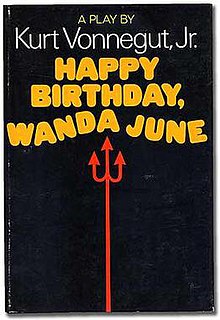
Review: Happy Birthday, Wanda June, by Kurt Vonnegut

Happy Birthday, Wanda June is Kurt Vonnegut's response to the uber-macho values of Ernest Hemingway, whose ideas of manliness involved killing animals for sport. This didn't just include Hemingway's fondness for bullfighting, whose goal is killing bulls as efficiently and elegantly as possible, but also Hemingway's hunting of exotic animals. Vonnegut wonders at the destructiveness of this sort of "heroic" manliness. It's the sort of thing that led to the United States dropping two atomic bombs on Japan. Vonnegut inserts his Hemingway caricature into a modern version of Odysseus, who returns home to a different sort of woman than the Greek hero did. Whether or not this is fair to Hemingway as a person, Vonnegut has nonetheless managed to write a witty, entertaining play, even if it does grow a little too preachy at the end.

Penelope Ryan's husband, Harold Ryan, went on a safari and has been missing for eight years. His son, Paul, was four when Harold left, but Paul worships the father he wished he'd had. Many people, in fact, worship Harold Ryan. That's because Harold is a war hero, having killed hundreds of Nazis, some with his bare hands. The killing didn't stop with the war, however. Harold loved to hunt, but after eight years he had been long assumed dead. Penelope finds herself with two suitors chasing after her: Herb Shuttle, a vacuum salesman who dreams of being Harold, and Dr. Norbert Woodly, who opposes violence of any kind and despises the hunting trophies that still litter the Ryan household. Unlike Homer's Penelope, Vonnegut's Penelope encourages both men, alternating between dates with each one. Paul hates them both, but he hates it even more that nobody seems to care it's his father's birthday.

But then Harold makes his return, along with his friend, Colonel Looseleaf Harper, who is haunted by his decision to drop the first atomic bomb. He just goes along with what others tell him, including Harold. Harold believes that when he returns home, everything will return to normal. And if his wife is a bit hesitant in her enthusiasm, well that's nothing a trip to the bedroom won't cure. In this he is sadly mistaken. Even his son is uncertain of what to make of him. Harold seems to despise his own son, believing him not to be manly enough. He even shoos Paul outside in order to get a chance to be alone with Penelope, but Penelope locks Harold out of the bedroom. She's had a college education and she's gotten different ideas of her husband now. Heroes are the type of people, she says to him, who hate home and try to stay away as often as possible, but when they are home they make "awful messes." That's exactly what Harold Ryan does.

Wanda June is also a character in the play. She's a ghost of a ten-year-old girl who was struck and killed by an ice cream truck. So it goes. She's in the play because Shuttle, wanting to appease Paul's anger over people ignoring his father's birthday, buys a birthday cake. This one was on sale because the little girl's parents didn't pick it up. Wanda June is a ghost in heaven, and heaven is such a great place because people can do anything there. She befriends Major Siegfried von Konigswald, a Nazi officer who is also known as the Beast of Yugoslavia. The Major was killed by Harold Ryan. But he and Wanda June say you shouldn't be mad at people who kill you. In fact, it's so great to be up in heaven that people should kill each other more often. This is obviously satire aimed at the likes of Harold Ryan, who believes that being killed in battle is an honor. It's not, Penelope counters, because being killed means you no longer exist. To the Harold Ryans of the world, dying means going to a heaven where you can play shuffleboard all you want and tornadoes will bounce you around but never hurt you. It's a grand place, so nobody should be upset over a little bit of killing.

Harold Ryan truly is a piece of work. He's the most interesting part of the play because he's such a monster. He has a manliness that's tough not to admire, but a personality that's easy to hate. He treats others with derision. He tells his wife to make breakfast without an ounce of gratitude and toys with the emotions of his son. Nobody is good enough for him. There's a part of Hemingway's own work that Vonnegut seems to be reflecting in Harold Ryan. Hemingway is critical, in his prose, of those who don't fit in with his ideals of manliness, which is hardly anybody. Just think of Robert Cohn, from The Sun Also Rises, and the hatred poured on him by the main character. Harold Ryan is the behind the scenes manly man, who drives several wives to drink themselves to an early grave and is now struggling to keep his current wife in his good graces. Vonnegut's values tend to match our own modern values of gender, where men have a growing role in raising the child and taking care of the home and even, God forbid, cooking and doing laundry. Gasp!

The one problem with the play that I have is its turn into moralizing and explaining at the end. There's a verbal showdown between Woodly and Harold where Woodly explains who Harold is and Harold, unbelievingly, sees himself in a new light, as though the conceited man the audience has grown to hate could be so easily swayed. Not that I am going to ruin what happens, as it isn't quite so predictable as you think. While I do agree with Vonnegut's message, the delivery is too direct. His depiction of Wanda June in heaven is effective because of its subtlety, and Vonnegut should have stuck with subtlety rather than pointedly stating his play's overarching "message." Yet I would still highly recommend this play. It has plenty of moments of witty humor and plenty more moments of tension-filled dialogue. Besides, people should read more, no matter what it is, because then there would be more peace and less killing. Dr. Norbert Woodly would love that.

Monday, June 22, 2015

Review: The Atlantis Gene, by A. G. Riddle

A. G. Riddle's The Atlantis Gene is one of those rare indie success stories in the book publishing world, a first time author whose book just exploded in sales out of nowhere. And now the movie rights have been picked up by CBS. Pretty cool. The biggest reason it's such a success, I would guess, is that it's actually pretty good. It touches on improbable conspiracy theories, blends history with adventure, creates a semi-romance that has some chemistry, and fires it all off in rapid-fire chapters. Sure it's uneven - the mark of a new writer - but the parts that work greatly outweigh those that don't. And while many readers will probably scoff at the use of 9/11 conspiracy, it's difficult to deny the draw of the apocalyptic plot. Riddle disarms his readers with his intensive research while simultaneously making eyes roll with improbable action - and that's all part of the book's charm.

The story rotates between many, many perspectives, but the two main characters are David Vale and Kate Warner. David Vale is an operative within a secret organization called Clocktower. Clocktower has been corrupted, however, by an even larger corporation called Immari, which hides its dirty work behind the veil of some of its many branches, such as research and security. Both of these organizations have branches all around the world, thus the novel's initial setting of Jakarta, Indonesia. Kate Warner is a researcher for Immari. Her research involves finding a cure for autism, and Jakarta's massive population and lax regulations make it an ideal place to do this research. Riddle sets up lab testing on human beings as a lesser of two evils. Autistic children in Jakarta are treated like prison inmates (at least as far as Riddle portrays it), so Kate and her fellow researchers see themselves as doing good. Little does Kate know that her employers have other ideas for her research. Two autistic children from Kate's lab are kidnapped, setting in motion Immari's evil plot.

The early parts of the novel make use of lots of action. David is a very skilled operative, evading Immari and rescuing Kate from their clutches - twice. Blended with this is a lot of talk about the early evolution of mankind. A volcanic eruption on the island of Java, what is deemed the Toba Catastrophe, nearly wiped out the homo sapiens species. For some reason this catastrophe also triggered an evolutionary response that led homo sapiens to drive the other human species to extinction. The trigger of this evolutionary response is at the heart of Riddle's story. Of course, Riddle is not on a scientific mission to solve the mystery/theory of the Toba Catastrophe. He is merely using it as a plot point. The villains in the novel, Dorian Sloane and Mallory Craig, seem to have a good idea of what caused it - a species called the Atlanteans, whose city was submerged in water tens of thousands of years ago.

What's at stake is humanity itself. Immari, we learn, is leading a terrorist attack called the Toba Protocol, which is meant to wipe out most of humanity in order to trigger another evolutionary response. A lot of things that happen in this book will make you cringe and roll your eyes. David explains how Immari is an organization that is tens of thousands of years old and that they were behind the 9/11 attacks instead of Al-Qaeda. Right. David and Kate will fight off hordes of trained soldiers. David will get shot, a lot. There's also a secret weapon shaped like a bell that melts people. The first half of this book is pretty laughable, but it's also hard to put down. But it's the second half that gets surprisingly good. While the events that happen aren't probable, they are, at least, believable. Plus, Riddle does a great job of tying up plot threads and enlightening readers on why things happen way they do.

Riddle's novel will likely remind you of Dan Brown's Da Vinci Code, with its secret societies and improbable conspiracies. His writing style is reminiscent of Dean Koontz, whose novels move so fast you almost don't have time to stop and think. Most of Riddle's chapters end in a flash, and news reports ingeniously fill in some exposition. As fast-paced as the novel is, there are parts that get heavily bogged down in detail and action. This is true at the start and in the middle. Surprisingly it's the discovery of a diary that helps turn the novel from a mediocre work to something better. The novel introduces a new perspective, from 1918, and a new narrative, one that is much more believable and compelling than the main narrative. Yet, this narrative helps elevate the main narrative (that is, after some silly action scenes involving hot air balloons). As more and more mysteries are unlocked, the novel grows more and more compelling. And then you reach the end. Yes, this book is silly, ridiculous, and at times just plain unrealistic, but it's also a lot of fun.

Saturday, June 20, 2015

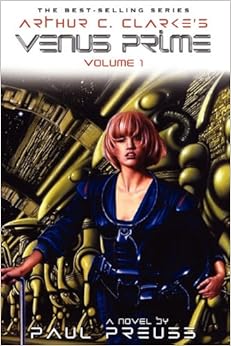
Review: Arthur C. Clarke's Venus Prime Volume One, by Paul Preuss

Venus Prime Volume One is a science fiction thriller/crime drama that borrows so many elements from other genres that it feels disjointed, but that doesn't make it any less intense, philosophical, or intriguing. The author, Paul Preusss borrows heavily from an Arthur C. Clarke short story called "Breaking Strain," and the rest of the stories in the Venus Prime series similarly borrow from Clarke's fiction. The idea behind Clarke's original stories was to imagine human life on Venus, and in writing his stories he discovered challenges he had not originally imagined. Venus, for one, is too hot for human life and it's covered in acid, so people would need to invent special technology to survive there. But there may be some good reasons for people to want to go there - particularly for resources. Preuss's version of Clarke's original stories is an admirable work because of what Preuss adds to it himself, particularly the character of Sparta.

The woman, Sparta, was part of a secret project that sought to enhance human beings using biotechnology. This project failed and Sparta's memory was wiped, but she has since been subject to experimentation and examination by the government agency that started the project. That is, until her doctor decides, out of a sudden act of compassion, to reawaken her memories (minus the past three years or so). She escapes in dramatic fashion by flying a helicopter. Despite her lengthy containment away from the public, she seems to know exactly what to say and what to do to get what she wants. She is able to hack into any computer system using a USB-like device that extends from the tip of her finger. She is also able to break into a car in order to steal the sliver (credit card) from it and buy herself some food and other essentials.

After her escape the story turns to a plot with a wealthy woman named Sondra Sylvester who owns a mining corporation. She has purchased some robots capable of mining on the surface of Venus and wants them shipped there as soon as possible. The trouble is, the next ship to depart, the Star Queen, is still under repairs and the owners are scrambling to get it ready in time. Meanwhile, Sylvester is enjoying her time with her immature, but apparently alluring, partner, Nancybeth. She also has her eyes on a book, a one-of-a-kind item that is only the second-known copy to exist. It's called The Seven Pillars of Wisdom and is worth a good fortune. However, Sylvester is outbid by an old lover, which, frankly, pisses her off. The book becomes entwined in the plot when it is placed on the Star Queen in time for the voyage to Venus.

This stretch of plot is lengthy, and less interesting than Sparta's, and for some time I wondered if Preuss had forgotten about his star character. Fortunately, this is not the case. Sparta makes a life for herself and becomes involved in an investigation that, you might guess, is involved with the Star Queen. The second half of the book takes place on Venus, in Port Hesperus, though I won't reveal much what happens there, except that it turns into an intense police mystery, sort of a buddy cop kind of thing. It's easy to get lost in the details, but Sparta keeps things moving at a brisk pace, always several steps ahead of the audience - but even she makes her mistakes.

What starts out as a Bourne Identity-esque book, with a hero unsure of her identity but having no trouble with her enhanced training/powers, quickly turns into a business drama, and then a philosophical space thriller, and finally a mystery thriller. The best part of this is the third. This takes place on the Star Queen, where only two crew members were placed aboard, despite the customary rule of three. An accident happens, one that makes it impossible for the crew to survive the remainder of the trip. Preuss watches, with fascination, what these two men begin to think and how they behave. We see things from the perspective of the captain, Peter Grant, who makes assumptions about his crewmate, McNeil, that may or may not be wrong. Preuss wonders how a man, one who considers himself morally sound, would begin to act and think when his life is at stake. Two men, with the available oxygen supply, couldn't make the trip. But one - one would survive. How this plays out is intriguing.

But Sparta truly is the star of the show. Here is a woman who is a strong character, not just through technological enhancements, but through her confidence and her personality. It is fun to watch the way she asserts her authority over the case in Venus, making sure the man assigned to her, Viktor Proboda, knows she is in charge. Not that Proboda is your typical macho man; he realizes her competence and grows to admire her. Not only is Sparta competent in times of pressure, she is also very smart, much smarter than most everybody else. It's true she has some unfair advantages due to her tools and gifts, but the kinds of smarts she has come from more than enhanced technology. I enjoyed seeing Sparta's story unfold. She is the perfect sci-fi heroine, and she is the lead character of what has begun as an amazingly entertaining sci-fi series.