Kurt Vonnegut wrote his most well-known works less than two decades after George Orwell published 1984, yet the themes between Orwell's work and Cat's Cradle are very similar: the consequences of the existence of nuclear weaponry. Orwell's biggest fear was that nuclear war would pave the way for authoritarian governments to rule the world. Vonnegut's biggest fear, however, was that nuclear war would lead to the annihilation of the human race. In the face of complete devastation, what is the meaning of life? Vonnegut's characters, and perhaps even Vonnegut himself, struggles with this nihilistic attitude. They, like all of us, would like to believe life has a greater meaning.
The story is told by John, in the first person, as he attempts to write a novel titled The Day the World Ended. The novel's opening line establishes its struggle with nihilism: "Call me Jonah." This is an obvious reference to Moby-Dick's opening line, "Call me Ishmael." Except in this case, the main character isn't really named Jonah, but John, suggesting he has a desire for a name fraught with Biblical meaning instead of a common name with no meaning.
John's quest is to learn everything he can about the father of the atom bomb, Felix Hoenikker. Felix is dead, but he has left behind three children: Frank, who has disappeared; Angela, who was forced to live much of her life as a caretaker of her father; and Newt, who was born a dwarf and has artistic aspirations. John writes letters to Newt in order to learn what it was like at the Hoenikker house the day the bomb was dropped. Turns out it was just an ordinary day. John also visits Dr. Breed, Felix's supervisor, and from him learns about a mythical weapon Felix imagined called Ice-Nine. Ice-Nine would be capable of freezing all bodies of water at once, depriving the world of what it needs to sustain life. What Dr. Breed didn't know was that Felix actually did create Ice-Nine.
Just as Vonnegut makes up an alien species in Slaughterhouse-Five, he makes up a religion in Cat's Cradle. This religion is Bokononism, founded by Bokonon, whose purpose is to show that people can be made to feel good by a religion based on lies. The Book of Bokonon warns that its teachings and writings are nothing but lies, but John, much like the rest of the followers of Bokonon, glaze over that part. Bokonon teaches that all people have a karass, which is a group of people connected by some force, and that each karass is driven by two wampeters, one waxing and one waning. The supreme act of Bokononist love and peaceful meditation is to touch the naked soles of your feet to those of another person, and this is called boko-maru. Vonnegut makes up many other Bokononist words as well, and defines them, though they sound meaningless. Perhaps that's the point.
Also made up is the island of San Lorenzo, which serves as the setting for the novel's second, and most entertaining, half. San Lorenzo is where Bokonon developed Bokononism, and it's also perhaps the only place in the world the religion is simultaneously outlawed yet practiced by all the people. Most of the important action happens on San Lorenzo, as it's the place where John meets the majority of the important characters. There's Mona, daughter of San Lorenzo's president, whose beauty was a huge inspiration for John's visit. Other very interesting events occur there, but I don't want to spoil the novel.
Cat's Cradle is a book that perhaps sometime in the near future I will have to visit again. I was not too impressed by the first half of the novel. There's a lot of background story, and then John happens to randomly run into people related to those he is interested in. When he comes upon Dr. Breed's son at a graveyard, it feels too much like Vonnegut is pulling the strings rather than letting the pieces fall naturally together. Maybe a second reading will change what I think of this first half, especially because the second half is so wonderful. It's where the book truly comes to life, making me laugh and feel depressed all at once.
There is a subtle undertone of anger reverberating through the novel. Many of the characters seem angry about something. Newt is angry about his small stature, and Angela is angry about her tall, unattractive stature. Dr. Breed is angry about John's seeming inability to truly understand science. John seems angry about the mass destruction that has been carried out with the aid of advanced science. Only the Bokononists on San Lorenzo aren't angry. They seem at peace, though they also seem apathetic. Vonnegut turns some surprising events on the island into great use as satire of a people's apathy towards governmental affairs. This is sad, funny, and scary all at once.
The title itself is the biggest clue regarding the novel's nihilism. Felix Hoenikker loved to make a cat's cradle out of a piece of string, but as Newt points out in one of the novel's most passionate lines, "There is no cat. There is no cradle." The cat's cradle is just a big fib. It's name has absolutely no connection with the design it creates - so why call it the cat's cradle? Newt has grown disillusioned by the magic of the world. Perhaps that's why religion is important, even the lies of Bokononism (and the rest of them, as Vonnegut seems to be suggesting), because it keeps magic alive in people's hearts. The atom bomb may have destroyed much of this magic because it portends the end of a world that humans have spent hundreds of thousands of years surviving and making meaning out of. All of it threatens to come crashing down by a single weapon that is the product of the knowledge passed down through humanity's history. Instead, let's follow the example of Bokonon: let's remove our shoes, sit down, and press the soles of our feet together in peaceful boko-maru.
Wednesday, March 12, 2014
Saturday, March 1, 2014
Review: 1984, by George Orwell
Where Suzanne Collins chooses her heroine, Katniss Everdeen, to have extraordinary athletic ability and Legolas-like skills with a bow and arrow, George Orwell provides his hero, Winston Smith, with varicose ulcers in his ankle. Winston has spent his adult life as a member of the Outer Party in London, in the nation of Oceania, which consists of the Americas and Britain. Under the watching eyes of Big Brother, Winston, like the rest of the party members, lives under constant fear that he will be accused of harboring thoughts against Big Brother. Telescreens keep an eye on citizens even in the comfort of their own homes. Thought Police detect rebellious thoughts by reading facial expressions. People often disappear without warning. Those who remain are left in terror.
Language itself has even undergone serious changes. This language is called Newspeak. Its purpose is to make speech more efficient by cutting out unnecessary words. Why have ten ways to say something is good when one will suffice? If you think your food is excellent, you would say it is plusgood or doubleplusgood. The purpose is to prevent thoughtcrime by eradicating the vocabulary required to think against the party. As one of the party mottoes goes, "Ignorance is Strength:" it is better that citizens are stupid in order that Big Brother stay in power. And as our government continues to make cuts to education spending, one must wonder whether some of our politicians haven't adopted this motto for themselves
Winston, as is required of heroes in the genre, despises the oppressive system he lives under. Nonetheless, he sees no choice but to continue to act as a tool of Big Brother in order to stay alive. He works in the Ministry of Truth, where, instead of truth, lies are told. And, ironically, Winston enjoys his work. He rewrites history to always make Big Brother look good. If Big Brother had made a prediction that turned out to be inaccurate, it's Winston's job to rewrite old articles so Big Brother was actually right. The ability to control history is a powerful one. One can turn the tide of opinion for or against a person by erasing a mistake or creating a narrative of horror. History, really, is only what is written and what is passed down, not what really happened. Nobody can go back and prove what really happened because the past no longer exists. It can easily be changed if everyone is convinced of an alternate version. Even in our internet era of surplus information, truth and fiction can easily become mixed up.
The novel's first third sets up much of the background on the society. It establishes characters, none of whom Winston is very close to. It's dangerous to be close friends with somebody because that person could just as easily turn you in. However, the novel turns to romance after the initial introductions, exciting romance because it is dangerous. It is also an adult romance. Winston and his love interest are physically attracted to one another, and they do more than just make out. Sex for pleasure is an act of rebellion in a world where scientists are working to abolish the orgasm. The portrayals of attraction in The Hunger Games are less realistic because they remove the element of sex. In its PG-13 world, the kiss is the major payoff. Humans have a biological need to act out on sexual urges, and in times of oppression that urge can become stronger because it is repressed.
While 1984 is certainly more for adults than The Hunger Games, it is, nonetheless, still widely taught in high schools. Part of me wonders whether its inclusion in the curriculum is due to a continuing influence of anti-communist thought from the Cold War era. It has some important ideas to consider, to be sure, and is very imaginative and frightening, but at the same time it's not particularly great writing. Orwell spends large chunks of time wading through dull ideology, much of it anti-communist, particularly as we read the sections from the book of Emanuel Goldstein, the leader of the rebellion against Big Brother. If Orwell had reduced or removed a lot of these passages, the book would be vastly improved. I'm also concerned by the way the book is taught in schools. It seems less importance is placed on the ideas in the book and more on minute details. When a test question asks how old Winston and Julia are, our literature education is sadly missing the mark.
1984 truly stands out in its feeling of hopelessness. In this world created by atomic destruction, power was taken by those who most wanted to hold onto it, at any cost. There's a sense that this lone man, Winston, can do nothing against such a power as Big Brother and the Thought Police. The reader has hope, to be sure, that he can. There's a belief that he can. Our culture perceives that the hero always wins. In movies, in books, in video games, the good guy wins the day, no matter how grim the situation. That's why 1984 is so terrifying. The best hero it can come up with is a man with varicose ulcers in his vein. As it begins to hurtle towards its conclusion the terror grows greater. While I do have some misgivings about the book, I can't help but admire the way Orwell mercilessly crushes our hopes. If society does go the way of 1984 (a big "if," admittedly), there's no guarantee somebody will be able rise up and do the right thing. That's what's frightening. The heroism of the individual is merely a myth.
Saturday, February 22, 2014
Review: Angela's Ashes, by Frank McCourt
The best memoirs detail an extraordinary life (either good or bad) or use humor, or both. Frank McCourt's does both, though perhaps the humor is more prevalent than anything extraordinary. In fact, what McCourt writes in his memoir, Angela's Ashes, was probably typical for a poor Irish family during the Great Depression/World War II era. Perhaps, in some ways, it's typical of a poor family today, though I suppose a moment in time will never be typical in comparison to another. McCourt never had an iPhone, anyway. What makes Angela's Ashes so extraordinary is that McCourt is able to make the day-to-day life of his childhood so fascinating, and his ability to write about some terrible life experiences with humor instead of self-pity.
At the age of four, Frank McCourt, whose parents met and married in New York, moved to his ancestral homeland of Ireland. Had they remained in New York, this would have been a different story. Christened Francis, Frank never had an easy time at life. His father was an alcoholic who couldn't hold onto a job because he'd blow his wages at a pub and forget to go in to work the next day. To make things worse, his father was from the north, and Frank apparently had his father's odd manner. His family had to live on the dole, Ireland's welfare system, because work was hard to find. Frank's father, Malachy, was a proud man who never collected the dole himself. This was a task for his wife. Malachy found more pride sitting on his arse at home or the pub. Though men are usually thought of as the stronger of the two sexes, history shows often it's the women who step forward during times of struggle. Men take it as a psychological blow when they lose their ability to support their family.
Frank had a large family. His parents wed when his mother, Angela, was discovered pregnant, and so Frank was born shortly afterwards. I lost count of the number of children they had - they just kept popping them out. But about as many died as survived. Living in poor households with poor medical aid, illness was very nearly a death sentence for the young. It seems a miracle that Frank and three of his brothers survived into adulthood when death was ubiquitous. Not only did he lose siblings, but friends his age as well. And adults who had come down with tuberculosis were either dead or coughing up their lungs. Not surprisingly, those dying off in droves were the poor, either because they couldn't work or because they didn't have enough money for anything but food and shelter, if that.
Reading Angela's Ashes, you never get a sense of dreary gloom. Sure, things were bad, but McCourt nonetheless writes about his difficult childhood with a sense of nostalgia. And humor. Lots of humor. You never get the sense of a man who feels sorry for himself, who is trying to make excuses for a possibly later difficult adult life. He describes moments that would drive many people to tears in a way that instead drives them to laughter. The memoir also never aims to preach. Frank is a boy who loves to read, but McCourt never aims to proselytize his own strength of character due to this attribute. It seems to be a way to escape the difficulties of life and see other worlds. In fact, the memoir never really feels like a memoir, as McCourt never makes self-referential comments nor does he point to his future.
One area that would be ripe for self-pity in other memoirs is the topic of McCourt's failure of a father. In other stories, this father would not only be incompetent, but a rotten person. Malachy may not have been able to overcome his alcohol addiction to take better care of his family, but he was not a bad father in all regards. Frank loved his father in the tender way his father regarded the children and his wife and through the stories of Cuchulain his father shared. Frank couldn't help but hate the man who returned home late from the pub, singing songs of Irish nationalism, but still love the tender, loving man beneath the drunkenness.
This is the second memoir by McCourt that I have read. The first was Teacher Man, his last, so I always knew what sort of life he would lead later. Knowing that made this an even more extraordinary read, as it turns out Angela's Ashes is the beginnings of a rags to riches story. That a young boy in some of the worst conditions of poverty could later become a successful teacher and then become rich writing a novel is an amazing feat. Also having read Teacher Man first, I saw a glimpse of a different sort of Frank McCourt, a McCourt who did not view the rest of his adult life with the same kind of nostalgia he gives his childhood here. It's amazing the difference in tone between the two books. In Teacher Man there's a sort of smugness, a narcissism, and poor attempts at humor that made it difficult for me to enjoy. Angela's Ashes seems, then, a surprise success from somebody not quite so full of himself as he would become later. Rather than nostalgia, he viewed his teaching career almost as a wasted life, one made complete only by the success of his memoir. That said, Angela's Ashes is an enjoyable, funny, and sometimes heartbreaking story about a normal, yet extraordinary life.
At the age of four, Frank McCourt, whose parents met and married in New York, moved to his ancestral homeland of Ireland. Had they remained in New York, this would have been a different story. Christened Francis, Frank never had an easy time at life. His father was an alcoholic who couldn't hold onto a job because he'd blow his wages at a pub and forget to go in to work the next day. To make things worse, his father was from the north, and Frank apparently had his father's odd manner. His family had to live on the dole, Ireland's welfare system, because work was hard to find. Frank's father, Malachy, was a proud man who never collected the dole himself. This was a task for his wife. Malachy found more pride sitting on his arse at home or the pub. Though men are usually thought of as the stronger of the two sexes, history shows often it's the women who step forward during times of struggle. Men take it as a psychological blow when they lose their ability to support their family.
Frank had a large family. His parents wed when his mother, Angela, was discovered pregnant, and so Frank was born shortly afterwards. I lost count of the number of children they had - they just kept popping them out. But about as many died as survived. Living in poor households with poor medical aid, illness was very nearly a death sentence for the young. It seems a miracle that Frank and three of his brothers survived into adulthood when death was ubiquitous. Not only did he lose siblings, but friends his age as well. And adults who had come down with tuberculosis were either dead or coughing up their lungs. Not surprisingly, those dying off in droves were the poor, either because they couldn't work or because they didn't have enough money for anything but food and shelter, if that.
Reading Angela's Ashes, you never get a sense of dreary gloom. Sure, things were bad, but McCourt nonetheless writes about his difficult childhood with a sense of nostalgia. And humor. Lots of humor. You never get the sense of a man who feels sorry for himself, who is trying to make excuses for a possibly later difficult adult life. He describes moments that would drive many people to tears in a way that instead drives them to laughter. The memoir also never aims to preach. Frank is a boy who loves to read, but McCourt never aims to proselytize his own strength of character due to this attribute. It seems to be a way to escape the difficulties of life and see other worlds. In fact, the memoir never really feels like a memoir, as McCourt never makes self-referential comments nor does he point to his future.
One area that would be ripe for self-pity in other memoirs is the topic of McCourt's failure of a father. In other stories, this father would not only be incompetent, but a rotten person. Malachy may not have been able to overcome his alcohol addiction to take better care of his family, but he was not a bad father in all regards. Frank loved his father in the tender way his father regarded the children and his wife and through the stories of Cuchulain his father shared. Frank couldn't help but hate the man who returned home late from the pub, singing songs of Irish nationalism, but still love the tender, loving man beneath the drunkenness.
This is the second memoir by McCourt that I have read. The first was Teacher Man, his last, so I always knew what sort of life he would lead later. Knowing that made this an even more extraordinary read, as it turns out Angela's Ashes is the beginnings of a rags to riches story. That a young boy in some of the worst conditions of poverty could later become a successful teacher and then become rich writing a novel is an amazing feat. Also having read Teacher Man first, I saw a glimpse of a different sort of Frank McCourt, a McCourt who did not view the rest of his adult life with the same kind of nostalgia he gives his childhood here. It's amazing the difference in tone between the two books. In Teacher Man there's a sort of smugness, a narcissism, and poor attempts at humor that made it difficult for me to enjoy. Angela's Ashes seems, then, a surprise success from somebody not quite so full of himself as he would become later. Rather than nostalgia, he viewed his teaching career almost as a wasted life, one made complete only by the success of his memoir. That said, Angela's Ashes is an enjoyable, funny, and sometimes heartbreaking story about a normal, yet extraordinary life.
Wednesday, January 8, 2014
Review: Propinquity, by John Macgregor
Clive has ambitions to enter medical school, and the grades to do so as well. His closest buddies also share his ambition, but soon other interests get in their way. Lake has a spiritual longing to discover something that will give his life meaning, so he travels to the Australian country side and interacts with some aboriginal people there. Gilberte also loses interest in medical school and travels to Italy to become a bodyguard. A third friend, whose name escapes me, has more radical, socialist ideas and turns his desires to aid a revolutionary cause in Haiti. This leaves Clive distraught, as his core group of friends leaves him with his increasingly disillusioned goal of achieving a medical degree. The death of his father releases this from him as he inherits his father's business.
The business, however, only lasts so long and Clive is yet again on track to earning his doctorate in medicine, this time in Oxford. Here the true plot of the story begins to unfold, when Clive meets Sam, the daughter of the Dean of the Westminster Abbey. Sam teases Clive with some mystery concealed beneath said abbey, and Clive somehow finds this very intriguing. Unfortunately, Clive's enthusiasm failed to infect me. Macgregor very slowly, painfully slowly, prods this secret out from Sam, though he does, in the meantime, make some very amusing detours.
No doubt, the comparisons to The Da Vinci Code are meant to stir greater interest in Propinquity, which was actually written first, but was recently re-published. Not having read Dan Brown's best-seller, my own comparisons will be limited, but I can say both books have to do with the Catholic church hiding, for thousands of years, some secret that would supposedly transform the entire organization if made known. Unfortunately this is where the book becomes its most tedious. When Sam teases Clive with a sense of mystery, I felt a sense of dread that the novel was about to turn away from what had been making it so much fun.
And indeed it does. Part of the problem is that Macgregor does not clearly reveal what this mystery is, or what is truly at stake if its secrets are released to the public. The characters seem very excited to reveal their new discovery to the public, but their excitement also seems to mask a certain naivete. There have been many attempts to discredit firmly established Christian beliefs, particularly those that seek to disprove events in the Bible, but it makes no difference. Faith is not so easily shaken by claims made by even the most expert of historians and scientists. Such a document as Clive and Sam uncover is more likely to go unnoticed except by a very small minority of scholars. This wouldn't be such a problem, however, if Macgregor had set his sights on something more solid than "gnosis," which he never clearly defines.
Macgregor certainly has talent. It's a rare book that makes me laugh out loud as much as this one did. I can't help but wish Macgregor had continued along the same lines as at the novel's start, but then, I guess, where else would it have to go? Perhaps it's simply that this is not the type of story for me, which delves too heavily into an abstract philosophy that seems to hold no real practical value. In the end this feels like two completely different stories mashed together. The first is about a group of young men seeking themselves during college. The second is an action fantasy drama about toppling a major religious institution's beliefs. Surprisingly it's the first that's the most fun. I'd like more of that one.
Saturday, January 4, 2014
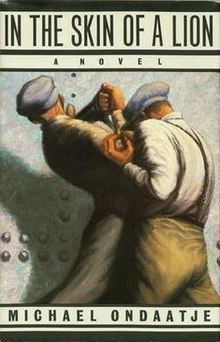
Review: In the Skin of a Lion, by Michael Ondaatje
The story begins from the perspective of Patrick Lewis as a boy in Canada. He lives with his father, who finds work in livestock and then in logging, where he specializes in dynamite. Some of these early scenes are intriguing in the way they capture the life of a poor family working in extreme cold condition. Ondaatje's eye for detail provide great insight into a cultural world that very few belong to. We feel how difficult life must be, day to day, as loggers are under constant danger of being swept underneath logs floating in the river and drowning. Patrick's father in particular faces danger every time he must clear a log jam with dynamite. There's also the cold. Michigan gets cold, but I doubt it gets as cold as in Patrick's Canada.
Then the novel switches to a bridge builder named Nicholas Temelcoff, a fellow who seems at peace with life, having an innate ability to climb and swing beneath the bridge in the dark. Again, we get a sense of the hard daily labor a man must face. Yet this man, as well as Patrick's father, seems to be a master of his craft. These two approach their work, and their lives, with a contentment, yet it would be difficult to say they are truly happy.
Time passes quickly and we run into Patrick again, chasing after some missing millionaire and falling in love with the millionaire's mistress. This is where things get wonky. First of all, the novel takes us away from Patrick for a fairly extensive amount of time, and then it returns us to him much older. Second of all, too many questions pop up about his new circumstances (how he is able to seduce an actress?) that make the story less believable. Also, why should we care about all of this? Patrick is the least interesting of the novel's characters. He feels more like a blank slate than a fully-fleshed out person. Things happen to him. He does things, sometimes extreme things, only because Ondaatje wills him to do so. Motivation be damned. Bizarre things happen that make the story difficult to believe. Whenever I became enchanted with a character or with a description of a character's working life details, the story would go back to dull Patrick and the strangeness surrounding him.
Had the novel been about Temelcoff or even the thief, Caravaggio, who appears much later, it would have been much more enjoyable. Watching them at work at their craft was a lot of fun. Watching Patrick struggle to attain an identity felt too choppy, especially since the novel does break to show the lives of these other two more fascinating characters. Those who fall in love with the poetic quality of writing will likely enjoy this novel. Those who need a little bit more in terms of story will have trouble finding the motivation to continue reading.
Monday, December 30, 2013
Review: The Curious Incident of the Dog in the Night-Time, by Mark Haddon
The Curious Incident of the Dog in the Night-Time is a novel about how people attempt to cope in a cold, harsh world. Don't let the fact that the main character has autism fool you into thinking this is a novel about autism. Author Mark Haddon has admitted to doing little research on autism for the novel. What the novel gives us is a different perspective on life, through the eyes of Christopher Boone, whose condition serves as a sort of tunnel vision lens, yet allows him to see things most people fail to notice. He lives by a set of rules that help him cope with the irrational and chaotic nature of the world. Of course, we all live by some set of rules, some set of guiding principles that allow us to do the same. What makes Christopher different is that while most of us learn to accept the irrationality of life, Christopher is doomed not to.
Christopher likes to interact only with a small set of people. At school he talks with his school mentor, Siobhan, about things he doesn't understand. He lives alone with his father ever since the death of his mother. His mother's death has made him more acquainted with his neighbor, Mrs. Shears, who helps his father out. His routine begins to change, only slightly, when he comes upon Mrs. Shears' dead poodle, stabbed with a garden fork. After an unpleasant encounter with a police officer who dares to touch him, Christopher decides to do some detective work and solve the mystery of the poodle's murder.
Becoming a detective means leaving his safe shell and stepping out of his way to ask people questions. Christopher doesn't much like talking to people because he doesn't understand body language. In fact, Christopher doesn't like a lot of things. He doesn't like the color yellow. It's a bad day when he spots four yellow cars in a row on his way to school. Conversely, he loves the color red, which means that sighting four red cars in a row means it will be a good day. He also doesn't like it when people use facial expressions to communicate because he doesn't know what they mean. He hates the use of metaphor because it confuses him. What Christopher does love is math. He is very logical and will probably be a very successful mathematician. The chapters are numbered by prime numbers rather than in direct sequence. Haddon is so good at convincing us that Christopher exists that it made me wonder whether Christopher is a version of himself, to some extent.
The novel revolves only loosely around the death of Mrs. Shears' poodle because the story, as told in the first person from Christopher's perspective, goes off on numerous tangents. These tangents are often amusing or revealing in some way, and they help explore the mindset of Christopher as well as what he values. Other things that are more important than the death of the poodle happen, but the poodle's murder is significant because it makes Christopher step outside his comfort zone. He appears to be the perfect sleuth, capable of sticking to the facts and not letting his imagination spoil his investigation. He considers all possibilities and eliminates the improbable ones. He even fancies himself a sort of Sherlock Holmes and talks extensively about some of the Holmes novels (as a warning, if you have not read Hound of the Baskervilles, Christopher shamelessly spoils the ending). Yet Christopher lacks an important tool to be a good detective - social recognition. What would be an obvious solution to this investigation for most observers is overlooked by Christopher because he, ironically, fails to put two and two together.
Some have compared Christopher Boone to Holden Caulfield of Catcher in the Rye, and I can see the resemblance. Caulfield, like Christopher, has a narrow view of the world. Where Caulfield sees everyone as phonies, Christopher seems to regard others as intellectually inferior. Both novels make use of the unreliable narrator, in that a reader not making full use of their critical reading skills might be mistaken in believing they are meant to adopt the narrator's viewpoint. However, with Christopher things are made more challenging by the fact that he is an intellectually gifted individual. You may find yourself with a nagging doubt or suspicion about something Christopher hasn't perceived, yet Christopher's undeniable logical intelligence will have you second-guessing yourself.
In Catcher in the Rye, one of the defining moments of how Holden views himself is when he likens himself as a rescuer of children, saving them from running off the edge of a cliff. He believes he holds the key to truth in a world of phonies, yet the reader sees otherwise. Christopher has a similar moment when he compares the way he sees the world to how others see the world. When most people gaze at a field and are asked to describe it, they may mention there were cows and a house and other details, all vaguely described. Christopher, however, will go so far as to tell you how many cows were there and how many had black spots and how many had brown spots and then how many spots each one had. He believes his way is superior, even though Siobhan admits this level of detail would be overwhelming to most. What Christopher misses out on, however, is the beauty of such a field. He takes it all in and simply plugs it into his mathematical brain.
Though the novel is written from Christopher's point of view, and though the reader has plenty of reason to sympathize with him, the character with which I made the greatest emotional connection was the father. The two most poignant moments in the novel involve him. We can sympathize with Christopher because he does suffer, yet his emotional state can be difficult to grasp. This novel does an excellent job of putting readers in the perspective of somebody with autism. However, I kept putting myself in the shoes of Christopher's father, thinking about just how difficult life would be to have to raise a child like Christopher. I mentioned in the first paragraph that the novel is about trying to cope in a difficult world. From Christopher's perspective, we see, in a peripheral way, how his own parents have attempted to cope with raising an autistic child. Raising a child is hard enough, but raising a child who emotionally does not develop the way most people do, who throws violent tantrums when things don't happen a certain way, is a trying experience. Christopher's father is a rare person who is able to do this with love, care, and patience. Not everybody is able to handle the difficulties life throws at them as he does.
The novel is very entertaining, with lots of laugh out loud moments and plenty other thoughtful ones. Christopher dives into all sorts of tangential subjects, but always from his fascinating perspective. The only parts I object to are some repetitive action scenes toward the end, where less detail may have been better. Yet, at the same time, Mark Haddon follows through with the logical impulses of his narrator. It's amazing the way Haddon is able to keep up Christopher's performance, including all the little details that go along with being Christopher. Haddon writes with such a precise style that Christopher is able to come to life as a person all his own. And when we root for Christopher to achieve his goals, we're rooting for an imperfect person to be successful in a difficult world, because if there's hope for Christopher, there's hope for any of us.
Christopher likes to interact only with a small set of people. At school he talks with his school mentor, Siobhan, about things he doesn't understand. He lives alone with his father ever since the death of his mother. His mother's death has made him more acquainted with his neighbor, Mrs. Shears, who helps his father out. His routine begins to change, only slightly, when he comes upon Mrs. Shears' dead poodle, stabbed with a garden fork. After an unpleasant encounter with a police officer who dares to touch him, Christopher decides to do some detective work and solve the mystery of the poodle's murder.
Becoming a detective means leaving his safe shell and stepping out of his way to ask people questions. Christopher doesn't much like talking to people because he doesn't understand body language. In fact, Christopher doesn't like a lot of things. He doesn't like the color yellow. It's a bad day when he spots four yellow cars in a row on his way to school. Conversely, he loves the color red, which means that sighting four red cars in a row means it will be a good day. He also doesn't like it when people use facial expressions to communicate because he doesn't know what they mean. He hates the use of metaphor because it confuses him. What Christopher does love is math. He is very logical and will probably be a very successful mathematician. The chapters are numbered by prime numbers rather than in direct sequence. Haddon is so good at convincing us that Christopher exists that it made me wonder whether Christopher is a version of himself, to some extent.
The novel revolves only loosely around the death of Mrs. Shears' poodle because the story, as told in the first person from Christopher's perspective, goes off on numerous tangents. These tangents are often amusing or revealing in some way, and they help explore the mindset of Christopher as well as what he values. Other things that are more important than the death of the poodle happen, but the poodle's murder is significant because it makes Christopher step outside his comfort zone. He appears to be the perfect sleuth, capable of sticking to the facts and not letting his imagination spoil his investigation. He considers all possibilities and eliminates the improbable ones. He even fancies himself a sort of Sherlock Holmes and talks extensively about some of the Holmes novels (as a warning, if you have not read Hound of the Baskervilles, Christopher shamelessly spoils the ending). Yet Christopher lacks an important tool to be a good detective - social recognition. What would be an obvious solution to this investigation for most observers is overlooked by Christopher because he, ironically, fails to put two and two together.
Some have compared Christopher Boone to Holden Caulfield of Catcher in the Rye, and I can see the resemblance. Caulfield, like Christopher, has a narrow view of the world. Where Caulfield sees everyone as phonies, Christopher seems to regard others as intellectually inferior. Both novels make use of the unreliable narrator, in that a reader not making full use of their critical reading skills might be mistaken in believing they are meant to adopt the narrator's viewpoint. However, with Christopher things are made more challenging by the fact that he is an intellectually gifted individual. You may find yourself with a nagging doubt or suspicion about something Christopher hasn't perceived, yet Christopher's undeniable logical intelligence will have you second-guessing yourself.
In Catcher in the Rye, one of the defining moments of how Holden views himself is when he likens himself as a rescuer of children, saving them from running off the edge of a cliff. He believes he holds the key to truth in a world of phonies, yet the reader sees otherwise. Christopher has a similar moment when he compares the way he sees the world to how others see the world. When most people gaze at a field and are asked to describe it, they may mention there were cows and a house and other details, all vaguely described. Christopher, however, will go so far as to tell you how many cows were there and how many had black spots and how many had brown spots and then how many spots each one had. He believes his way is superior, even though Siobhan admits this level of detail would be overwhelming to most. What Christopher misses out on, however, is the beauty of such a field. He takes it all in and simply plugs it into his mathematical brain.
Though the novel is written from Christopher's point of view, and though the reader has plenty of reason to sympathize with him, the character with which I made the greatest emotional connection was the father. The two most poignant moments in the novel involve him. We can sympathize with Christopher because he does suffer, yet his emotional state can be difficult to grasp. This novel does an excellent job of putting readers in the perspective of somebody with autism. However, I kept putting myself in the shoes of Christopher's father, thinking about just how difficult life would be to have to raise a child like Christopher. I mentioned in the first paragraph that the novel is about trying to cope in a difficult world. From Christopher's perspective, we see, in a peripheral way, how his own parents have attempted to cope with raising an autistic child. Raising a child is hard enough, but raising a child who emotionally does not develop the way most people do, who throws violent tantrums when things don't happen a certain way, is a trying experience. Christopher's father is a rare person who is able to do this with love, care, and patience. Not everybody is able to handle the difficulties life throws at them as he does.
The novel is very entertaining, with lots of laugh out loud moments and plenty other thoughtful ones. Christopher dives into all sorts of tangential subjects, but always from his fascinating perspective. The only parts I object to are some repetitive action scenes toward the end, where less detail may have been better. Yet, at the same time, Mark Haddon follows through with the logical impulses of his narrator. It's amazing the way Haddon is able to keep up Christopher's performance, including all the little details that go along with being Christopher. Haddon writes with such a precise style that Christopher is able to come to life as a person all his own. And when we root for Christopher to achieve his goals, we're rooting for an imperfect person to be successful in a difficult world, because if there's hope for Christopher, there's hope for any of us.
Monday, December 23, 2013
Review: My Sister Lives on the Mantelpiece, by Annabel Pitcher
The main character, Jamie, lives with his father and his sister, Jasmine, whose twin, Rose, was killed by a bomb five years before. Since that time, Jamie's mother left the family for a man named Nigel, and Jasmine dyed her hair purple and began to dress as a goth. His father has turned into a raging alcoholic and quit his job, which makes one wonder how he ended up with custody of the kids. What sort of mother would let her children live with a man like him? Jamie was five when the attack happened, so he doesn't remember it very well. He also doesn't remember Rose. To him it's just an eccentricity that his father keeps an urn containing her ashes on the mantelpiece, and it's an annual tradition to head out to the water and contemplate dumping the urn's contents.
Jamie's family moves to a new town, out of London, where Jamie must now attend a new school. This is a christian school, so it's a little surprising that one of the students is a Muslim girl named Sunya. Sunya instantly becomes an object of fascination to Jamie. He is curious, not about her garb, but because his father has developed an intense hatred of Muslims since Rose's death. He makes daily visits to anti-Muslim websites and believes all Muslims are insane suicide bombers at heart. So it's distressing to Jamie that Sunya takes an immediate interest in him, yet her sunny personality eventually wins him over.
This serves as the main plot, but there are several subplots, including Jamie's and Jasmine's struggle to take care of themselves while their father spends his days passed out or vomiting in the toilet. There's conflict when Jasmine introduces her new boyfriend, of the green-haired, spiky mohawk variety. And Jamie obsesses over the day his mother will finally pay him a visit, as she has promised. Multiple subplots are fine, but their downside is that they stretch the story too thin and none of the plot points are strongly developed.
Pitcher does a nice job of writing from the perspective of a ten-year-old boy. The writing is crisp, in the unsophisticated voice of a young boy. Sometimes the sentences flow breathlessly, as the narrator keeps them alive by adding another "and" to the end. This isn't necessarily how ten-year-olds talk, but it is accurate about how they write. Periods are sometimes forgotten, or the problem is that kids haven't quite grasped the concept of a sentence just yet. Sometimes this writing grows repetitive, with too many sentences having the same breathless structure, yet it's never dull.
Memory is another area Pitcher gets right. Too many stories, both in books and the movies, provide characters with photographic memories. These teenagers or adults remember everything, but the reality of memories is that they fade over time. That Jamie barely remembers his sister is understandable, and it's believable that his grief for her is almost non-existent. Perhaps Pitcher does go a little far in portraying Jamie's amnesia, though, when you consider how traumatic the event was. Most faded memories tend to be of everyday sorts of things, but when a bomb explodes right in front of you and blows your sister to smithereens, that's a memory that will have very vivid indentations on your mind. This is just an example of how Pitcher tends to deaden the emotional impact of her story, and it seems to be a trend followed by many young adult novels.
Another problem is Pitcher's tendency to portray other characters and issues as one-dimensional. Jamie's father's alcoholism seems less realistic than hyperbolic. His mother's abandonment is hard to believe considering what a loving family they were before the bombing. Sunya is often unrealistically, if not eerily, bubbly. You have your standard classroom bully who acts like an angel in front of the teacher, and the teacher who seems to hate most children. The plot goes into odd places later because Pitcher doesn't take the time to fully develop any one scenario. The only characters who have any sort of depth are Jamie and Jasmine, yet even there you'll find a strong note of melancholy and not much else.
As a novel aimed at young adults, the above-mentioned problems aren't quite so bad. There is some value to be had for young teens, and parents can take relief in the fact that the bomb violence as described in the novel is artfully, not graphically, portrayed. More than likely girls will enjoy this more than boys. Not to say Pitcher unsuccessfully writes from the perspective of a boy, but Jamie has a feminine feel, such that I was unaware he was a boy until his name, James, was mentioned. There's also the element of romance between Jamie and the Muslim girl, Sunya, that will leave boys less inclined to read this than girls. Throughout the entire novel, the only friends Jamie has are girls: his sister Jasmine and Sunya. The only boyish thing Jamie does is participate in soccer in a brief episode. It's unfortunate the novel goes the route of romance because the age of the two characters involved makes this unlikely. Not that the romance involves any making out, but it does involve the desire to hold hands and for Jamie to catch a glimpse of Sunya's hair underneath her hijab. To make matters worse, the romance is predictable and lacks spark.
The novel feels much more episodic than cohesive, and those episodes use predictable story arcs. The romance plot, for example, has Jamie's feelings for Sunya bounce between love and hate several times throughout the course of the novel. One moment he wants nothing to do with her, then he craves her attention, and then he remembers that Muslims killed his sister and ignores her, and so on. It grows irritating after a while. Random plot threads dominate the bulk of the work, involving the aforementioned soccer game with all of the usual elements involved in that kind of story line; an inevitable encounter between Jamie's father and a Muslim, which blows up in unrealistic, poorly-written fashion; Jasmine's new boyfriend and what her father thinks of him; Jamie desperately awaiting his mother to finally visit (seriously, what is wrong with that woman?); and an audition for Britain's Got Talent. This seems like a lot to happen to a ten-year-old in such a short span of time, but it wouldn't be so bad if it was done with more cheer or more originality.
Subscribe to:
Posts (Atom)