Monday, July 9, 2012
Bookmark Monday: Orange Man
I've decided to join in on Bookmark Monday, hosted by Aloi at guiltless reading, because it sounds like fun. And I love to collect bookmarks.
So here's mine for this week:
In those cases you can't find your bookmark, at least you know where your cat is. They come in different breeds, too! And Orange Man's so lazy he could probably save my spot for at least a few hours.
Black Boy, by Richard Wright (1945)
The opening of the novel sets up a pattern of defiance and punishment that defines the rest of it. In defiance of his parents' orders to stay locked up in his room, he begins to throw things into the fireplace, setting the house on fire in the process. He hides under the burning house to escape a beating, but when his parents finally drag him out they beat him to within an inch of his life. The severity of the punishment doesn't quell his defiant nature, however.
Wright had a difficult childhood. His family was poor and he rarely had enough food to eat everyday, so he grew up a scrawny boy. His parents divorced while he was young and because he moved back and forth between homes so often he never had an uninterrupted year of school until he was a teenager. Even then, he never went beyond the ninth grade. His family was very strict. Nobody was allowed to ask any questions, no matter how innocuous, and anybody who did received a reminder smack. Wright still asked questions. Lots of them. And the smack that followed became so habitual that his instinct was to avoid it, which one day drove his grandmother down the porch steps, where she broke her hip. He even learned to fight back when appropriate, such as against his uncle who had no reason to raise his belt to him.
Defiance wasn't the only thing that got Wright into trouble, however. He was a naive boy who expected things to turn out better than they did. As a result, he grew disillusioned and disappointed. He came to realize that it was because he was black that society treated him differently. The first time he worked at a white lady's house, he's offered a breakfast of moldy molasses, which she found perfectly acceptable for a little black boy. He was so upset he never showed up again. His suspicion of whites grew stronger with each negative experience.
As an adult, the racism he faced took a more dangerous turn. He often felt frightened for his life. At one job, a pair of coworkers ganged up on him and threatened to kill him, forcing him to move to another city, and at another job his coworkers coerced him and another black employee to box for money. They played tricks on the two, making them suspicious that the other was trying to kill him. These cruel japes are played, it seems, because the white employees see these two black men as nothing more than playthings. All Wright wants is to make some money to support his family and be left alone to read his books. And he reads a lot.
The novel does settle into a somewhat predictable pattern. Wright enters situation after situation expecting a great experience, only to become disillusioned by the realities of racism. However, this feeds into the novel's main themes. Wright does an excellent job of blending humor, action, suspense, and philosophy. It's also inspiring that he could grow into the great writer he became despite the overwhelming obstacles he faced, and it's sad all the same that those obstacles were there to begin with. In its clarity, its depth, and its thematic content, Black Boy is a very important American novel about a man struggling to survive and thrive in the world's wealthiest nation.
Friday, July 6, 2012
Book Beginnings: The Perks of Being a Wallflower
Every Friday Rose City Reader hosts Book Beginnings on Fridays. What you do is share the opening line(s) of the book you are currently reading and briefly discuss what you think about the opening line or the book or whatever else inspires you. Make sure to share your entry with Rose City Reader and in my comments below.
Here's my book beginning:
"August 25, 1991
Dear friend,
I am writing to you because she said you listen and understand and didn't try to sleep with that person at that party even though you could have."
- The Perks of Being a Wallflower, by Stephen Chbosky
I'm finally going to start this, though it does require prying A Clash of Kings from my hands. It looks like it is written as a series of letters, and the opening to the letter is interesting. After reading the unconventional ttyl books, written as instant messages, I guess I'm off to another unconventionally-written story. Not that there's anything wrong with that.
Thursday, July 5, 2012
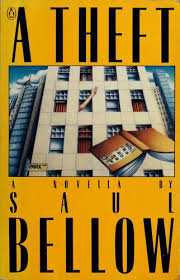
A Theft, by Saul Bellow (1989)
Clara grew up in the country, raised by wealthy fundamentalist parents who donate their money to televangelists. She moved to New York, where she met Ithiel Regler, called Teddy, a brilliant scientist who works for the federal government. She fell in love, and supposedly he did too, though the pretty emerald engagement ring he bought for her was not his choosing. He was only caving in to her demands. Their relationship didn't work out, though twenty years later she still feels he is the only man she really loved. As such, she keeps in touch and still wears the ring.
She married four men after breaking off her engagement with Teddy. She complains that her current husband, Wilder, spends too much of his time reading read thrillers by John Le Carre and doesn't help out with their three kids. She married him for sex alone. He happens to enjoy the fact she is still friendly with some of her high profile exes, and tapes interviews of Teddy whenever he's on TV. Clara confides this information, and more, in her friend, Laura Wong. Laura mostly sits and listens. We don't learn much about her, suggesting that Clara holds no interest in her personal life, but she seems to be the only friend Clara has outside of Teddy. Another important character is Gina, an Italian woman who Clara hires to take care of her kids. Clara sees in Gina a character of high quality, though some of Gina's actions seem to contradict this. Clara allows her to bring her Haitian boyfriend over, but only if the kids are in bed, and one night Gina has a party that balloons into more people than Clara thought there would be.
And now we come to the theft. As you might have guessed, the object of the theft is the engagement ring. In his subtle way, Bellow introduces a second theft, which actually happens first, though nobody ever refers to it as a theft. First of all, Clara loses the ring. Because it is insured, she files a claim and collects $15,000. Then, by chance, the ring turns up again, under her bed. However, she doesn't tell the insurance company she found it because, well, she had already spent all the money. Then, the ring is stolen. Clara thinks she knows who the culprit is, and she develops a very low opinion of this person. It never seems to enter her mind that she is also a thief, and her theft is even worse.
Based on what I've just written, you might be thinking this sounds like a good book. And I admit it has the elements in place to be a fascinating read, but the execution is off. Bellow is, perhaps, a little too subtle. To the point it's not very clear what he's trying to get at. The narrator has a limited third-person perspective and seems more or less partial to Clara. We learn much from Clara's dialogues with Laura Wong, Teddy, and her psychiatrist, though she does most of the talking. It's hard to say what these people think of Clara. The psychiatrist is paid to listen to her, and even Laura has a professional connection with her. Teddy seems to genuinely like her, though not enough to marry her. What we do know is what she thinks of herself, which is that she's of a superior caste of people. The problem is, the novel seems to endorse this view of her. I can't tell what Bellow's aims were; it seems he's playing things with a little too much subtlety. He provides too much contradictory evidence for the reader to develop a thoughtful opinion of her.
To make matters worse is this excerpt from the blurb on the back of the book:
"As she attempts to recover the precious ring, Clara emerges as a genuine heroine, a woman of great depth and unsuspected capacities of wisdom and love."
I think the blurb has it wrong, but it's not clear whose view the blurb represents: the author's, the publisher's, or some other party. Clara is self-absorbed and jumps to hasty conclusions. Based on a very minor detail, a supposed change in Laura's tone of voice, Clara has the belief that her friend wants to steal Teddy from her, though it is assumed Laura has never met Teddy. She has romantic ideas about Gina, but negative feelings about her boyfriend, who she has never talked with. She's a poor mother and a poor wife. We never see her interacting with her daughters or her husband, and when she mentions them it's only to complain. To add to that, she's clearly a racist, which we know based on the number of times she claims that she isn't.
Perhaps this sounds like a thought-provoking read, and certainly I've spent a lot of thought on it, but it was a chore to sort out. This is not very enjoyable. At 110 pages it felt at least twice its length. I reread passages again and again to try and figure them out, only to move on in frustration. I have my mind made up about Clara, but I don't know if the conclusion I've drawn is the one Bellow intends. If you were thinking about getting into Saul Bellow's works, I wouldn't start here.
Wednesday, July 4, 2012
WWW Wednesdays
WWW Wednesdays is a meme hosted by Should Be Reading. What you do is answer the following three questions:
What are you currently reading?
I finally started A Clash of Kings, by George R. R. Martin. Where A Game of Thrones had a somewhat slow start, A Clash of Kings picks up at the cliffhangers its prequel left off at, and you know everybody by now, so it's off to a better start. So far so good.
What did you recently finish reading?
I most recently finished A Theft, by Saul Bellow. When I posted this in last week's WWW Wednesdays, a lot of people sounded interested in this one. Unfortunately, it turned out to be a very frustrating novel. At 110 pages, it felt much longer. It took me 2 days to read it, and then I read 150 pages of A Clash of Kings in one day. I will post my review tomorrow. Also, I finished ttfn. The review is here.
What do you think you'll read next?
I have finally found a copy of The Perks of Being a Wallflower, by Stephen Chbosky. I'll probably start reading it before the weekend starts.
Tuesday, July 3, 2012
June Wrap-Up
I know I'm a few days late, but here's a list of the books I read in the month of June, with links (by clicking the titles) to reviews where possible. In all I read 6 books, but wrote reviews for 14 books. Most of the books I reviewed I had read during my Young Adult Literature class in the Winter semester, and I still have some more reviews of those to come.
The Gammage Cup, by Carol Kendall
An old fantasy about a people called the Minnipins who live in supposed safety in the Land Between the Mountains. Has some wonderful language and thematic content inspired by the Red Scare.
A Game of Thrones, by George R. R. Martin
The first in Martin's epic A Song of Fire and Ice series. I really enjoyed this and have just started the next book, A Clash of Kings, and that one so far is even better because it starts off a little quicker.
My cat enjoyed this as well.
Fahrenheit 451, by Ray Bradbury
I read this in commemoration of Bradbury's death. It was the first novel I read by him, and I found it very thought-provoking. I want to read more.
ttyl and ttfn, by Lauren Myracle
The first two in Myracle's trilogy of books that are written entirely in instant messages. These are decent reads, entertaining and full of energy.
A Theft, by Saul Bellow
This is the last book I read for the month, a short novella that felt much longer than it was. I will post my review for this either tomorrow or Thursday.
Other books I reviewed but read earlier this year:
The Pearl, by John Steinbeck
Neverwhere, by Neil Gaiman
The Hunger Games, by Suzanne Collins
Cat Among the Pigeons, by Agatha Christie
Go Ask Alice, by Anonymous
Chains, by Laurie Halse Anderson
Embroideries, by Marjane Satrapi
War Horse, by Michael Morpurgo
Shooter, by Walter Dean Myers
The Gammage Cup, by Carol Kendall
An old fantasy about a people called the Minnipins who live in supposed safety in the Land Between the Mountains. Has some wonderful language and thematic content inspired by the Red Scare.
A Game of Thrones, by George R. R. Martin
The first in Martin's epic A Song of Fire and Ice series. I really enjoyed this and have just started the next book, A Clash of Kings, and that one so far is even better because it starts off a little quicker.
My cat enjoyed this as well.
Fahrenheit 451, by Ray Bradbury
I read this in commemoration of Bradbury's death. It was the first novel I read by him, and I found it very thought-provoking. I want to read more.
ttyl and ttfn, by Lauren Myracle
The first two in Myracle's trilogy of books that are written entirely in instant messages. These are decent reads, entertaining and full of energy.
A Theft, by Saul Bellow
This is the last book I read for the month, a short novella that felt much longer than it was. I will post my review for this either tomorrow or Thursday.
Other books I reviewed but read earlier this year:
The Pearl, by John Steinbeck
Neverwhere, by Neil Gaiman
The Hunger Games, by Suzanne Collins
Cat Among the Pigeons, by Agatha Christie
Go Ask Alice, by Anonymous
Chains, by Laurie Halse Anderson
Embroideries, by Marjane Satrapi
War Horse, by Michael Morpurgo
Shooter, by Walter Dean Myers
Monday, July 2, 2012
ttfn, by Lauren Myracle (2006)
ttfn finds Angela,
Maddie, and Zoe in their junior year of high school, with old worries now a year behind
them and new worries ahead. Angela’s parents are preparing to drop a bombshell on her. Maddie has made friends with a pot-smoking boy
named Chive, who also sees no harm in sharing
partners. Zoe has become close friends with Doug Schmidt, who in the
first book was smitten with Angela. This is the
setup for their upcoming troubles.
Myracle likes to focus both on issues we
hear about in the news and personal problems that are more familiar to teenage
girls. In Angela’s case, her father has been laid off, and now the family has to move to California for his new job. In this way Myracle makes a connection with a real thematic issue affecting many families today, and she puts it squarely into the perspective of a teenage girl who can only comprehend the fact she's going to have to move away from her best friends. I'm sure many teenage girls in similar situations can relate to this, though adult readers will likely relate more to the father losing his job. Pot smoking and drug use are also hot issues, particularly when it comes to teen use. The way Maddie justifies smoking pot, by saying it's no big deal, is an accurate portrayal of how teenagers respond to the reactions of concerned friends.
The novel can be a little bit too repetitive, especially regarding how Angela feels about moving. Too many
conversations focus on how upset she is and how
the three best friends are meant to be together forever. This bogs down
Myracle’s usually vibrant energy, which still shows through in large chunks of the novel. And you know whenever somebody continually repeats that they will be together forever that they will begin to drift apart. Angela physically moves away, and Zoe and Maddie begin to spend
time with their boyfriends rather than one another. That this happens is only
natural, though the girls are upset to realize it.
As the girls have grown older, they have grown less afraid of talking about sex. There are lots of discussions about blow jobs, masturbation, and even things done between a boy and a girl that
don’t involve sex. These girls are at an age when sexual experimentation is a fact with some, and likely a topic of conversation for most. I think Myracle’s handles the discussions of sex realistically. None of the girls actually have sexual intercourse, but at least one of them comes close. While the girls don't obsess over it, we find examples of ways that boys imagine even the most innocent gesture as something sexual. Zoe tells Maddie about a boy in her class who says he knows why girls jiggle their legs while sitting down. Only a teenage boy could come up with the idea he has, and only a teenage boy would believe it.
Overall I thought ttfn was just as good as ttyl. It
kept me entertained, and even had me laughing out loud at times. I find
some of the conflicts less believable than others, such as one between Angela and Zoe over Doug. Perhaps teenage girls would fight
over such things and in that case they would relate better than I
can, but it still had me wishing for a little more substance. It's a little too convenient that the main conflicts of each of the girls reaches a climax on the exact same night, especially when you consider one is 3,000 miles away. And of course the conflicts resolve a little too quickly
and easily, considering how much time Myracle spends developing them.
Still, it was a fun, if predictable read, though I’m sure teenage girls would
like it better than anybody else.
Subscribe to:
Posts (Atom)

