Showing posts with label Joe Hill. Show all posts

Friday, June 26, 2015

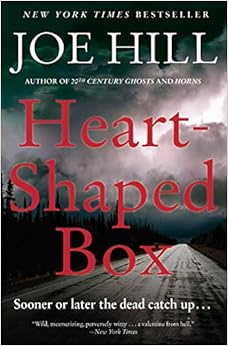
Review: Heart-Shaped Box, by Joe Hill

Joe Hill is nearly the spitting image of his father with Heart-Shaped Box, a ghostly thriller with the same sort of villains and dialogue Stephen King might have written. I've already read Horns, so I know Joe Hill has his own style, and I believe he will grow into an excellent horror writer with unique ideas. Heart-Shaped Box isn't quite as good as Horns, as it suffers from habits I'm worried could bog down some of Hill's later works. For one, Hill loves to give background information. He allows background information to take over the main plot where just a little bit of background information might have been more effective. It's a shame, too, because the novel has lots of promise at the start and even gets good again towards the end.

Judas Coyne, known as Jude, has retired from the heavy metal lifestyle after members of his band passed away due to one cause or another. Still filthy rich, Jude collects grotesque objects, such as a five-hundred-year-old peasant skull and a three-hundred-year-old confession signed by a witch. He also owns a video of a gang suffocating a couple (and it's this video that understandably precipitates his divorce). Jude even collects women and names them after states like Florida and Georgia. These women, like Jude, also love the grotesque, dressing in the Goth fashion of black hair, lipstick, and fingernails. Jude's obsession with grotesque objects eventually leads him to purchase a ghost.

Now, he doesn't directly purchase the ghost. He purchases a suit that belonged to the deceased. This suit is shipped to him in a heart-shaped box. His dogs, Angus and Bon, don't like it. His girlfriend, Georgia, doesn't like it either. Jude himself begins to dislike it when a creepy old man with a razor-sharp pendulum begins to make an appearance. Eventually, Jude's secretary, named Danny, drives himself to suicide, and it seems clear that this ghost is out to kill Jude and everyone he loves. Jude discovers that this ghost is the grandfather of Jude's troubled ex-girlfriend, Florida, who apparently committed suicide not long after Jude kicked him out. So the ghost is out for revenge, right?

The story goes back and forth between Jude and Georgia's escape from the ghost to background information about Jude's past, namely his relationship with Florida (the woman, not the state). It's not that this background is bad, per se, but it delves too far and takes on improvised characteristics, where revelations from the past help form plot points in the present. This seems lazy, the way that Jude suddenly remembers important things with perfect clarity. There is a lot of emotional power in what happens in the story, but the improvised feeling takes away the emotional impact from these events. Florida, anyway, is not the one we were following from the start. It is Jude and Georgia we care about, but their stories are sidelined. Hill had a similar problem with Horns, which has a terrific opening, but then stalls with a needlessly long background story.

Hill does write some powerful passages of horror. His description of the ghost, Craddock, is his best work in the whole story. Craddock is what makes the story interesting, since Jude and Georgia fail to have an intriguing personality despite their anti-social tendencies. When Craddock first appears, the imagery Hill uses is haunting. At that point I thought that I was in for a treat. Unfortunately, Hill never replicates that horror. There are some moments of fear for the lives of the main characters, and some moments of awful violence. But, as threatening as the ghost is, he disappears and reappears at the convenience of the plot. He is there, however, just enough to let us know this will end in death, his or theirs. At least something big is at stake.

In his first two novels, Hill displays a love of music. Heart-Shaped Box is devoted almost entirely to heavy metal/rock n' roll. The references to rock bands are everywhere. Jude's own name is an obvious reference to The Beatles (a band Ig in Horns loved a lot, and a band King also adores). Nirvana is another reference, and there is also mention of the Foo Fighters, Metallica, and others. It's disappointing this music doesn't have a very big impact on the plot. It seems that Hill missed an opportunity that his novel's title promised. Hill clearly wants to aim for something unique, but his heavy focus on background information grounds him in conventional plotting. His story is well-organized and it plods along slowly and deliberately, like a storyteller who wants to take his time and let the story live on as long as he can - just as Jude clings to life. These are the tells of a good storyteller, and I hope Hill has his breakout moment soon. It would be nice to have a new horror writer to look forward to for another generation.

Sunday, September 1, 2013

Review: Horns, by Joe Hill

If Joe Hill is hoping to take the reins of horror from his father, Stephen King, then Horns looks like a pretty good bid for that spot. That's not to say Hill is a copy cat of his father. He demonstrates a writing style and voice all his own, though with the occasional flourish his father might provide. Hill writes with a voice more terse, a little more dry, than his father's, but also with the occasional comical remark that's so surprisingly funny you might find yourself laughing out loud. Where Hill truly shines is in his character development and the pacing of his story. He slowly, carefully reveals exciting new developments to his plot, to the changes in his main character. It's a shame that the conclusion turns out to be your usual hero/villain showdown, with all of the cliches it. However, almost everything leading up to those final moments is sublime.

Ignatius Perrish wakes up to the worst hangover of his life. It's so bad, in fact, he has sprouted devil horns on his head. Not only that, but people begin behaving oddly around him. The receptionist at the doctor's office discloses that she wants to scream at a woman whose child is misbehaving in the waiting room. When Ig sits next to this woman, she touches his arm and he suddenly sees all of her bad deeds. Then she unabashedly tells him of her desire to kick her daughter in the ass, literally. What Ig, and the reader, gradually begin to realize is that with these horns comes a supernatural power that causes people to want to act out their darkest desires, but only if Ig grants them permission. He can't even hold a normal conversation with his parents or brother. This is even more terrifying when you discover certain details about his past.

I won't reveal too much, because there's a surprise early on I don't want to spoil. The novel gradually feeds us information about Ig's past life. We learn that his girlfriend, perhaps even soul mate, Merrin, was raped and murdered just the past year, and the entire town thinks Ig committed the crime. But the case never went to trial because of a fire that destroyed DNA evidence. With his new powers, Ig learns things from people, awful things that have to do with what they think of him. He goes to his church to see if Father Mould can help, only to learn the pastor believes Ig should hang himself. Also, Father Mould has been having an affair with Merrin's mother. Ig becomes wary about meeting other people because of these terrible revelations. At the same time, he finds it thrilling to take revenge on those who speak so cruelly about him, forcing them to act out on their dark desires in ways that hurt them.

Part of what makes the novel work so well is the complexity of its main characters. Ig is the good guy in that he has enough of a conscience to deny most people to act out on their dark desires. Yet he's still human. He can't help but act on his baser desires for revenge and power because it excites him. There's something cathartic about his ability to do something evil and get away with it. Even the novel's villain has complexities. This is important to bring up because it's one area where King struggled (or maybe didn't care so much). Most of  King's heroes and villains are one-dimensional characters (with varying degrees of effectiveness) who tend to act predictably. A King hero has only minor flaws, while a King villain has absolutely no redeeming qualities. Hill, on the other hand, aims for more human complexities.

When I say Hill's writing style is dry, I don't mean it as a criticism. His voice is mostly straight forward, get to the point, with the occasional parenthetical quip. His humor is told dryly, though often to hilarious effect. Hill's writing is also witty, without being obvious or showy. One example of his wit is the novel's title. Horns most obviously refers to the pair of horns growing from Ig's head. Yet we also learn that Ig's father made his fortune playing horns, and his brother Terry has also made his fortune doing the same, while Ig's asthma prevented him from following suit. Horns, then, may symbolize the past and/or missed opportunities.

Hill is at his most thought-provoking when discussing religion. He twists themes of good and evil on their head by positing the devil as the good guy. Ig is, after all, an incarnation of the devil, yet he is repulsed by the dark secrets people reveal to him and forbids most from acting on them. In a sense, then, the devil serves as a moral authority above those who feel the influence of his horns. Hill relishes in the idea that God and the devil are partners more than they are adversaries. The devil punishes sinners, and if God wants sinners punished, aren't the two on the same side? Ig comes to a lot of interesting, and sometimes funny, conclusions regarding religion that some may find controversial, but the open-minded will enjoy pondering.

For the most part, the novel's pacing is superb. The way Hill slowly reveals Ig's powers is exciting. Here is an author who knows the virtues of patient plotting. The story begins in the middle of the action, with Ig discovering his horns, and then it goes backwards so the reader can learn more about the major players and events that give the present more significance. The rest of the novel goes back and forth between the past and present until the reader has a near complete picture of Ig's relationship to Merrin and others, as well as what happened the fateful night Merrin was killed. A few of the flashback chapters were superfluous. This is especially true regarding the villain. Explaining why a character becomes a villain tends to ruin the magic of the story. Some people are just evil, no explanation needed.

The real disappointment I have is with the ending. It devolves into your usual action showdown, involving a battered hero and a villain who takes a breather to explain everything. Worst of all, this happens twice. People complain about the way King ends his books, and sometimes he does end them in bizarre fashion, but I prefer non-traditional sorts of endings. The ending to The Dead Zone was excellent, and it made sense. According to King, Hill helped change the ending to 11/22/63, which I thought had a disappointing ending because it playing things safe. Plenty of people will be happy with the ending to Horns, I'm sure, because it's comfortable in its use of recognizable tropes. I feel like it's an insult to the care Hill put in the rest of his story. Nonetheless he shows remarkable talent. I look forward to seeing Daniel Radcliffe star in the title role of the movie. I also look forward to reading more of Joe Hill's work, as I'm sure he will be a mainstay for a long, long time.