Showing posts with label A Song of Ice and Fire Series. Show all posts

Tuesday, July 30, 2013

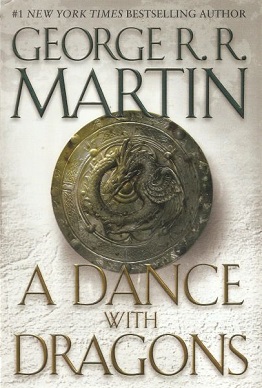
Review: A Dance with Dragons, by George R. R. Martin

George R. R. Martin's fifth installment in his A Song of Ice and Fire series stumbles over its own excesses. A Dance with Dragons has the advantage over its predecessor in that it has some of the series' most popular characters: Tyrion, Daenerys, and Jon. However, it lacks the compelling story arc that A Feast for Crows had with Cersei. This book, and the previous one, has Martin trying to do too much with his world: too many characters to follow and too many details about settings outside of Westeros. It seems that Martin has fallen in so much love with his world and his characters he forgot to write a story around them. We learn "much and more" about the lesser known free cities across the sea, but as the goal of the series is to land somebody on the Iron Throne, why should we care about the history of the free cities? This is the first novel in the series that forgets its characters are supposed to be playing a game of thrones, and in the end it is the worst the series has to offer.

***Warning: This review contains spoilers. If you have not read at least the first four books in the series I would not recommend reading on.***

A Feast for Crows was the first novel in the series not to kill off a king, but it certainly had fun with a certain queen regent. A Dance with Dragons doesn't have quite so much fun with its kings or queens. The only two it features, anyway, are Daenerys and Stannis, and it may be surprising to learn that Stannis fares the better of the two. Stannis is the only character playing the game of thrones; anybody else interested in playing are too far from the action to make an impact. However, the problem isn't simply that nobody is giving this game a go, but that for those who aren't, very little happens, despite the promise of A Storm of Swords.

A Storm of Swords ended with a lot of very interesting events that gave readers plenty of reason to want to read the next book. Unfortunately, after two books the most interesting of these still have not come to fruition. If you remember, Tyrion murdered his father and fled with the aid of Varys and Jaime. Where he went and what he would do was one of the biggest mysteries of the series. It turns out he was shipped off to Magister Illyrio, who you may remember from the first book as the man who aided Viserys and Dany. The plan is to get Tyrion to Dany so he can give her some aid (or she could kill him for being a Lannister). Tyrion travels with a group led by Griff and his son Young Griff, who are both more than they seem, though I think it's a mistake for Martin to introduce two such high profile characters so late in the series. While the idea of Tyrion counseling Dany sounds fun, what really happens is that Tyrion sets off on a series of misadventures. Fortunately Tyrion's signature humor is still intact, at least early on. Later he becomes more serious, and he's continuously brooding over his first wife, Tysha, and wondering where whores go. This sudden obsession with Tysha slows Tyrion's sections to a crawl.

Dany, if you remember, was having an exhilarating time conquering the free cities with her Unsullied army and freeing slaves. Her path to Westeros seemed all but paved. However, readers will be disappointed to learn that Dany has decided to settle down in the city of Meereen, where a faction of people called the Sons of the Harpy have started a small rebellion against her. People are upset she has abolished slavery. Dany has a decision to make: stay and fight, or move on. Her conscience tells her to stay, though her closest advisor, Ser Berristan Selmy, tells her otherwise. Dany's sections are some of the novel's dullest, as she addresses the complaints of the Meereenese people, obsesses over the sellsword captain Daario, and begins to realize her dragons are growing larger and more unruly. Because Meereen is not Dany's end goal (or is it?), it's difficult to care about the city's internal politics.

Jon's conclusion in A Storm of Swords was just about as exhilarating as Tyrion's. I was looking forward to seeing him in action as the new Lord Commander on the wall. To be sure, Jon has the fastest and best start in the entire novel, but it's sad to say the highlight of the entire novel is when Jon punishes Janos Slynt for insubordination - and that's in the first hundred pages. Jon's main struggle is his balancing act between obeying the vows he made to the Night's Watch and his desire to help Stannis win the north. Once Stannis, leaves the wall, though, Jon's sections slow to a crawl. We learn far more about the wildlings than is interesting, and Jon broods over the fact that those who counsel him disagree with everything he does. Towards the end Jon's decisions grow more questionable. He mirrors Dany (and even Cersei) in the fact he makes poor decisions and fails to heed the counsel of those wiser than him. While this could have been intriguing, it gets bogged down in too many needless details.

Theon makes a return. For those who have kept up on the show, it will be no surprise to learn that Theon is still alive, but this is his first appearance in the novel since A Clash of Kings. Just as in the show, Theon has been kept alive as Ramsay Snow's pet. If you thought Joffrey was bad, wait until you learn Ramsay's hobbies. Theon has been reduced to less than a man, less than a dog, into a creature named Reek. He has become so fearful that he quickly dispels any thoughts of his previous identity. He is Reek, it rhymes with meek. However, Theon becomes instrumental in helping the Boltons capture a fort and then establish their claim to Winterfell by marrying Ramsay to a false Arya Stark. Though I thought Theon was a despicable character in book two, I found Ramsay so revolting I was hoping Theon would finally get the better of him. Theon's parts, however, move just as slow as the rest. So slow, that a promised showdown towards the end of the novel gets delayed by heavy snowfall.

As for the rest of the characters, a large number receive their own perspective at some point or other. Davos and Bran are some of the more interesting of these, but each only receives three sections and they are done halfway through the novel. Davos, in the fourth book, was reportedly beheaded. Whether that actually happens I will leave for you to discover. However, his parts are some of the most suspenseful and exciting in the book, thanks in part to an awesome showing by Wyman Manderly. Bran finally reaches the three-eyed crow, which turns about to be much different than imagined. Here Bran realizes his destiny, though the novel is done with him almost as soon as he gets started. Asha Greyjoy has a couple of chapters, though mainly for the purpose of keeping an eye on another major character. Victarion also has a few sections of his own, as he sets out on his quest to marry Dany. Some of Victarion's parts are actually some of the best as the novel approaches its end. He is one of the few characters actually taking action and there is some promise in what he has to offer.

Quentyn Martell promises to play a major role, though ultimately disappoints. In the fourth book, it was revealed that Arienne Martell had a secret marriage pact with Viserys, but Doran believes that pact might have some weight in convincing Dany to marry Quentyn. Quentyn's marriage to her would also have the benefit of lending her a large army in Westeros. However, he's not a very attractive fellow and doesn't have the stomach for bloodshed. Arya has a pair of chapters that show her continued training to become an assassin for the many-faced god, however not much happens. It's a shame where Martin has taken Arya's story and her character. Hopefully he improves on it later. There's an appearance by Areo Hotah, though I forget the contents, and Jaime has a single chapter that ends by closing up one cliffhanger from the previous book and simultaneously creating another. Late in the novel Barristan Selmy gets his own chapters. He's similar to Ned Stark and Davos in that he has a high regard for honor, only it's too bad he's not in a more compelling situation.

Part of the fun of the series has been watching people effectively or ineffectively playing the game of thrones. The problem with this last book is that very few people play at the game effectively. Dany and Cersei fail to listen to the wise counsel of those around them. Jon does the same on the Wall. Most of those who do have the ability to play effectively are either too far from the action (Tyrion) or not given a perspective (Varys and Littlefinger). Jaime's sections in the fourth book were so refreshing because he was actually getting things done, and Griff and Victarion also seem to be making very strategic decisions. It's just too bad those last two are newcomers to the series.

The first three books in the series are excellent because each chapter ended with a compelling revelation or twist. In A Dance with Dragons, you will find yourself underwhelmed by the conclusion of a majority of the chapters, and none of them will excite you. That's not to say this is a bad book. It's still an impressive feat and it still has its moments of entertainment. Overall, though, it feels like sitting on a roller coaster that climbs up and up very slowly, but once it reaches the top and begins its descent you realize you're only ten feet off the ground and wish you hadn't wasted so much time waiting in line.

Friday, July 5, 2013

Review: A Feast for Crows, by George R. R. Martin

A year later, I finally got back into George R. R. Martin's massive fantasy series, A Song of Fire and Ice (usually referred to as A Game of Thrones). Due to the complexity of the plot and the world Martin has created, it was tricky getting back into the series after such a delay, so I can only imagine how difficult it was for fans who waited five years after the third book, A Storm of Swords, came out. Based on many reviews I've seen for the book, it seems this is where readers have begun to grow unhappy with the series. Perhaps it's because they were so upset about the long wait. Or maybe it's due to the fact that the series' most popular characters, Tyrion, Dany, and Jon Snow, are all MIA. There's also the problem that Martin takes up a few unclear plot threads that, by the novel's end, lead seemingly nowhere. These are legitimate gripes, but it's important to evaluate the book as it is and not as it should have been. Here you should find that A Feast of Crows, though uneven at times, is just as addictive as its predecessors.

***Spoiler Alert! If you have not read the first three book in the series, I would not recommend reading past this point.***

Wars in the previous books have left the Seven Kingdoms in shambles, but chaos and death are perfect conditions for crows to thrive in. Bands of outlaws have taken to raping, killing, and stealing. Some small groups such as the Ironmen have decided to make an attempt to fill the leadership void left from the death of several kings. Many have become more devout in their religion, and a group called the Sparrows has risen to cleanse the lands of corruption. Events in the previous book left the Lannisters as the lone bearer of power, though not without adversaries. It was the deaths of two characters in particular who have given cause for crows to feast.

While Robb Stark's surprise execution during the Red Wedding did away with the Lannisters' harshest opposition, Tywin Lannister murder by his own son, Tyrion, harmed the stability of the Lannister hold on the throne. However, it fits perfectly into the as yet unknown plans of the Tyrells, who saw to the poisoning of Joffrey, and now have a much younger, more malleable Lannister in Tommen to wed the twice-widowed Margaery. However, Cersei, as queen regent, has hopes of making herself the greatest ruler who ever lived. For Cersei alone this book is worth reading. She's a crazed, egotistical, paranoid woman who believes herself a goddess. She will do anything to hold onto the reins of power and knows how to use her sex appeal to win the obedience of certain men. Her paranoia, however, guides her decisions more than her wisdom. Against the good advice of those close to her, Cersei quickly removes as much Tyrell influence as possible, and as the second-most powerful family in the realm, you can probably see that's not a good idea. Cersei comes up with scheme upon scheme as though she can't have enough of the drink of power, and the desire to see how this scheming pans out makes the book difficult to put down.

Jaime makes a return from the third book, much humbled since losing his prized sword-fighting hand. He was the one who released Tyrion from prison and set in forth the events that led to his father's death. But Jaime has also grown suspicious of Cersei since Tyrion told her she'd been sleeping with Osmund Kettleback and their cousin Lancel (and maybe Moon Boy for all Tyrion knew). These words haunt Jaime. Regardless, it's clear that without his sword hand Cersei has become less attracted to him, and she grows upset with him when he begins to counsel her on how foolish her schemes are. As such, Cersei sends him along on a quest to get him out of her hair. Jaime's parts are welcome, as they give us insights into King's Landing from a more observant point of view, and then later let us see some of what's happening outside King's Landing. He also delivers the funniest line in the whole novel ("This must have been an uncommonly sinful horse"), which is certainly welcome in a book where humor is in such short supply.

Brienne is the third major character, and her parts are much better than you might expect. In the previous two novels, Brienne was accused of killing Renly, though his death was the work of Melisandre's black magic, and she later escorted the prisoner Jaime to King's Landing, through a roundabout way, on Catelyn Stark's command. The end of book three found Jaime sending Brienne on a mission to seek out and return Sansa, who disappeared after Joffrey's fateful wedding. Brienne, in previous books, was a bit of a dull character who spent much of the time sulking. On one hand I do sympathize with her for being a woman who does not fit in with the traditional ideals of a woman. Men tease her about her ugly looks and they don't believe it's right for a woman to take up the sword, but very few of those men would stand a chance against her in battle. Perhaps it was unfair for readers to see her from behind the eyes of Jaime in the third book, as he hurled insult after insult at her, but her character is much improved when seeing things from her point of view. One of the reasons I enjoyed her part is because she's the only character who truly gets to set off on an adventure, one with an unknown ending. That said, though, her finale is disappointing, leaving the reader in a cliffhanger.

Martin also gives the reader a look at characters we have not yet been acquainted with. Three Greyjoys each have a chapter or two. Aeron Damphair, Balon Greyjoy's youngest brother and a priest, starts the book off. The religions of the drowned men is a strange one. Priests perform an extreme form of baptism where men are drowned and then resuscitated, and it is Aeron's opinion that a man is no good if he has never been drowned. In the third book we learned that Balon Greyjoy, one of the many kings, died from falling off a bridge. At issue is who should be crowned king next. Euron "Crow's Eye" Greyjoy, the oldest brother behind Balon, is on a return voyage to claim the throne, as Theon is assumed dead, but Aeron wants the next oldest brother, Victarion, to become king because he is a godly man. Asha, Theon's sister, also has a strong claim to the throne, but she's a woman. The Greyjoy passages were much more interesting than I imagined. Aeron summons what is called a kingsmoot, which is a semi-democratic meeting to elect the next king. The Iron Islanders are a perfect example of the "crows" who feast on the remains of the bloody war of the five kings.

We also meet some of the Martells, people from Dorne. Here I had to consult the back of the book and the map several times to situate myself. If you will remember, the Dornish people hail from south of King's Landing. Prince Oberyn Martell, the Red Viper, visited King's Landing for Joffrey's wedding in order to win the head of Ser Gregor Clegane as justice for the death of Elia Martell, wife of the late King Aerys. Prince Oberyn had his chance when he championed for Tyrion, who was accused of murdering Joffrey, but in the fight with Ser Gregor the two killed one another (Ser Gregor's death much longer lasting and more painful). In Oberyn's stead rules Prince Doran, but Oberyn's bastard-born daughters, the Sand sisters, have been clamoring for rebellion. The Dornish sections, unfortunately, are a little scattered and confused. First we meet Areo Hotah, the massive bodyguard for the young prince betrothed to Myrcella Lannister, and then we see Arys Oakheart, the kingsguard sworn to protect Myrcella, and finally we stick with Arianne Martell, daughter of Doran and heir to Dorne. Some of this is interesting, but part of me wonders whether Martin would have been better off without it, and the revelations at the end aren't particularly earth-shattering.

Of course, there are still other characters. Samwell is the fourth major character, sent on a quest to take Gilly and her child to the Tarly home, while he remains in Oldtown to study to become a maester. I've always liked Sam, and I also like the choice of actors to play him and Gilly in the HBO show. His portions of the novel are a little slow and not as interesting as some of the others, but I still enjoyed them. I hope the best for Sam's fate in the series. Arya and Sansa play very small roles. Sansa's parts are rather good, as we get to see behind the scenes of Petyr Baelish's schemes and plots. Arya's parts, unfortunately, are not so good. When we last saw her, she left the Hound and headed for a ship to take her to Braavos, where she could find Jaqen. When we see her in this book, it's unclear what she's doing. Having heard a little bit regarding what happens in book five, I can see now what is she's up to, but Martin doesn't make it particularly clear in book four. Perhaps this is deliberate, but it doesn't do much to wash the bitter taste in the reader's mouth following her strange conclusion in this book.


What makes these books so great is the human factor. These novels are about human failures and the frailty of human success. Many of the characters have some major flaw, defect, pain, or weakness. Brienne is a woman with the build and looks of a man. Tyrion is a dwarf. Bran is a cripple. Jaime is a warrior without his sword hand. Sam is fat. Prince Doran has terrible gout. These are men and women who are unable to mask their vulnerabilities, but must work that much harder to make up for them in the novel's cruel world. Pain comes much more often than not. Almost all of the characters are strongly driven to achieve some goal, which makes it that much more disappointing when they come upon a powerful force working against them. The end goal of this series is that somebody will be crowned king/queen of the Seven Kingdoms, and maybe more. Only one person (or two) can achieve this goal, which means that most of the characters in the series are doomed to failure, and that's just a part of human life. We will fall in love with characters and root for them, but only one can win, and it can't always be the one you're rooting for.


While there is certainly a little unevenness in A Feast for Crow's story, Martin's accomplishment in this series is astounding. He has done the incredible feat of juggling a massive assortment of complex characters and intertwining them in a fantastic story. Part of my own feelings of disappointment lie in the fact that the book had to end. There's also the fact that I really wanted to know where Tyrion ran off to, and I want to see Daenerys continue to kick ass, and I'm very curious to see how Jon Snow handles his new Lord Commander position. At least book five is already out. My main concern is that by the time Martin finally releases book six I will have forgotten so much I'll need to keep turning to the map and the character list every five sentences. Nonetheless, the imagination of the author who wrote these books is phenomenal.

Thursday, August 30, 2012

A Storm of Swords, by George R. R. Martin (2000)

*Spoiler alert for those who have not read at least the first two books*

The third book in George R. R. Martin's monstrous A Song of Ice and Fire series has one less king than its predecessor, but that still leaves five, by my count, and it's the Lannisters who are sitting pretty in the seat that matters most of all - the Iron Throne. A Storm of Swords covers a much wider range of Martin's world than either of the previous two books. With an exception of Tyrion and Sansa, no two character perspectives are in the same place, and where they are in the world varies widely. From Jon beyond the wall to Daenerys across the sea we have a glimpse of everything, except for the Iron Islands where Balon Greyjoy has crowned himself king. And not only is the scope of book three much larger, its storylines are better developed and it is much more emotionally resonant than the previous two. It's almost impossible to know what to expect from this roller coaster of a novel.

Jaime Lannister from the HBO series
The only perspective missing this time around is Theon Greyjoy's, whose quest to conquer Winterfell left him in an unknown condition. But in his place pop up two more: Jaime Lannister and Samwell Tarly. Jaime is the biggest surprise here, though I guess after Theon it's only appropriate. So far Theon has been the only unlikable perspective, even after you include Jaime. Villainous as he may be, Jaime is very entertaining, and he does have a certain sense of Lannister honor that Theon was lacking. I find it interesting to note that the Lannisters have the two funniest characters in the series, though that family is not one I'm rooting for to win King's Landing. It seems that Tyrion inherited his wit from his oldest brother, though not Jaime's ability with a sword. The end of A Clash of Kings left Jaime's fate unknown, but we learn in the opening chapter that Catelyn left him in the capable hands of Brienne of Tarth in order to deliver him to the Lannisters in return for the two Stark girls. Jaime realizes that Catelyn is banking on the goodness of Tyrion to make this happen, because in no way would Cersei or Joffrey consent to the trade. They would merely keep Jaime and the girls, or, well, girl. No one knows where Arya is.

Samwell Tarly from the HBO series
The other new perspective comes from the Samwell Tarly, a cowardly man of the Night's Watch. When we last saw him, Jon had left him with 300 men of the Night's Watch to defend against Mance Rayder's massive wildling army. Sam's no warrior, but he is required to tend to the ravens and send out messages. However, things have gone awry since then. In the prologue we learn what it means when the warhorn is sounded three times. Through the course of the novel Sam learns to be brave, though not in ways you would expect. He doesn't become a bold and brave warrior, but he does make brave decisions. And he does survive the onslaught of wights and Others, which is saying something. I'm not sure where Sam's story will take him in the next book, but he does make some bold and surprising decisions at the end of this one.

I'll go briefly into the stories of the rest of the characters:

- Tyrion wakes up to recover from a nasty head wound and learns to his disappointment that his father has taken his place as King's Hand. The progress Tyrion made to remove his sister's power has all but been undone. His father does reward him for his efforts at fighting off Stannis Baratheon's forces, but the reward is not exactly something Tyrion wants.

- Sansa as well remains at King's Landing, no longer betrothed to King Joffrey. She finds this as a relief at first, until Joffrey lets it be known he still hopes she will serve as his concubine after he's married Margaery Tyrell, the widow of Renly. Sansa secretly has two potential methods of escape, however. One through Ser Dontos, and another through a marriage offer from the Queen of Thorns to her oldest grandson, Willas, a cripple who will inherit Highgarden. Young Sansa doesn't seem to care that the Tyrells are only after her Winterfell title and she never wonders who Ser Dontos is conspiring with to get her out.

- Through Catelyn we find the welcome return of Robb Stark, who has brought a surprise with him.

- Arya's adventures lead her to some surprising places and we meet a lot of new characters through her.

The actor who will play Mance Rayder in the HBO series
- Jon has a girlfriend, though he's having a very difficult time playing the turncloak. He does meet Mance Rayder, but he's hardly under the radar of suspicion. It's Ygritte who saves him, though he's reluctant to break certain vows.

-Bran travels with Jojen, Meera, Hodor, and Summer to find the three-eyed crow, which resides beyond the wall. Bran's sections are the least interesting, still, though his warg ability does develop.

- Davos has barely survived the battle at the end of the second book, and finds himself returned to Dragonstone with Stannis. He wants nothing more than to see Melisandre dead because he fears her dark powers from the Lord of Light and believes she's tainting his king.

- Last but not least is Dany, whose parts are a huge improvement over those in the second book and are some of the best in the book. Dany travels with two new friends, Arstan Whitewater and Strong Belwas, who have been asked to return her to Magister Illyrio. Ser Jorah Mormont is suspicious, and he insists that Dany test the loyalty of these two and Illyrio, and she does, with some exciting results.


Werner Herzog, just because
In his documentary, Grizzly Man, Werner Herzog says, "I believe the common character of the universe is not harmony, but hostility, chaos and murder." Martin's series seems to follow that line of thought as well. Robert Barratheon's death after being king for nearly 20 years has left his old position in a tenuous state, as armies have risen to support six kings, now five with the death of one of them. Honor is an admirable characteristic to have, but as we've seen with Ned Stark, treachery wins the day in Martin's chaotic world. Even the disciplined and orderly Night's Watch falls prey to the chaos of the undead, though their discipline is the trait that would serve them best against Mance Rayder's undisciplined army. Martin doesn't create a world where good will inevitably triumph over evil. We don't know what will happen. This is where Martin's fantasy series departs from many other stories of heroes and villains. In those stories we know who is the hero and who is the villain, and thus we know who will win, but in Martin's series there is no clear-cut good or evil. There are good acts and evil acts, and any character is just as capable of committing one as the other.


Ygritte from the HBO series
I would argue this is the best of the series so far. It has more warmth than the second novel, with some romance between Jon and Ygritte, among others, and the bonds of friendship developed between Arya and Gendry. Though at the same time events in the book had me very upset and despairing over the situation of characters I liked. There was much more feeling in this book than there was in the second book. It does help that we don't have the perspective of someone like Theon, who was immensely unlikeable, and even sickening. As mean as Jaime Lannister can be, at least he's funny. And what he has to say about Brienne does have some truth. She's not a very interesting character. Each individual story is much better developed this time around. There are more surprises along the way here, where A Clash of Kings relied on momentum from the end of the first book, the surprise assassination of Renly halfway through, and an exciting battle at the end of the novel. The events in A Storm of Swords are more personal to each character and I felt more deeply for them because of this. I'm very curious to see what Martin does in his next, A Feast of Crows.

Friday, August 17, 2012

Book Beginnings: A Storm of Swords


Every Friday Rose City Reader hosts Book Beginnings on Fridays. What you do is share the opening line(s) of the book you are currently reading and briefly discuss what you think about the opening line or the book or whatever else inspires you. Make sure to share your entry with Rose City Reader and in my comments below.

Here's my book beginning:


"The day was grey and bitter cold, and the dogs would not take the scent."

-A Storm of Swords, by George R. R. Martin

 That's the first line of the prologue, about as spoiler-free as it gets for those who haven't read either the first or second book. Reading further into the prologue you begin to realize the fact that the dogs don't take the scent does not bode very well. So far I'm 250 pages in and enjoying the book quite a bit.

Also, I'm hosting my first ever giveaway, for 3 copies of The Angels' Share. Make sure to check it out.

Monday, July 23, 2012

A Clash of Kings, by George R. R. Martin (1998)

If you look at the history of real civilizations, you'll find that they all go through periods of dark ages, when chaos rules and rulers find their grasp on power tenuous and the people don't feel safe. By the end of George R. R. Martin's A Game of Thrones, that is exactly where the the Seven Kingdoms finds itself. As you might guess from the title, there is more than one king, and they're not exactly friendly with one another. Some are willing to share the kingdom; others aren't. The desire for power is stronger than the need for peace. What Martin does in A Clash of Kings, the second installment of his A Song of Ice and Fire series, is create the sense that nobody is safe, that anything can change on a whim, and that the crown is guaranteed for none.

*For those who have not read the series at all, you might want to skip to the last paragraph, or just skip this review entirely, unless you're not afraid of spoilers. I certainly wouldn't recommend reading this if you have not read the first book in the series.*

Stannis Barratheon from the HBO series
The death of King Robert Barratheon was the spark that set the Seven Kingdoms into chaos. The Lannisters took power, claiming Joffrey as king, despite his dubious birth. Joffrey makes an awful king. He acts like a little kid who drops an army of black ants at a red ant mound just to watch them kill each other. His first major decision, beheading Ned Stark, goes against the advice of all of his counselors and all but ensures Robb Stark, now King of the North, will not accept any peace offerings. This is where we find ourselves at the start of book two. One of the main characters is dead, but two new have joined: Davos Seaworth and Theon Greyjoy.

Through Davos we meet Stannis Barratheon, brother to Robert and the rightful heir to the king. Stannis is cold-hearted, admirable only in his distaste for lavish parties and tournaments, but otherwise inflexible and unforgiving. He finds no love amongst his people. Davos is a better choice to follow. Named the Onion Knight, he's the only advisor who Stannis fully trusts, because when Stannis held Storm's End years ago, Davos came to the rescue with a ship full of onions while the castle was under siege. Davos, a smuggler, was knighted, but at the cost of the fingers on one hand, under Stannis' brand of justice. Stannis relies on Davos because Davos is not deceitful. He doesn't sugarcoat his words. He speaks his mind and is loyal. His loyalty, his kindness, and his frankness make him a lot like Ned Stark, and he is one of the few truly likeable characters in the novel.

Davos Seaworth from the HBO series
Theon you will recognize from the first book, though you learn much more about him in the second. Interestingly, in the first season of the HBO series he plays a much more prominent role than he does in the first book. We learn that Theon was a ward to the Starks in name, but in actuality he was a hostage. Ten years before, Theon's father, Balon Greyjoy of the Iron Islands, rebelled against King Robert, but his rebellion was crushed and the Starks took Theon as a ward to prevent them from rebelling again. Theon was ten years a Greyjoy and ten years a Stark, and ends up a confused, despicable character. Part of me wants to pity Theon. Growing up in Winterfell meant he would no longer be viewed by his father as being "Ironborn," and at Winterfell he felt loved only by Robb, but lived with the reminder that he didn't belong there. We get glimpses of Theon's torment. He's a lot like Viserys, though perhaps a little more competent. I wanted to pity Theon, but couldn't.
Theon Greyjoy from the HBO series

There are certainly improvements in some of the storylines this time around. I think Arya's story is much more interesting, as is Bran's. Arya finds herself in some interesting places, and at one point has the potential to cripple one of the major contenders for power if only she could have looked beyond her own selfish concerns. And Bran seems to have some sort of connection with his direwolf, Summer. Two children, Jojen and Meera, visit Winterfell to help provide a lift to Bran's chapters. Jojen seems to have some magical abilities, and magic has started to become a major player in the realm, despite the skepticism of the maesters. One gets the feeling things of the old world are making a return.

Renly Barratheon from the HBO series
From Jon's point of view we learn about the goings-on beyond the wall, and the developments there are troubling, as are some of the decisions Jon is forced to make. Through Catelyn we get to know Renly, the fourth king of the realm. The youngest Barratheon is very likeable, and would perhaps make the best king of the bunch, except he shares in his oldest brother's extravagance. We also meet a new character, Brienne, a woman warrior promoted to Renly's Rainbow Guard. Interestingly, the HBO series has a very surprising behind-the-scenes look at Renly.

Dany's story is mostly put on the back burner. Last we saw her she cracked open her dragon eggs and now has three young dragons. She travels through the Red Waste in search of civilization with Ser Jorah Mormont and 100 Dothraki. Despite how little a role she plays in the overall story, the novel ends with some promising developments for her.

Sansa Stark from the HBO series
Sansa Stark remains a prisoner of the Lannisters, betrothed to King Joffrey. Poor Sansa. She made some horrible mistakes at the end of the first book, but how can you really blame a young girl blinded by thoughts of love? Sansa no longer loves her betrothed, for obvious reasons, but she must pretend to love him or face his wrath. She's a sweet girl, and sympathetic. When a knight, Ser Dontos, makes a fool of himself at a small tournament, Sansa saves him from execution by Joffrey, asking that he be made their fool. For this, Ser Dontos is in her debt. We also get to know the Hound better. He's a terrifying man and difficult to like, but his presence provides an undeniable sense of security. It's clear that he loves Sansa, as he refuses Joffrey's commands to hit her and calls "little bird." It hurts him that his burnt face frightens her, though the only way he shows hurt is through anger. He makes for an interesting contrast to his brother, Ser Gregor Clegane, the Mountain. Ser Gregor has absolutely no honor, despite his status as a knight. The Hound despises titles, but he has more honor than most of the knights in the novel. It takes more than an oath to have honor.

Sandor Clegane, aka The Hound, from the HBO series
Tyrion, as you might recall, was my favorite character from the first book, and that doesn't change in this one. He is the kindest member of the Lannister family, and as Hand of the King he tries his best to undo the damages Joffrey has done, while ensuring the Lannisters hold onto their power. Of course, because I don't much care for the Lannisters in general, I find it difficult to cheer for Tyrion's aims, though I like him as a character. It's very entertaining watching the way he handles Varys and Littlefinger and Grand Maester Pycelle, and as always he has a sharp wit that's good for plenty of laughs. I'm not sure I much care for the way the plot develops with his whore, Shae, but that's only a minor part of the plot.

One of the critiques I have for the first book, though I didn't mention it in my review, is that very little attention is spent on religion. That is not the case here. We get to know the religion of the Stark's religion better, which has something to do with praying the godswood. Catelyn's family, and many others, prays to the new gods, seven in all, with the likes of the Mother and the Warrior. The Greyjoys pray to the Drowned Gods, perhaps because they are situated on an island. Stannis has formed an alliance with a priestess named Melisandre, who prays to the God of Light, her religion being the only monotheistic one in the novel. I find it difficult to imagine an epic series like this to play out with little reference to religion, but Martin fortunately devotes a little more time to it here.

A Clash of Kings starts off faster than A Game of Thrones. The prologue is better and we already know most of the main players and events. We learn more about some of the characters, such as Theon, though others like Dany fall under the radar. There is more sex and more violence this time around, or at least it seems more graphic, not that this is an improvement. I think Martin goes too far at times, but the HBO series takes it even further, sometimes including scenes that add nothing to the development of the plot or characters. I think the end of the novel falters in comparison to the first book. Where A Game of Thrones left off with several jaw-dropping cliffhangers, A Clash of Kings ends less climatically. There is an epic battle at the end, but how it concludes feels a little too convenient. A few characters have unknown fates, some stake off on adventures, but mostly nothing so impressive happens that I feel I can't wait to start the next book. I don't mean to say this is not a great novel, as it really is, and it still leaves me clamoring for more. The series truly is one of a kind, and I can't think of any other fantasy world that feels so real and is so well-developed and full of surprises. In a way, I wish it never ended.