Showing posts with label Kurt Vonnegut. Show all posts

Tuesday, June 23, 2015

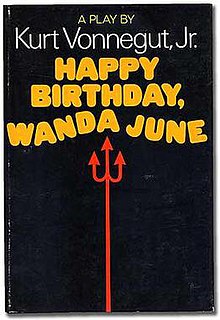
Review: Happy Birthday, Wanda June, by Kurt Vonnegut

Happy Birthday, Wanda June is Kurt Vonnegut's response to the uber-macho values of Ernest Hemingway, whose ideas of manliness involved killing animals for sport. This didn't just include Hemingway's fondness for bullfighting, whose goal is killing bulls as efficiently and elegantly as possible, but also Hemingway's hunting of exotic animals. Vonnegut wonders at the destructiveness of this sort of "heroic" manliness. It's the sort of thing that led to the United States dropping two atomic bombs on Japan. Vonnegut inserts his Hemingway caricature into a modern version of Odysseus, who returns home to a different sort of woman than the Greek hero did. Whether or not this is fair to Hemingway as a person, Vonnegut has nonetheless managed to write a witty, entertaining play, even if it does grow a little too preachy at the end.

Penelope Ryan's husband, Harold Ryan, went on a safari and has been missing for eight years. His son, Paul, was four when Harold left, but Paul worships the father he wished he'd had. Many people, in fact, worship Harold Ryan. That's because Harold is a war hero, having killed hundreds of Nazis, some with his bare hands. The killing didn't stop with the war, however. Harold loved to hunt, but after eight years he had been long assumed dead. Penelope finds herself with two suitors chasing after her: Herb Shuttle, a vacuum salesman who dreams of being Harold, and Dr. Norbert Woodly, who opposes violence of any kind and despises the hunting trophies that still litter the Ryan household. Unlike Homer's Penelope, Vonnegut's Penelope encourages both men, alternating between dates with each one. Paul hates them both, but he hates it even more that nobody seems to care it's his father's birthday.

But then Harold makes his return, along with his friend, Colonel Looseleaf Harper, who is haunted by his decision to drop the first atomic bomb. He just goes along with what others tell him, including Harold. Harold believes that when he returns home, everything will return to normal. And if his wife is a bit hesitant in her enthusiasm, well that's nothing a trip to the bedroom won't cure. In this he is sadly mistaken. Even his son is uncertain of what to make of him. Harold seems to despise his own son, believing him not to be manly enough. He even shoos Paul outside in order to get a chance to be alone with Penelope, but Penelope locks Harold out of the bedroom. She's had a college education and she's gotten different ideas of her husband now. Heroes are the type of people, she says to him, who hate home and try to stay away as often as possible, but when they are home they make "awful messes." That's exactly what Harold Ryan does.

Wanda June is also a character in the play. She's a ghost of a ten-year-old girl who was struck and killed by an ice cream truck. So it goes. She's in the play because Shuttle, wanting to appease Paul's anger over people ignoring his father's birthday, buys a birthday cake. This one was on sale because the little girl's parents didn't pick it up. Wanda June is a ghost in heaven, and heaven is such a great place because people can do anything there. She befriends Major Siegfried von Konigswald, a Nazi officer who is also known as the Beast of Yugoslavia. The Major was killed by Harold Ryan. But he and Wanda June say you shouldn't be mad at people who kill you. In fact, it's so great to be up in heaven that people should kill each other more often. This is obviously satire aimed at the likes of Harold Ryan, who believes that being killed in battle is an honor. It's not, Penelope counters, because being killed means you no longer exist. To the Harold Ryans of the world, dying means going to a heaven where you can play shuffleboard all you want and tornadoes will bounce you around but never hurt you. It's a grand place, so nobody should be upset over a little bit of killing.

Harold Ryan truly is a piece of work. He's the most interesting part of the play because he's such a monster. He has a manliness that's tough not to admire, but a personality that's easy to hate. He treats others with derision. He tells his wife to make breakfast without an ounce of gratitude and toys with the emotions of his son. Nobody is good enough for him. There's a part of Hemingway's own work that Vonnegut seems to be reflecting in Harold Ryan. Hemingway is critical, in his prose, of those who don't fit in with his ideals of manliness, which is hardly anybody. Just think of Robert Cohn, from The Sun Also Rises, and the hatred poured on him by the main character. Harold Ryan is the behind the scenes manly man, who drives several wives to drink themselves to an early grave and is now struggling to keep his current wife in his good graces. Vonnegut's values tend to match our own modern values of gender, where men have a growing role in raising the child and taking care of the home and even, God forbid, cooking and doing laundry. Gasp!

The one problem with the play that I have is its turn into moralizing and explaining at the end. There's a verbal showdown between Woodly and Harold where Woodly explains who Harold is and Harold, unbelievingly, sees himself in a new light, as though the conceited man the audience has grown to hate could be so easily swayed. Not that I am going to ruin what happens, as it isn't quite so predictable as you think. While I do agree with Vonnegut's message, the delivery is too direct. His depiction of Wanda June in heaven is effective because of its subtlety, and Vonnegut should have stuck with subtlety rather than pointedly stating his play's overarching "message." Yet I would still highly recommend this play. It has plenty of moments of witty humor and plenty more moments of tension-filled dialogue. Besides, people should read more, no matter what it is, because then there would be more peace and less killing. Dr. Norbert Woodly would love that.

Wednesday, March 12, 2014

Review: Cat's Cradle, by Kurt Vonnegut

Kurt Vonnegut wrote his most well-known works less than two decades after George Orwell published 1984, yet the themes between Orwell's work and Cat's Cradle are very similar: the consequences of the existence of nuclear weaponry. Orwell's biggest fear was that nuclear war would pave the way for authoritarian governments to rule the world. Vonnegut's biggest fear, however, was that nuclear war would lead to the annihilation of the human race. In the face of complete devastation, what is the meaning of life? Vonnegut's characters, and perhaps even Vonnegut himself, struggles with this nihilistic attitude. They, like all of us, would like to believe life has a greater meaning.

The story is told by John, in the first person, as he attempts to write a novel titled The Day the World Ended. The novel's opening line establishes its struggle with nihilism: "Call me Jonah." This is an obvious reference to Moby-Dick's opening line, "Call me Ishmael." Except in this case, the main character isn't really named Jonah, but John, suggesting he has a desire for a name fraught with Biblical meaning instead of a common name with no meaning.

John's quest is to learn everything he can about the father of the atom bomb, Felix Hoenikker. Felix is dead, but he has left behind three children: Frank, who has disappeared; Angela, who was forced to live much of her life as a caretaker of her father; and Newt, who was born a dwarf and has artistic aspirations. John writes letters to Newt in order to learn what it was like at the Hoenikker house the day the bomb was dropped. Turns out it was just an ordinary day. John also visits Dr. Breed, Felix's supervisor, and from him learns about a mythical weapon Felix imagined called Ice-Nine. Ice-Nine would be capable of freezing all bodies of water at once, depriving the world of what it needs to sustain life. What Dr. Breed didn't know was that Felix actually did create Ice-Nine.

Just as Vonnegut makes up an alien species in Slaughterhouse-Five, he makes up a religion in Cat's Cradle. This religion is Bokononism, founded by Bokonon, whose purpose is to show that people can be made to feel good by a religion based on lies. The Book of Bokonon warns that its teachings and writings are nothing but lies, but John, much like the rest of the followers of Bokonon, glaze over that part. Bokonon teaches that all people have a karass, which is a group of people connected by some force, and that each karass is driven by two wampeters, one waxing and one waning. The supreme act of Bokononist love and peaceful meditation is to touch the naked soles of your feet to those of another person, and this is called boko-maru. Vonnegut makes up many other Bokononist words as well, and defines them, though they sound meaningless. Perhaps that's the point.

Also made up is the island of San Lorenzo, which serves as the setting for the novel's second, and most entertaining, half. San Lorenzo is where Bokonon developed Bokononism, and it's also perhaps the only place in the world the religion is simultaneously outlawed yet practiced by all the people. Most of the important action happens on San Lorenzo, as it's the place where John meets the majority of the important characters. There's Mona, daughter of San Lorenzo's president, whose beauty was a huge inspiration for John's visit. Other very interesting events occur there, but I don't want to spoil the novel.

Cat's Cradle is a book that perhaps sometime in the near future I will have to visit again. I was not too impressed by the first half of the novel. There's a lot of background story, and then John happens to randomly run into people related to those he is interested in. When he comes upon Dr. Breed's son at a graveyard, it feels too much like Vonnegut is pulling the strings rather than letting the pieces fall naturally together. Maybe a second reading will change what I think of this first half, especially because the second half is so wonderful. It's where the book truly comes to life, making me laugh and feel depressed all at once.

There is a subtle undertone of anger reverberating through the novel. Many of the characters seem angry about something. Newt is angry about his small stature, and Angela is angry about her tall, unattractive stature. Dr. Breed is angry about John's seeming inability to truly understand science. John seems angry about the mass destruction that has been carried out with the aid of advanced science. Only the Bokononists on San Lorenzo aren't angry. They seem at peace, though they also seem apathetic. Vonnegut turns some surprising events on the island into great use as satire of a people's apathy towards governmental affairs. This is sad, funny, and scary all at once.

The title itself is the biggest clue regarding the novel's nihilism. Felix Hoenikker loved to make a cat's cradle out of a piece of string, but as Newt points out in one of the novel's most passionate lines, "There is no cat. There is no cradle." The cat's cradle is just a big fib. It's name has absolutely no connection with the design it creates - so why call it the cat's cradle? Newt has grown disillusioned by the magic of the world. Perhaps that's why religion is important, even the lies of Bokononism (and the rest of them, as Vonnegut seems to be suggesting), because it keeps magic alive in people's hearts. The atom bomb may have destroyed much of this magic because it portends the end of a world that humans have spent hundreds of thousands of years surviving and making meaning out of. All of it threatens to come crashing down by a single weapon that is the product of the knowledge passed down through humanity's history. Instead, let's follow the example of Bokonon: let's remove our shoes, sit down, and press the soles of our feet together in peaceful boko-maru.

Monday, October 1, 2012

Review: Slaughterhouse-Five, by Kurt Vonnegut (1969)

Slaughterhouse-Five sets out to protest war without glorifying it, and it succeeds in accomplishing that task. Vonnegut can find no answer for mankind's decisions to commit gross violence against its own kind, except in the meaningless song of a bird: "Poo-tee-weet?" He purposely does not develop his characters with any depth, a decision that works because it signifies the toll that war takes on the individual. The novel's hero, Billy Pilgrim, wanders through life with little concern or feeling for anything. It doesn't seem to bother him that he slips through time, to the past, the present, and the future. Then again, I wonder if it's possible to read the time travel element on a less literal level. As I was reading it, I couldn't help but wonder whether the alien species called the Tralfamadorians were a part of Billy's damaged postwar mind, a symptom of post-traumatic stress disorder.

At some point of his life, Billy Pilgrim became "unstuck" from time. This means he can travel to any moment in his life at any time. Not that he does this willingly. He seems to travel from one moment to another at random, and he has no choice but to revisit that part of his life. In fact, all moments of his life exist at all times, which means he is both dead and not dead at all times. For narrative purposes, these moments aren't just puked up into one blob on a page, but there is a semi-logic to the order that we see them. There is also a semi-chronological order to them. For the most part, we learn about Billy's service in World War II chronologically. The rest of his life progresses in a less chronological manner, and we also know things that are going to happen, such as the death of Edgar Derby, long before they do happen. But that's the Tralfamadorian way.

What does happen to Billy Pilgrim is much less important than how Vonnegut presents what happens to him. Billy is a pathetic person who seems to react to the events in his life with a resigned hopelessness. Billy doesn't protest the unfairness of his life, and in some ways even seems blissfully unaware of how unfair his life is, as when he walks around as a prisoner of war in ridiculous clothing for his own warmth, to the amusement of spectators. I've heard critiques of the novel as "quietist," suggesting that Vonnegut is trying to say people should resign themselves quietly to their fates as Billy does. However, I believe Vonnegut is commenting on reality rather than offering suggestions to help cope with life's atrocities. This is especially relevant today, when you read that veterans have dramatically higher suicide rates than the rest of the population. They've simply lost the will to go on.

Vonnegut makes lots of use of irony, satire, and humor, and in surprising ways. The famous line from the novel, one he uses in relation to death, "So it goes," seems to comment on society's desensitized attitudes towards death. The phrase calmly and easily tosses the impact of death aside, yet sometimes the reader can't help but feel its effects immensely, particularly in the way the phrase actually draws more attention to death. Vonnegut has a gift for drawing the reader's attention to the sadness of human fate by making us laugh. One of the funniest scenes of the book takes place at a POW camp, where English POWs welcome the exhausted Americans by putting on a play of Cinderella. At one point Billy laughs and can't stop laughing until his laughter turns into shrieks and he has to be carried into the hospital. I don't think I laughed harder in the novel than at this point, but I felt guilty for laughing. Billy's uncontrollable laughter was a product of the horrible things he experienced in the war up to that point.

I also wonder whether we're not supposed to find irony in the idea that Billy has come "unstuck" from time. In fact, I believe Billy has become stuck in time, and in multiple senses. He seems to wander through his adult life, in the 1960s, trapped in two other places: Dresden and Tralfamadore. While other things happen to him or around him his mind travels back to his time in the POW camp, and when he returns, sometimes details return with him. The feet of dead prisoners are referred to as being "blue and ivory," and later when Billy wakes up next to his wife and gets up to use the bathroom, his feet are blue and ivory. At other times he seems so caught up in his thoughts about Tralfamadore that he has no concept for his surroundings, as when his adult daughter scolds him for sitting in a chilly room writing down his ideas about the aliens. His time on Tralfamadore seems to be pure fantasy, as he breeds with a beautiful movie star, Montana Wildhack, for the research purposes of the Tralfamadorians. Is Tralfamadore real, or a product of his damaged psyche?

There seem to be lots of hints scattered about that Tralfamadore is a product of Billy's imagination. After his first encounter with Montana Wildhack, for example, he wakes up in his home in Ilium to realize he's just had a wet dream about her. That his perhaps imaginary experience on Tralfamadore serves as a coping mechanism for his experiences in the war can be found in parallel descriptions about him undressing in Dresden and on the flying saucer. Kilgore Trout, Billy's favorite author, is probably the biggest piece of evidence to show that Billy has only imagined his encounter with the Tralfamadorians. For one, many of the ideas we learn from Trout's books are very similar to details we learn about the Tralfamadorians, such as the fact they can perceive sexes in the fourth dimension. But Trout is also a big clue about the reliability of the narrator.

We can assume the narrator is the author himself, since Vonnegut makes many mentions of himself in the first person. Some of what he says is factual. Dresden was bombed, and Vonnegut was there when it was bombed. However, Kilgore Trout is a fictional person, though he's not treated as such. This mixture of fact and fiction, both told as though they were one and the same, clues the reader in that we can't necessarily take the narrator at his word. Thus, though he describes Tralfamadore as though it were real, that doesn't mean it is. It could very easily be a product of Billy's post-traumatic stress disorder, a coping mechanism. The idea that Billy can see all times of his life is never fully established either. We don't really know when the present time is, so it's difficult to gauge whether we truly do see into Billy's future. There is a scene where Billy describes how he dies, but this scene is tricky. It's not written as something that has or is happening, as the rest of the scenes are, and the narrator states it not as fact, but as something Billy has said. The question is, can we take Billy at his word? I don't think so.

Kurt Vonnegut has sympathy for the small guy, the sort of people who tend to be the victims of such things as war. That's why his story has no heroes in it. The only heroic thing anybody does is when Edgar Derby stands up and delivers a short diatribe against Nazism to a senior Nazi official, but the speech really doesn't mean much in the long run. Vonnegut's sympathy is strongest in his, or Trout's, criticism of the story of Jesus Christ. The problem is that when Christ was crucified, he was a somebody, the son of God, and so it was a huge mistake for the Romans to crucify a man who had such powerful connections. Vonnegut, or Trout, believes the story would be improved if Christ was crucified as a nobody and then God decided to name him man's savior. As it stands, it's okay to do whatever you like with somebody as long as they don't have connections. Somebody like Billy Pilgrim or Edgar Derby. For a powerful man like Jesus, revenge will be had, but for the rest of us, only the birds will speak up: "Poo-tee-weet?"

Friday, September 21, 2012

Book Beginnings: Slaughterhouse-Five


Every Friday Rose City Reader hosts Book Beginnings on Fridays. What you do is share the opening line(s) of the book you are currently reading and briefly discuss what you think about the opening line or the book or whatever else inspires you. Make sure to share your entry with Rose City Reader and in my comments below.

Here's my book beginning:


"All this happened, more or less."

-Slaughterhouse-Five, by Kurt Vonnegut

This comes from the introduction of the novel, which is actually chapter one. It suggests that what Vonnegut has to have afterward is not all fiction, though what is and what isn't may be hard to say. Certainly, nobody was ever abducted by aliens, but perhaps Vonnegut's suggested symbolism is true, as a representation of post traumatic stress disorder. I'm over halfway through my second reading, and it's even better this time around.