Showing posts with label Neil Gaiman. Show all posts

Saturday, August 27, 2016

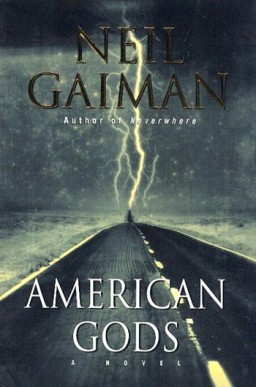
Review: American Gods, by Neil Gaiman

In its meandering ways, American Gods is an underwhelming behemoth of a novel. Neil Gaiman himself is a god in the fantasy writing world. His writing is magic and he has written some fantastic pieces of fiction, both in novel and graphic novel form. His voice is also a work of art. He deserves a spot up there with Morgan Freeman and Werner Herzog in creating magic with that voice. While reading American Gods, I couldn't help but hear how his voice might pronounce phrases, the way he might pause, or the way he might stress certain words. And yet Neil Gaiman is not a god (and I'm not implying that he thinks he's one, either). While others may treat him as a god whose pen turns everything he writes into gold, he does misfire now and then, and American Gods is one of those misfires.

Halfway into my reading of American Gods, I was puzzled by my inability to appreciate the work as others had. Despite the praise I had both heard and read, I was bored. I wasn't engaged. The humor was lacking or muted. The characters, none of them, were particularly well-drawn. Shadow is a nothing of a character, somebody who has things happen to him and who does what he is told. Shadow is not unlike the main character from The Ocean at the End of the Lane, about whom I also had the same complaint. This work never quite develops a fully coherent plot, nor does it provide itself with much of a purpose. It feels like it should be deep in purpose, but whenever I try to grasp for it, I come up with nothing. Too many of the travels and plot events end up going nowhere.

Perhaps part of my problem was that I didn't care. I didn't care about the gods. I didn't care about Shadow and what happened with his wife. The gods, and Shadow's wife, turn out to be very unlikeable, and I think that's on purpose. But the gods are the biggest problem. Gaiman is probably trying to say something profound by showing all the gods from all over the world who have come to America at some point or another and have been forgotten. The question is, is it bad that they are forgotten? Is this saying something about America? Is there a critique somewhere in there? I mean, there are plenty of gods who are no longer worshiped. Along with the Norse gods like Odin and Loki and Thor, there are the Roman gods such as Zeus and Athena, and the Greek gods. What is Gaiman trying to get at? I couldn't grasp it.

The other problem comes down to the idea that there is a conflict between the new gods and the old gods. The new gods are gods of internet and television and whatnot. How are those gods? Where do you draw the line? Gaiman suggests that where people used to sacrifice living things to gods, people now sacrifice time. So shouldn't everything that we sacrifice time to be a god? I spent a lot of time reading this book. Do books have a god? Do commutes to work have a god? Does work itself have a god? School? Studying? Vehicles? Zoos? Parks? And on the same line as the previous paragraph, is Gaiman providing a critique in this conflict? The problem was that I spent time attempting to see his larger point, and every attempt I made grasped at straws. People may just say I don't get it, and I can't say I disagree with that. I don't get it. When it comes down to a conflict between gods, I didn't care. The gods were not human enough and whatever they were trying to symbolize is not convincing enough.

Gaiman has proven himself to be a great meanderer. The Graveyard Book is an excellent example of his meandering, and in that book it works. It's fascinating the way he creates a world and brings it to life. In American Gods, though, his meandering merely muddles his world. I get a feeling of fatigue, of searching for purpose. Gaiman has also proved that he can write terrific stories with clear plots. Neverwhere played to Gaiman's best strengths with humor, well-developed characters, and villains who were both amusing and terrifying. In American Gods, anytime Gaiman seems to be getting somewhere, the novel gets stuck in a rut. His villains aren't particularly interesting or scary, and his gods are mostly terrible people, too much to care about. Wednesday charms teenage girls into having sex with him and tricks hardworking people out of their money. Another god swallows men with her vagina. The gods seem more like villains than people we should root for, and I wasn't sure what Gaiman wanted his readers to think.

One consistent thing I saw in reviews, is that if this was written by anyone other than Gaiman, such and such a reviewer probably would have enjoyed the novel more. This doesn't make sense except to elevate Gaiman to that status of a god. It's as if to say that he is such a god that an inferior work written by him would be an excellent work written by another, lesser writer. American Gods would have been as meandering as it is no matter who wrote it, but it might not have seen the same praise. But because this is a Gaiman work, there is some enjoyment to be had. There are moments that do work, where the reading is pleasant even if the purpose is unclear. That said, I would still have trouble recommending this to anyone but a Gaiman fan, or a fan of mythology. Others may find themselves thinking Gaiman is overrated, and they would be wrong. This simply is not one of his better works, in my mind.

Monday, June 20, 2016

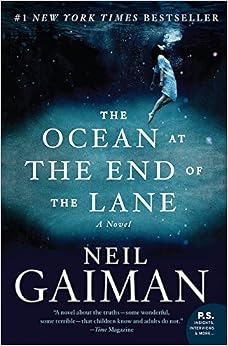
Review: The Ocean at the End of the Lane, by Neil Gaiman

Even when his stories are slightly less than satisfying, Neil Gaiman's prose still manages to be absorbing and beautiful. And, as I listened to the Audible version of The Ocean at the End of the Lane, Gaiman's voice is equally absorbing. He doesn't attempt any funny tricks or give each character a different voice. He simply reads and his voice is magic. As I listened while the narrator (not named) is eating a honeycomb soaked in milk, my mouth watered from Gaiman's evocative prose. The Ocean at the End of the Lane is a novel that's not quite a novel (pretty short) and that's not quite young adult and not quite adult. It's a novel that is anchored by a somewhat terrifying, enchanting middle, but left wanting at both ends.

What begins much like a memoir, transforms into a tale of magical realism when the narrator meets a family called the Hempstocks. This family of three women, Gran Hempstock, Ginnie Hempstock, and Ginnie's daughter, Lettie Hempstock, have extraordinary power, able to listen in on conversations from a distance and suggest thoughts and words and actions into the minds of others. The narrator barely bats an eye at this magic. At seven years old, magic is a given. He befriends Lettie and she takes him on some adventures, one of which gets him into some trouble. The novel's slow unfolding eventually rewards patient readers when we finally meet the novel's villain, the wonderfully named Ursula Monkton.

Ursula is not what she seems, and only the narrator knows this. To everyone else in his family, she is a godsend. His mother sees her as the perfect babysitter; his sister claims her to be her best friend; and his dad finds her to be excitingly attractive. When the narrator doesn't fall in line like his family, Ursula lets her power show, entrapping him in the house. Behind her beauty lurks a powerful terror. These scenes are Gaiman at his hauntingly best, and Ursula does more than enchant his family, but the reader as well.

As evocative as Ursula Monkton is, the rest of the novel fails to match her charm. The narrator is a dull, powerless boy, and it is in the vein of modern stories that the main character passively witnesses extraordinary things happening to and/or around him, but he never actively engages in the action. Gaiman's purpose, I believe, is to show how powerless and fragile is man when faced against more powerful forces, but the issue in this case is that he fails to provide a well-developed character who has emotional weight.

Adding to the sense of tedium is the use of cliches throughout this work, something I don't quite expect from Gaiman. These are not obvious cliches, but there were many instances where, while listening, I could predict the next sentence because it was the sort of thing that had been written many times before. When the narrator tells Ursula Monkton, for example, that he isn't afraid of her, it isn't much of a surprise when he needlessly reveals to the reader that he is, in fact, afraid of her. Still, the brevity of the novel means it won't take up too much of your time, and Gaiman does provide some satisfaction even as you wonder if it is a necessary story.

Tuesday, June 30, 2015

Review: Stardust, by Neil Gaiman

I listened to Stardust on Audible, as read by Neil Gaiman, who does an excellent job bringing his story to life. And yet, as much as I admired Gaiman's reading, I couldn't help but feel that the story plods along too slowly, with too many detours, and not quite enough excitement. Everything falls into place so neatly and without much suspense. It's all a little too pleasant.

Tristan Thorn lives in the city of Wall, a fictional place in England that separates the "real" world from the "fantasy" world of Faerie. Tristan is in love with Wall's most beautiful woman, Victoria (thought I imagine he has slim pickings in such a walled off town), and sets off to collect a fallen star in exchange for her love. Wall's entrance and exit is guarded 24/7 and nobody is allowed to come or go, yet Tristan gets a special pass. This is because he is not one hundred percent human. His father made love with a faerie woman during a festival many years before, and everybody in Wall except Tristan seem to know this. So the guards allow him to leave.

The fallen star is not simply a hunk of rock and metal, but it takes the form of a young woman named Yvaine. And Tristan is not the only person after her (falling stars are not uncommon in this fantasy world, it seems). The Lord of Stormhold, old as he is, tosses a topaz into the sky, which knocks Yvaine down to Earth, and sets his remaining living sons on task to find the topaz. He who retrieves it will gain Stormhold. That is, if Septimus, the seventh son, doesn't kill them all first. There is also a witch, named Lamia (in the movie), who sets off to collect the star's heart and bring it to her sisters so they can eat it and regain their youth.

While all of the side plots are relatively simple, the problem is that there are too many interruptions to the story. This problem arises right away when the story begins from the perspective of Tristan's father and of his meeting and coupling the fairy. When it switches to Tristan, I couldn't help but wonder whether the story's opening was necessary. Sure it sets up the fact that Tristan is different, but Tristan's half-human, half-faerie quality is barely harnessed. He knows the location of any place if asked, though he doesn't knows how he knows this. And the story breaks often to tell of what the witch is doing, and the point of this only seems to show off her power. And then there's the somewhat amusing plot around Primus, who seeks to avoid assassination from his brother.

There's also the problem that everything is predictable and the resolutions to these plots are anticlimatic. The obvious prediction is that Tristan will fall for the star. Yvaine spews so much hatred towards him when they first meet that you know by the end it will turn into love. Throughout the whole story, neither Tristan nor Yvaine need to lift a finger to get out of any predicament, except once. Tristan is helped all along the way, first by a mole-like creature who provides him a magic candle that allows Tristan to cover lots of ground quickly. The only time Tristan does anything to save himself is by thrusting his arm into fire at just the right moment in order to light the candle and escape the witch. Otherwise there is always some sort of convenience that allows Tristan and Yvaine to skate past danger unharmed. While there is a lot to be said about Gaiman's magical prose, it's the story that's most important, and in this case the story just grows dull.

Monday, June 29, 2015

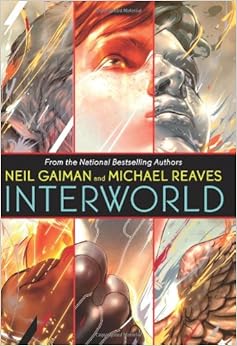
Review: Interworld, by Neil Gaiman and Michael Reaves

An interesting tidbit in the book's "Afterword" mentions that Interworld was originally planned as a television series in the mid-90s. That idea was scrapped however, as there was concern over the audience base, and the story was later written into a young adult novel in 2007 (and a now completed trilogy). That concern over the audience is legitimate, as authors Neil Gaiman and Michael Reaves can't seem to decide whether to aim this at a younger audience or an older audience. On one hand, the science behind the story is surprisingly complex. It's so complex that there were several passages that went way over my head, but those were the moments that intrigued me the most. On the other hand, the plot goes the usual way of young adult action stories, with paper-thin characters and an improbable showdown between the good guys and bad guys. If Gaiman and Reaves stuck with one or the other, they may have had something.

Gaiman fans may recall Neverworld as they read Interworld, as both stories are about a character who somehow has the ability to travel to parallel worlds. In Interworld, that character is Joey Harker, a high school student who has absolutely no sense of direction. That is, until he realizes he has the ability to Walk. Walking means to travel between the different parallel universes through a space called the In-Between. To Walk requires an innate ability to understand the In-Between, which Joey has. He doesn't realize this until the day of his social studies final exam, given by his teacher, Mr. Dimas, whose teaching methods seem questionable. The exam puts students into groups, blindfolds them, and sets them off into a random part of town, from which they must make their way back to school. Joey, of course, gets lost, and in his panic, he Walks.

During his Walking, Joey bumps into an armored stranger who wants him to follow him. Panicked yet again, Joey flees and Walks into another group of strangers who use magic to put him under their spell. This is when we learn who the first stranger is. His name is Jay, and it is his recorded journal entry that changes the novel from mundane young adult fiction into something much more interesting and complex. Joey Harker's ability to Walk is not his alone, or maybe it is, but also the infinite versions of Joey Harkers that exist in all of the parallel universes. Jay is one of these. These Joey Harkers have different names, all beginning with the letter J, and some are different sexes and others are different species (one has wings, one is like a werewolf, one is a cyborg), and all are different shapes and sizes. Joey, amongst all of these, is the plainest, but, oddly enough, plainness is usually what makes one a hero in stories like this.

Jay rescues Joey and, after some plot turns I won't reveal, gets him back to the home world, the Interworld, a base that floats from universe to universe, untrackable except by Walkers. Here we learn that the construct of the Altiverse (which contains the infinite universes that frequently pop up) is like a spectrum. Instead of our political spectrum of left and right (democrat and republican), the spectrum falls between magic and science. Some worlds are entirely magical, and these worlds produce persons who can use magic. The worlds based on science produce very sophisticated technology. Then there are worlds in between, that have a little of both. Our Earth would fall more in the science side, but close to the middle of the spectrum. This spectrum is important, because a balance must be kept. However, two organizations, HEX and Binary, fight to make the Altiverse fit squarely into only one side, science or magic. Interworld's job is to make sure the balance remains intact. Thus we have themes of not just science vs. spirituality, but the damage wrought by humanity's turn to extremes.

The story is peopled with many characters, though none are very complex. Just as is the case for many young adult adventure stories, most of the characters are just names with one character trait, and even Joey is paper-thin for a hero. It seems Gaiman could have made a much more interesting story out of one of the other versions of Joey, such as J/O, the cyborg with a Napoleon complex; or Jo, the winged girl; or Jakon, the werewolf girl; or Josef, the tanky kid whose version of Earth has a very strong gravity. The most interesting character of all is Hue, a mudluff, or a creature that resides in the In-Between. The In-Between is apparently peopled with mudluffs, who are supposedly dangerous, but Hue is the only one we meet, and he is hardly dangerous. Hue is a bubble-like creature who can change colors, which is how he communicates. He grows loyal to Joey and also serves as a plot device to move the story forward at several key moments. It's difficult to imagine the story working without Hue.

The main trouble with the story, however, is choosing its audience. It begins with the young adult audience in mind, with a kid worried about impressing a girl clearly not interested in him, and the usual teenage concerns written into such stories. Then the story grows more thematically complex, and it dives pretty deep into the science behind parallel universes, as Joey gets some schooling in Interworld, a la Harry Potter in Hogwarts. In this stretch there were moments of humor and moments of philosophy, and also a surprisingly touching moment involving Joey's mother. But then the story leaves behind the complexity and dives yet again into the young adult story formula. Not that I mean to degrade the young adult genre, but there are certain conventions some authors use that clearly mark a story as young adult, and those conventions are so predictable that it is difficult for adults to enjoy. That's where Interworld heads, which is a shame. I was beginning to feel that this was going to be another masterwork from Gaiman, but instead grew disappointed.

So who does this appeal to? Not to adults who would like something more from the plot, and not to teenagers who may grow bored with the lengthy passages dealing with the science. It's a very strange novel, in that regard, and makes me wish that authors didn't aim to make a story young adult, but trusted in the ability for young adults to enjoy a good story. Gaiman's Graveyard Book is aimed at young adults, but is written in such a way that adults can enjoy it as well. The misstep in Interworld is Gaiman and Reaves' belief that teenagers could be smart enough to understand or enjoy the science, but without realizing that teenagers that smart would also desire something more than the easy-to-predict storyline. This paradox makes it difficult for me to know who to recommend the novel to, except fans of Gaiman who are willing to read anything he writes.

Wednesday, May 30, 2012

WWW Wednesdays


WWW Wednesdays is a meme hosted by a blog, Should Be Reading. What you do is answer the following three questions:

What are you currently reading?

I am currently reading Cat Among the Pigeons by Agatha Christie. It's my first time reading a novel by her, and I am enjoying it so far.

What did you recently finish reading?


I recently finished reading Neverwhere by Neil Gaiman. Highly recommended!

What do you think you'll read next?


I am considering reading a young adult fantasy novel called The Gammage Cup by Carol Kendall.

Friday, May 25, 2012

Book Beginnings: Neverwhere

I've decided to try something I came across today posted in the blog, Rose City Reader, called Book Beginnings on Fridays. Bloggers post the opening line or lines of the book they are currently reading and share with others. Then you share your thoughts on the book/opening line. Here is my book:


"The night before he went to London, Richard Mayhew was not enjoying himself."

- Neverwhere, by Neil Gaiman

I'm almost finished with the book and I would definitely recommend it. As you might guess from the opening lines, Richard has some bad days ahead of him. The book has lots of humor, great characters, and a neat world set in the London Above and the London Below.

Friday, May 18, 2012

The Graveyard Book, by Neil Gaiman (2008)

The Graveyard Book is a delightful fantasy, a recreation of Rudyard Kipling's The Jungle Book. It is a tale about a boy raised in a graveyard by ghosts, rather than a boy raised in a jungle by animals. Gaiman is a prolific writer, having written adult novels, young adult novels, graphic novels, and even movie screenplays. This is the first novel of his that I have read, and I am curious to read more. He writes in a very playful style, with a narrator who isn't afraid to be witty, and on top of that, the story is entertaining, too.

Nobody Owens, or Bod, is adopted by Mr. and Mrs. Owens, ghosts who reside in a London graveyard. Silas, a creature that can travel between the world of the living and the dead, appoints himself as Bod's guardian. Only he has the ability to leave the graveyard and fetch the boy some food. On the night Bod is adopted by the Owens family, a man called Jack kills his entire family, but his job won't be over until he also kills Bod. However, Bod is protected by the Freedom of the Graveyard, which allows him to do such things as Fading, Slipping, and Dreamwalking. As long as he is in the graveyard, he can turn invisible from any human. These abilities will be crucial for his survival.

The story is about his life as a child up until his mid-teens. During this time he has many adventures and meets many new people. He befriends a living girl named Scarlett, who isn't sure if he is imaginary or not, but is quite certain the ghosts he claims to be talking to are made up. Bod shows her a dark secret of the graveyard, a tomb down a flight of stairs where a creature called the Seeker resides, waiting for the arrival of its master. This frightens Scarlett and she isn't sure if she can trust him anymore, but before she can decide, her parents decide to move away.

Bod meets other interesting creatures, as well. Miss Lupescu is assigned to be his tutor and guardian when Silas must leave for a short while. She is a boring lady with an interesting secret (take a guess). He has an adventure with ghouls, who want to turn him into one of them. He meets a witch in the graveyard, named Liza, who everyone warns him about but she seems pretty nice. He participates in the Dance of the Macabre, the one time of the year when the living and the dead interact, though nobody remembers it the next morning. And Scarlett makes a return visit, and her mother, now divorced, takes a liking to Mr. Frost, a historian who has been studying the graveyard Bod lives in. Inevitably, of course, Bod will have to deal with the man Jack, who is patiently hunting him, and I will say no more about that.

Gaiman has a very engaging writing style. He inserts wit wherever he can and has the ability to generate a laugh out of even the dullest moment. His dialogue is particularly good. He does a great job of infusing personality into the voices of his characters. Silas is mysterious and terse, leaving Bod desiring to learn more. Bod himself is very clever. When he speaks with other humans, the fact that he is different is readily apparent. He is very intelligent, but his knowledge is limited mostly to what the ghosts in the graveyard know, which is centuries old, and so his manner of speaking is odd to other humans. Gaiman does a great job of connecting his many side stories, as well. We see how Bod learns something new from each conflict he comes across, and this helps the novel feel connected.

The final stretch of the novel is much more suspenseful than the rest, as it involves scenes with the man Jack, but it is also the most disappointing. Inevitably, all questions are answered during this final stretch, and satisfying as the answers are, they are rarely as fascinating as the questions, in any story. Also, the novel makes use of the talking villain syndrome, in which the villain explains everything to the boy, giving the boy extra time to carry out his plan to defeat said villain. I suppose this is standard for the genre, though otherwise Gaiman is careful to avoid cliches.

The novel is billed as a children's book, having been awarded the Newbery Honor Medal, and this seems appropriate. Some of it can be scary, like the man Jack and the Seeker, but the scary parts aren't too scary. The story is really a lot of fun, and one that parents would enjoy as well. It is over 300 pages long, but is a very quick and easy read. When compared to other popular novels of its age group, such as Harry Potter and The Hunger Games, The Graveyard Book shares the whimsy and fun of the Harry Potter books but lacks the violence of The Hunger Games. By the end of the tale, you can at least feel good knowing that Bod has learned a lot and grown into a fine young man.


Even if you are not familiar with The Jungle Book, I recommend you read Gaiman's The Graveyard Book.