Tuesday, August 8, 2017

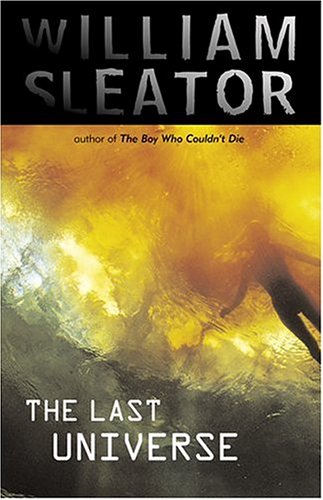
Review: The Last Universe, by William Sleator

What begins as a rather mundane tale about a girl whose older brother has been crippled by multiple sclerosis transforms into something pretty amazing by the end. William Sleator is an author I've discovered only recently, and I'm glad I did. His stories tend to involve regular young teenagers who are cast into extraordinary circumstances, generally involving some bizarre science phenomenon. Boltzmon! has its hero meet an apparently real being that is able to teleport him between alternate worlds, and The Boxes introduces a young boy to clockwork creatures that are able to play with time. And now The Last Universe is about a pair of teenagers who discover the awesome, yet unpredictable, power of quantum mechanics. Yes, the human story, and even the story of the crippling disease, is rather weak. But when Sleator introduces the science elements, things begin to grow interesting, and I even learned a thing or two about quantum mechanics.

For Susan, it is sad that her brother is slowly dying from a disease that physically weakens him, but it's also a drag. She's stuck at home, being kicked off her instant message chats with friends in order to take her brother, Gary, for walks in his wheelchair. He likes to go for walks around the expansive garden that comprises the backyard, though he isn't necessarily piqued by the idea that he can't actually walk himself. In the backyard they often run into the gardener from Cambodia, Luke, and his cat, oddly-named Sro-dee, though it makes sense later on (and for those who know a little about quantum mechanics). Lately, odd things have been happening in the garden. The pond where Susan and Gary's Aunt Caroline drowned has been growing lotus flowers, which Luke claims can't bloom in that sort of climate. Gary seems different too, sometimes more lively, sometimes sulky. He's interested in finding the maze that Susan can see from the kitchen window, but can't ever seem to find it in person, for some reason.

This story is about discovery. About discovering a scientific concept, a new part of the world, and trying to use it to improve oneself. Gary seeks a way to reverse his disease and is confident the maze holds the key. But discovery does not always go the way humans hope. This story shows what happens when people try to use the power of an unpredictable science for their own betterment. This isn't necessarily a story of hope or a story of warning, but a story about the unpredictability of life. No matter how strong-willed one is, and Gary and Susan are certainly strong-willed, the world doesn't bend to that will. I don't want to give away what happens, but I will end by saying that this is a story whose science elements makes it a much better story than it initially seems.

Friday, August 4, 2017

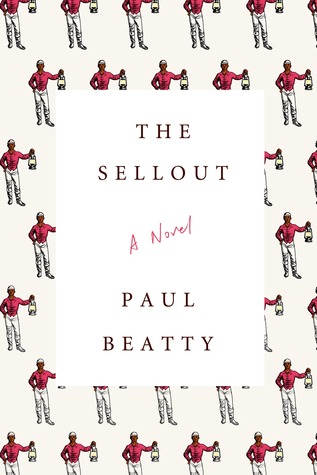
Review: The Sellout, by Paul Beatty

I laughed quite a bit reading this book. Paul Beatty's imaginative inventions are clever and often hilarious, things that seem pulled out of left field, but that are put together much more carefully than they initially appear. And while I can't say I've read many books that caused me to laugh out loud more often than this one, something about it, somehow, still ended up feeling unsatisfying. This feels like a lengthy stand-up routine with loose strands of plot, and I guess when something is built up as a "Swiftian satire" and "a powerful novel of vital import," there's bound to be disappointment.

Beatty's manic energy is overwhelming at first, especially when coupled with his massively long sentence structure. A paragraph later you're left breathless, both because of the laughter and because you're still trying to digest what you just read. The style almost forces the reader to forge ahead recklessly along with him, even though there are speed bumps telling you to slow down, such as the many references scattered throughout his work, many of which you might not know (I sure didn't). This mania does slow down eventually, and this is where the novel is at its best. The description of the main character's father, a psychologist whose social experiments on his son are simultaneously hilarious and sad. The satire comes from the fact that some of the novel's characters want to institute some form of racism, such as the black ex-Little Rascals actor who wants to be a slave or the bus that magically becomes safer when a sign indicating "Whites Only" is placed at the front.

But The Sellout isn't just social satire. There is plenty of humor of the self-deprecating variety, especially in regards to the main character's failed love life. These parts, along with the comical attempt to put a town, Dickens, back on the map (labeling one border with the opening line of A Tale of Two Cities), are feeble attempts at plot. Beatty doesn't seem very interested in plot, really. He allows his writing to travel where his mind takes it, offering plenty of social commentary, often in the form of a series of three lists. So many of the jokes begin to feel repetitive due to Beatty's insistence on using lists as his jokes, and usually one of the three items includes a basketball player's silly smugness over the ability to throw a ball into a hoop. Funny, yes. Hilariously funny, in fact. Glad I read it? Yes. Did it change my life or my perspective on race or the U.S.? Perhaps not. In a world of information overload, this is probably inevitable, so I guess it's okay to have a good laugh along the way.

Thursday, July 20, 2017

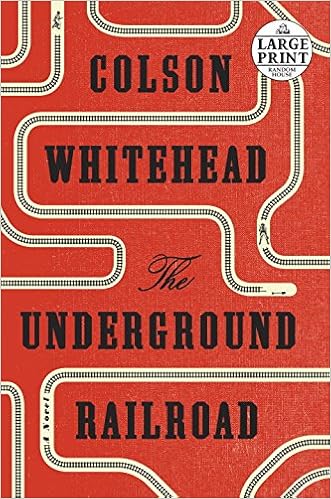
Review: The Underground Railroad, by Colson Whitehead

An unflinching look at slavery and fugitive slaves, Colson Whitehead doesn't romanticize the era, neither slave nor slaveowner, doesn't elevate anyone to a status of hero or villain. The protagonist, Cora, is certainly the hero of the novel, but her acts of violence leave her feeling guilty and mark her as less than good. And the antagonist, the slave catcher Ridgeway, is just making a living carrying out the law of the land, as inhumane as that law was. While the underground railroad that Whitehead portrays is a fantasy, a literal railroad under the ground, the story of slavery is a real one, a harsh reality that reveals the depths of depravity that the people of the United States of America, the country of equality, had once reached. Whitehead shows how slavery not only brought down slaves and blacks as a whole, but was also harmful to whites. In her attempt to escape, Cora learns that it's not so easy to shake off the shackles of slavery and its deleterious effects remain for a long time.

Cora's grandmother was a first generation slave, having traveled from plantation to plantation until ending up in Georgia on the Randall farm. Cora's mother, Mabel, was famed as the only slave to escape the farm successfully, and Cora never forgave her for leaving her behind. But a more learned slave, Caesar, who winds up on the farm when his previous owner duplicitously split his family up, seeks her help to escape. Cora's reluctant. Successful escapes are rare. The whole country is turned against the slave and slave catchers can be ruthless in their hunt. And those who escape often meet horrendous ends. Of course she relents, or there would be no story. Her owner, James, passes away and is replaced by his brother, Terrence, a cruel, vicious man who marks her as his by slipping his hand down her shirt in front of the whole plantation.

While the history books portray slave escapes in simple terms, heroicizing the person who helps the slave fugitive, Whitehead shows the whole process to be messy and bumbling, full of errors. The person helping the slaves escape is not always kind-hearted, but hardened to the work, fearful of discovery, even cowardly. Even the escaping slave is not a model of moral virtue, no Uncle Tom. Cora, in her escape, kills a twelve-year-old boy. Yes, he was trying to capture her and she was fighting for her life, but at twelve, he was innocent, and the charge of murder is a dangerous label for the runaways. It's also a taint on her character. Slavery has shaped her into a vicious person, especially when she senses her life is in danger, and has hardened her from any softness except in rare instances.

I mention romanticism and heroics because often that's how stories of slavery are painted, whether historical or fictional. Many stories about slavery are often concerned with whether a master is kind or cruel, as if that trumps the fact that the slave is a piece of property and not a human being. The slave is portrayed as morally pure, religious, and loving. This strips them of their humanity - no person fits all of those qualities so perfectly. There's a scene where Cora earns work in a museum as a living exhibit piece on a set about slavery. She soon realizes that the slaves are the only ones played by real people. All of the white actors are mannequins. This gives the impression of Cora as a creature in a zoo exhibit. Plus, Cora notices that the stories the exhibit shares about slavery don't mesh with reality. I've visited my share of museums showing slavery in a way that strips it of its violence. Whitehead wants to dispel that myth, of ignoring the bloody violence of the institution. This is made clear when a fugitive slave returned to the Randall farm is punished by having his genitals cut from him, sewn in his mouth, and after three days he is burned alive.

Whitehead's prose is detached and choppy. He uses sentence fragments throughout and his style lacks any smoothness. It's rough, just like the treatment of slaves. Detached as the narrator is, Whitehead doesn't allow this narrator to keep emotional weight at bay. This is an emotionally powerful story, full of suspense, despair, sorrow, and, at times, even triumph. It's also an action-packed story, carrying the reader across several states, lulling the reader and characters into false senses of security before stripping it away. At times Whitehead does spend a bit much time on tangents, philosophizing on the personhood of the slave. While interesting, it does slow down the plot and it's not anything new for those versed on their slavery history. Yet it's only natural that he includes these passages. This is a thoughtful work, one that is filled with powerful moments and never dull.

Monday, July 17, 2017

Review: Passing for Human, by Jody Scott

The only thing that Jody Scott's Passing for Human seems sure about is its manic energy. Each page crackles with an energy unsurpassed by none, and yet this energy is its undoing. Scott, I assume, is attempting to tackle serious social issues, yet her flippant tone makes it hard to take anything that happens seriously. The breathless way Scott jumps from action to action, idea to idea, leaves the reader with nothing to grasp, whether ideologically or visually. I see that the book was originally published in 1977, but never really took off, and now Scott's estate would like to see if her book will fare better after her death. I'm afraid this has aged a lot and many readers won't understand references to Emma Peel or Brenda Starr, though maybe that doesn't matter. The writing style may appeal to those who like frequent mentions of "zowie!" but to others it will grow tiring. This is sci-fi-lite, satire-lite, and just light stuff in general.

An alien race, the Rymesians, are observing Earth to determine whether the planet's dominant species, humans, known to Rymesians as bushmen, deserve to remain alive or not. On this quest is anthropologist Benaroya, often confusingly referred to as simply B. (lazy editing?), Brenda Starr, Brenda, Miss Star, Emma Peel, Emma, and Miss Peel, among other names. This grows more confusing when more Rymesians enter the fold and are referred interchangeably by their Rymesian name and their human body name. These Rymesians have dolphin bodies in their natural form, but a body is not truly important to them. Their souls, or consciousness, or what have you, are able to jump from body to body. Not in the sense that they can take control of any person, but they can jump into any empty body at any time. This is nothing based in any sort of science, but more of a spiritualism. Anyway.

A cliche story would take this concept and cause the alien to come to love the human race and want to save it. This is not a cliche story, but that's not to say this isn't what happens. It's very confusing, actually, what happens. Benaroya begins flying down the highway in a fancy car, being chased by police officers. Her skillful driving skills, however, cause them to crash and die. Then she provokes a frustrated woman into a race, causing her to crash and die as well. Benaroya, in her bikini Brenda Starr body, is arrested and within the hour has seduced her lawyer into having sex with her in his office and professing his love, and all the while she's just excited to have mated with a human so quickly. This may sound amusing, with a few zowies! and zoinks! thrown in for good measure, but it's actually more tiring than it sounds.

For one, Scott, or maybe just her characters, shovels venom upon the human race. It's tough to tell if Scott is the one so spiteful of the human race or just her alien characters, and it's also tough to tell exactly why she or they are so spiteful. Everything from the shape and makeup of human bodies to humanity's careless handling of Earth's resources is an object of scorn. But the scorn fails to do any true cutting because it's fired off like a five year old boy trying to aim his urine into the toilet and hitting the seat and floor instead. Somebody who agrees with her might not see a problem with some of her remarks, and I don't necessarily disagree, but the level of vitriol isn't really earned in the novel.

Scott certainly writes with a lot of manic energy, but another word I would use to describe her writing style is ephemeral. It fails to grasp anything - setting, character, satire - and the reader will have trouble grasping these things as well. The action at the beginning feels impossible. The car races through the streets seemingly without other vehicles or objects, without the limitations or noises or feelings of driving at such a speed. Characters move from area to area as though by means of teleportation. Benaroya proclaims hatred of the human species early in the book and mere chapters later somehow has a fondness of them and does not want them destroyed. I know Scott is trying to be funny and satirical, but her satire crosses some lines and teeters dangerously near to her seeming misanthropic. Scott seems to be using her Rymesians as a stand in for humans who view other humans and animal species as inferior and deserving of scorn. On the other hand, Scott also seems to be using her Rymesians as a vessel for her own dire view of humanity. While critiques of humanity are always needed, and always coming, there should be at least something constructive, not just hate.

Monday, August 29, 2016

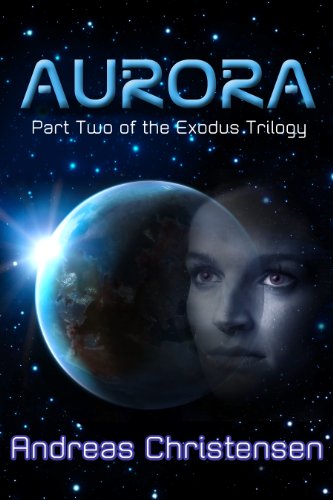
Review: Aurora, by Andreas Christensen

Aurora, the sequel to Andreas Christensen's Exodus, is a book that could have been intriguing, that could have been thought-provoking, that could have been entertaining, had the author done some research. As it stands, it is far too implausible to take seriously. There's also the problem that the choice of plot and conflict is misguided. A story about a colony of humans trying to survive on a brand new planet, and the struggles they come across in the process, is intriguing enough to write a novel about, but Christensen instead focuses his conflict on a far less interesting political conflict that boils over from the first book. The conflict in fact feels forced, as the government is not oppressive until the plot requires it. It's unfortunate that the author has little interest in developing the more intriguing parts of the world he has created.

Aurora continues where Exodus left off, with the remainder of humanity on their new home planet trying to survive. At the heart of the conflict is the government, which many people protest is too heavy-handed. Having anticipated this, a group of rebels back on Earth had planted people who could change this political culture. One of these is Thomas Dunn, who is such a shady character it's a wonder that the new president, George Havelar, trusts him, or that Maria Solis, the Latino daughter of Ramon Solis, right hand man of Havelar, would fall in love with him. But I guess the characters are so paper thin it's hard to care anyway.

Other key players include Kenneth Taylor, a psychologist who doesn't really like the way Havelar runs things, but keeps quiet. Tina Hammer was one of the commanders of the flight to the planet, but she has retired from military life in order to build a fishing empire. Greg Hamilton was the lead commander, who joins Tina. Ben Waters was one of thirty or so teenager who was smuggled aboard the Exodus and was lucky enough not to be shipped back to Earth. Each of these characters has some sort of grumblings about the way Havelar runs things, but the problem is it's not very clear what he does that's so problematic. The main issue is that he does not allow expeditions to explore very far on the new world. No reasoning is provided, but the complaints seem more akin to a teenager complaining about too many rules than an adult reaction. They hardly warrant any sort of rebellion. And even when Havelar unveils in secret some plan he has, it doesn't sound crazy or evil, just stupid.

Christensen is far less concerned about survival on a new planet than he is with his political conflict, and that's a shame. His brushing off of potential conflicts based around survival also adds immensely to the implausibility of his world. For example, it isn't until a third of the way into the novel that somebody finally dies. After light-years of travel and over 150 years, only two people have died by the time we reach a third of the way through book two. Human history tells us that whenever people colonize a new land, whether or not it was already populated by other people, lots of people die. They die from disease. They die from the elements. They die by each other. They also die by wildlife. It should be no different with colonizing a new planet. In fact, there's reason to believe survival could be harsher on a new planet. Descriptions of life on the planet show characters living a life of luxury compared to what you would expect. It's true that technology is better, but there are so many unknowns that it's impossible that it took so long for anybody to die, even by accident or human stupidity.


Christensen is not a particularly good writer. I don't mean to say he's a bad writer, but perhaps his talents aren't well-suited to fiction. He doesn't dive into the heads of characters very well, even though chapters are split up by character. One character could easily replace the other. Mantras tell writers to show rather than tell, and while there are fantastic tellers out there, Christensen is not one of them. He may have benefited more from showing his plot unfold rather than tell about it. Events happen and we learn about them after the fact, and this has the affect of making things harder to believe. There's also the issue that the dialogue is poorly organized. A line of dialogue will be followed, without a paragraph break, by a description of a character who is not speaking. Here is an example of the way Christensen writes his dialogue throughout the entire story:

" 'Don't worry about it. And by the way, I'm not that kind of psychologist.' She smiled back at him."

In most stories, this dialogue indicates that the speaker is the "she" in the paragraph, who would be, in this case, Maria Solis. The problem however, is that Kenneth Taylor is actually the speaker. It's true that context makes this easy to figure out, but the way Christensen ignores these rules of writing dialogue breaks the novel's magic. It brings the reader's attention to the fact that they are reading a novel because the reader must re-calibrate their brain to say that no, it's not Maria who is speaking, but Kenneth. It is maddening, and this example is typical of how Christensen writes his dialogue throughout the entire novel.

I can say that at least you won't take up a lot of time with these books. They are over fairly quickly, but you probably won't gain any new understandings of the world or even be particularly entertained. Christensen seems to want to reflect the political climate of our time, but he places this sort of thing in the wrong kind of book. In a book about surviving on an alien planet, it's not unreasonable to want to see humans struggling to survive. And just when things begin getting intense, a deus ex machina is inserted that adds immensely to the implausibility. I just can't find it in me to continue reading this series.

Saturday, August 27, 2016

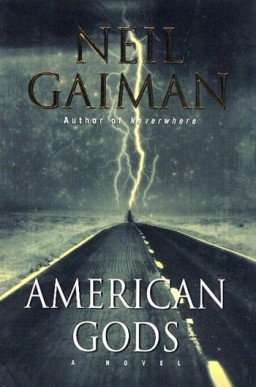
Review: American Gods, by Neil Gaiman

In its meandering ways, American Gods is an underwhelming behemoth of a novel. Neil Gaiman himself is a god in the fantasy writing world. His writing is magic and he has written some fantastic pieces of fiction, both in novel and graphic novel form. His voice is also a work of art. He deserves a spot up there with Morgan Freeman and Werner Herzog in creating magic with that voice. While reading American Gods, I couldn't help but hear how his voice might pronounce phrases, the way he might pause, or the way he might stress certain words. And yet Neil Gaiman is not a god (and I'm not implying that he thinks he's one, either). While others may treat him as a god whose pen turns everything he writes into gold, he does misfire now and then, and American Gods is one of those misfires.

Halfway into my reading of American Gods, I was puzzled by my inability to appreciate the work as others had. Despite the praise I had both heard and read, I was bored. I wasn't engaged. The humor was lacking or muted. The characters, none of them, were particularly well-drawn. Shadow is a nothing of a character, somebody who has things happen to him and who does what he is told. Shadow is not unlike the main character from The Ocean at the End of the Lane, about whom I also had the same complaint. This work never quite develops a fully coherent plot, nor does it provide itself with much of a purpose. It feels like it should be deep in purpose, but whenever I try to grasp for it, I come up with nothing. Too many of the travels and plot events end up going nowhere.

Perhaps part of my problem was that I didn't care. I didn't care about the gods. I didn't care about Shadow and what happened with his wife. The gods, and Shadow's wife, turn out to be very unlikeable, and I think that's on purpose. But the gods are the biggest problem. Gaiman is probably trying to say something profound by showing all the gods from all over the world who have come to America at some point or another and have been forgotten. The question is, is it bad that they are forgotten? Is this saying something about America? Is there a critique somewhere in there? I mean, there are plenty of gods who are no longer worshiped. Along with the Norse gods like Odin and Loki and Thor, there are the Roman gods such as Zeus and Athena, and the Greek gods. What is Gaiman trying to get at? I couldn't grasp it.

The other problem comes down to the idea that there is a conflict between the new gods and the old gods. The new gods are gods of internet and television and whatnot. How are those gods? Where do you draw the line? Gaiman suggests that where people used to sacrifice living things to gods, people now sacrifice time. So shouldn't everything that we sacrifice time to be a god? I spent a lot of time reading this book. Do books have a god? Do commutes to work have a god? Does work itself have a god? School? Studying? Vehicles? Zoos? Parks? And on the same line as the previous paragraph, is Gaiman providing a critique in this conflict? The problem was that I spent time attempting to see his larger point, and every attempt I made grasped at straws. People may just say I don't get it, and I can't say I disagree with that. I don't get it. When it comes down to a conflict between gods, I didn't care. The gods were not human enough and whatever they were trying to symbolize is not convincing enough.

Gaiman has proven himself to be a great meanderer. The Graveyard Book is an excellent example of his meandering, and in that book it works. It's fascinating the way he creates a world and brings it to life. In American Gods, though, his meandering merely muddles his world. I get a feeling of fatigue, of searching for purpose. Gaiman has also proved that he can write terrific stories with clear plots. Neverwhere played to Gaiman's best strengths with humor, well-developed characters, and villains who were both amusing and terrifying. In American Gods, anytime Gaiman seems to be getting somewhere, the novel gets stuck in a rut. His villains aren't particularly interesting or scary, and his gods are mostly terrible people, too much to care about. Wednesday charms teenage girls into having sex with him and tricks hardworking people out of their money. Another god swallows men with her vagina. The gods seem more like villains than people we should root for, and I wasn't sure what Gaiman wanted his readers to think.

One consistent thing I saw in reviews, is that if this was written by anyone other than Gaiman, such and such a reviewer probably would have enjoyed the novel more. This doesn't make sense except to elevate Gaiman to that status of a god. It's as if to say that he is such a god that an inferior work written by him would be an excellent work written by another, lesser writer. American Gods would have been as meandering as it is no matter who wrote it, but it might not have seen the same praise. But because this is a Gaiman work, there is some enjoyment to be had. There are moments that do work, where the reading is pleasant even if the purpose is unclear. That said, I would still have trouble recommending this to anyone but a Gaiman fan, or a fan of mythology. Others may find themselves thinking Gaiman is overrated, and they would be wrong. This simply is not one of his better works, in my mind.

Friday, August 26, 2016

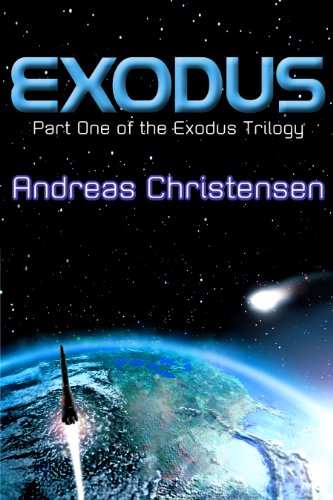
Review: Exodus, by Andreas Christensen

It's a terrifying idea: a massive object from space is on a collision course with the Earth. It's terrifying because we could see it coming, but we'd be powerless to stop it. Of course, such Hollywood movies as Deep Impact and Armageddon have imagined ways people could redirect or destroy the comet/meteor. But what if the object was so large that it would be impossible to redirect or destroy it? This is what Andreas Christensen (what a name!) aims to examine in his Exodus trilogy, beginning with his first book, Exodus. The idea isn't original, but it's so fascinating that it's tough to pass by a story that decides to examine it, whether it's a story that you might find on a cheap Syfy movie or a big budget Hollywood blockbuster. As interesting as parts of this book are, it suffers from the marks of an amateur writer. The pacing is off, the character development is poor, and the book just plain suffers from boredom due to repetition and an over-reliance on explaining things.

The prologue introduces a rogue planet that is destined for a collision course with the Earth. Luckily, though, Mars was in the way. Or maybe not so lucky, since the collision with Mars has set the planet in an orbit towards the sun in which it will collide with Earth. Why did nobody notice a rogue planet hurling through the Solar System, you might be wondering? In this version of Christensen's planet Earth, the United States has decided to stop funding NASA because of a terrible tragedy during an expedition to Mars. To make matters worse, the U.S. government had been eroding its basic protections for people, such as the First Amendment, for decades (this takes place in 2070). This is perhaps where Christensen adds something unique, in the addition of a political tyranny of sorts. It's unfortunate that he doesn't fully explain this erosion of rights. It's not clear exactly what is not allowed and what the consequences are for breaking that law. Again, the mark of an amateur author. Maybe Christensen barely knows himself.

Essentially what the conflict boils down to are two things. One, scientists attempt to come up with a way that they can launch a small number of people into a gigantic ship so that they can colonize a distant planet. They only have twelve years before the rogue planet smashes into Earth. I think Christensen is pretty generous here, but in fairness, when all the world's scientists are focused on this problem, I guess it could maybe be possible. The other conflict involves a small number of people who would like to sabotage the plans, politically at least. Not everybody is happy with the direction the United States government was continuing to head, and with the current president in charge of the mission, it seems likely he will attempt to further his regime on this distant planet. So this rogue group wants to get people on board who make sure a better government is in place.

Notice I haven't mention a single name. There are lots of characters, but zero personalities. Tina Hammer, who opens the book, is notable, as Christensen describes her, because she is an African American woman who is a fighter pilot. There's also Maria Solis, a Latino girl whose parents are high up in what is called the Consortium, which seems to be a conglomerate of businesses that have a lot of power and access to government information. Honestly, there are others, including a senator, an FBI agent, a psychologist, and a mix of people chosen to train for the Exodus expedition, but I can hardly remember who's who.

As I said, the solutions to the problem of migrating a population across a massive amount of space is solved rather quickly. Scientists discover a good planet fairly quickly. They solve the problems of speed quickly. They figure out how to create cryogenic sleep rather quickly. Those who've read any Arthur C. Clarke may remember that it took the scientists in Songs from a Distant Earth several centuries to come up with all of this. In fact, Christensen could probably learn a thing or two from Clarke. Human philosophy is often more interesting than a how-to guide in getting us up to space. Christensen's science isn't very specific, not like Andy Weir's in The Martian, but his story does get bogged down too much in mechanics and not enough in humanity. It's amazing how calm people seem to be considering their imminent doom. At the end there is a little bit of chaos, but this doesn't seem to really reflect human behavior in this scenario.

I've begun reading the second book before writing this review, and I will say that Christensen hunkers down and focuses his story a lot better. We get a better look into the characters and motivations and we get much more coherence, rather than a randomly organized set of problems and solutions that Christensen presents here in book one. I considered giving up, but it's a short book, so I finished it. This is tough to recommend though. Serious fans of sci-fi will grow bored with the paper-thin development. Notably, there is a strong lack of any original ideas, with an exception of the political suppression. It's a shame Christensen chose to spend so long on this aspect of the story. Clarke used this sort of story as background in his Songs from Distant Earth, and Christensen proves the wisdom in Clarke's choice by expanding the background story into a full, tedious novel.