Wednesday, July 11, 2012

WWW Wednesdays


WWW Wednesdays is a meme hosted by MizB at Should Be Reading. What you do is answer the following three questions:

What are you currently reading?


I'm over 350 pages into this massive book now, and it's still entertaining. There are lots of surprising developments that keep popping up and make me want to know what happens next. So it's hard to put down.

What did you recently finish reading?


I took a break from A Clash of Kings to read The Perks of Being a Wallflower by Stephen Chbosky. I really enjoyed it, and I've just now posted the review as well, which you can find here.

What do you think you'll read next?


I'm finally going to get around to finishing The Hunger Games trilogy. My brother has lent me the last two books, which my wife is flying through in a hurry. Hopefully by next week's post I'll have started reading this one.

The Perks of Being a Wallflower, by Stephen Chbosky (1999)

The Perks of Being a Wallflower is a novel about intelligent high school kids. Hollywood likes to think audiences only want to hear about the dumb ones who do nothing but party, talk about the opposite sex, and have no ideas of their own. I hope the movie starring Emma Watson doesn't follow this tradition. Because Stephen Chbosky has written a novel that allows teenagers to have their own ideas and even be wise. Of course, there is still partying, drugs, sex, love, and all of that stuff, but that's part of growing up. And Chbosky handles it in a mature way.

It's 1991, and Charlie has just begun high school. He's nervous because he's a very shy kid. He doesn't have a lot of friends and doesn't make them easily. At least until he meets Sam and Patrick, who are stepsiblings and are in their senior year. Charlie immediately falls for Sam, though she tells him not to think of her that way, and Patrick has a secret gay relationship with the star quarterback, Brad. It should be no surprise that by the end of the novel Charlie will have been kissed by both Patrick and Sam. Kissed by them because he's far too passive to actually initiate the kissing. These are his closest friends, and he learns a lot from them. In one profound scene he is so happy to be with them that he proclaims he feels "infinite."

Charlie, from the upcoming MTV movie
Charlie comes from a pretty good family. He has nice parents who are mostly out of the picture. They don't seem to mind that he stays out late on school nights, and they don't seem to realize he's started chain smoking. Charlie also has an older sister, who's a senior and one of the smartest of her class, and an older brother, who plays football for Penn State. Charlie's relationship with his siblings is mixed. He doesn't not get along with them, per se, but they generally have nothing to do with one another. This is especially true after Charlie walks in on his sister having sex with her boyfriend and she calls him a pervert.

Sam, from the upcoming MTV movie
The novel is written in the form of letters from Charlie to an anonymous person. This adds a sense of intimacy to the novel. It's as though Charlie's writing the letters and sharing his experiences with you, the reader. I grew to like Charlie. He's overemotional and cries a lot, and he seems unhappy more than he is happy. I would say that's part of being a teenager, because it is, but Charlie's definitely different than most teenagers. In addition to being very sensitive, he is very smart. He reads and enjoys books like To Kill A Mockingbird and A Separate Peace, books most high schoolers despise with a passion. I liked Charlie from the start, but these feelings were cemented in a touching scene where he discovers sympathy for George Bailey in A Wonderful Life, the character who gets drunk and squanders the money that forces Jimmy Stewart to sacrifice his dreams. He wishes the movie were from George Bailey's perspective because he wants to believe that George's life has meaning. Like I said, Charlie's a bright kid.

His English teacher, Bill, recognizes this too. He befriends Charlie and lets him borrow books, modern day classics like Catcher in the Rye, and asks him to write essays about them. Bill is a cool teacher. I want to be like Bill. He has a dream of leaving teaching and writing plays, but likes teaching so much he decides not to quit. The friendship between these two blossoms and we learn Bill's intentions towards the end in perhaps the novel's most touching scene.

Patrick, from the upcoming MTV movie
It's clear that Charlie is depressed. He's sad about his Aunt Helen's death because they were close. Though with Aunt Helen you get a sense that there's something more. He also visits psychiatrists who do nothing but ask him about his past, which bothers him. Bill encourages him to participate in life, which is great advice, though it does get Charlie into drugs and alcohol. It also gets him his first girlfriend, Mary Elizabeth, who soon discovers she needs somebody a little less passive. Charlie seems to take in his experiences like a sponge. Or, rather, like a wallflower. He lets things happen around him and observes and thinks, but this frustrates people because they want him to act.

Despite all of this focus on sorrow, The Perks of Being a Wallflower is a soothing read due to its poetic language. Chbosky so accurately reflects high school life that it made me think back to my high school days. My first crush. My first heartache. Like Charlie, I was amazed when somebody else regarded me as a somebody, rather than the nobody I acted like I was. That was why Bill wanted him to participate, and so do Sam and Patrick. What Chbosky's trying to say is that you can learn a lot by being a wallflower, but to experience life and feel "infinite" requires that you actually do something rather than wait for it to happen. You might be surprised by the results.

Monday, July 9, 2012

Bookmark Monday: Orange Man


I've decided to join in on Bookmark Monday, hosted by Aloi at guiltless reading, because it sounds like fun. And I love to collect bookmarks.

So here's mine for this week:


In those cases you can't find your bookmark, at least you know where your cat is. They come in different breeds, too! And Orange Man's so lazy he could probably save my spot for at least a few hours.

Black Boy, by Richard Wright (1945)

Richard Wright's autobiography poses the question, how can a black man experience life and freedom in a post-slavery, Jim Crow world? His own life experiences demonstrate the difficulty of this question. He must work harder than everyone else to achieve less, and the harder he works the more resistance he faces, both from the white world and the black world. His own relatives beat him for asking too many questions, and his white coworkers intimidate him for having the gall to speak to them. Wright comes out as a unique character in his time and place. He refuses to submit to the will of his superiors, but fights back or flees when appropriate. He also has a unique innocence, a sense that his life shouldn't face any greater obstacles than the next man's. His own naivete sets up many moments of disillusionment along his life's course, but they also make him stronger, and this, of course, is at the heart of the novel's themes.

The opening of the novel sets up a pattern of defiance and punishment that defines the rest of it. In defiance of his parents' orders to stay locked up in his room, he begins to throw things into the fireplace, setting the house on fire in the process. He hides under the burning house to escape a beating, but when his parents finally drag him out they beat him to within an inch of his life. The severity of the punishment doesn't quell his defiant nature, however.

Wright had a difficult childhood. His family was poor and he rarely had enough food to eat everyday, so he grew up a scrawny boy. His parents divorced while he was young and because he moved back and forth between homes so often he never had an uninterrupted year of school until he was a teenager. Even then, he never went beyond the ninth grade. His family was very strict. Nobody was allowed to ask any questions, no matter how innocuous, and anybody who did received a reminder smack. Wright still asked questions. Lots of them. And the smack that followed became so habitual that his instinct was to avoid it, which one day drove his grandmother down the porch steps, where she broke her hip. He even learned to fight back when appropriate, such as against his uncle who had no reason to raise his belt to him.

Defiance wasn't the only thing that got Wright into trouble, however. He was a naive boy who expected things to turn out better than they did. As a result, he grew disillusioned and disappointed. He came to realize that it was because he was black that society treated him differently. The first time he worked at a white lady's house, he's offered a breakfast of moldy molasses, which she found perfectly acceptable for a little black boy. He was so upset he never showed up again. His suspicion of whites grew stronger with each negative experience.

As an adult, the racism he faced took a more dangerous turn. He often felt frightened for his life. At one job, a pair of coworkers ganged up on him and threatened to kill him, forcing him to move to another city, and at another job his coworkers coerced him and another black employee to box for money. They played tricks on the two, making them suspicious that the other was trying to kill him. These cruel japes are played, it seems, because the white employees see these two black men as nothing more than playthings. All Wright wants is to make some money to support his family and be left alone to read his books. And he reads a lot.


The novel does settle into a somewhat predictable pattern. Wright enters situation after situation expecting a great experience, only to become disillusioned by the realities of racism. However, this feeds into the novel's main themes. Wright does an excellent job of blending humor, action, suspense, and philosophy. It's also inspiring that he could grow into the great writer he became despite the overwhelming obstacles he faced, and it's sad all the same that those obstacles were there to begin with. In its clarity, its depth, and its thematic content, Black Boy is a very important American novel about a man struggling to survive and thrive in the world's wealthiest nation.

Friday, July 6, 2012

Book Beginnings: The Perks of Being a Wallflower


Every Friday Rose City Reader hosts Book Beginnings on Fridays. What you do is share the opening line(s) of the book you are currently reading and briefly discuss what you think about the opening line or the book or whatever else inspires you. Make sure to share your entry with Rose City Reader and in my comments below.

Here's my book beginning:


"August 25, 1991

Dear friend,
       I am writing to you because she said you listen and understand and didn't try to sleep with that person at that party even though you could have."

- The Perks of Being a Wallflower, by Stephen Chbosky

I'm finally going to start this, though it does require prying A Clash of Kings from my hands. It looks like it is written as a series of letters, and the opening to the letter is interesting. After reading the unconventional ttyl books, written as instant messages, I guess I'm off to another unconventionally-written story. Not that there's anything wrong with that.

Thursday, July 5, 2012

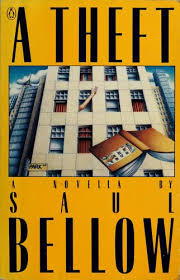
A Theft, by Saul Bellow (1989)

This is the second novel I've read by Saul Bellow, a Nobel Prize-winning author. The first, Seize the Day, is very good, about a destructive American obsession with success. A Theft is a little trickier. It's about a woman, Clara Velde, with a successful career life, though a failed love life. What makes this novel so troublesome is that it's not very clear what the reader is supposed to make of Clara. Is she supposed to be a highly flawed heroine, or a fount of love and wisdom? Bellow exercises his powers of subtlety a little too well in this novella, to the point that reading it becomes a chore.

Clara grew up in the country, raised by wealthy fundamentalist parents who donate their money to televangelists. She moved to New York, where she met Ithiel Regler, called Teddy, a brilliant scientist who works for the federal government. She fell in love, and supposedly he did too, though the pretty emerald engagement ring he bought for her was not his choosing. He was only caving in to her demands. Their relationship didn't work out, though twenty years later she still feels he is the only man she really loved. As such, she keeps in touch and still wears the ring.

She married four men after breaking off her engagement with Teddy. She complains that her current husband, Wilder, spends too much of his time reading read thrillers by John Le Carre and doesn't help out with their three kids. She married him for sex alone. He happens to enjoy the fact she is still friendly with some of her high profile exes, and tapes interviews of Teddy whenever he's on TV. Clara confides this information, and more, in her friend, Laura Wong. Laura mostly sits and listens. We don't learn much about her, suggesting that Clara holds no interest in her personal life, but she seems to be the only friend Clara has outside of Teddy. Another important character is Gina, an Italian woman who Clara hires to take care of her kids. Clara sees in Gina a character of high quality, though some of Gina's actions seem to contradict this. Clara allows her to bring her Haitian boyfriend over, but only if the kids are in bed, and one night Gina has a party that balloons into more people than Clara thought there would be.

And now we come to the theft. As you might have guessed, the object of the theft is the engagement ring. In his subtle way, Bellow introduces a second theft, which actually happens first, though nobody ever refers to it as a theft. First of all, Clara loses the ring. Because it is insured, she files a claim and collects $15,000. Then, by chance, the ring turns up again, under her bed. However, she doesn't tell the insurance company she found it because, well, she had already spent all the money. Then, the ring is stolen. Clara thinks she knows who the culprit is, and she develops a very low opinion of this person. It never seems to enter her mind that she is also a thief, and her theft is even worse.

Based on what I've just written, you might be thinking this sounds like a good book. And I admit it has the elements in place to be a fascinating read, but the execution is off. Bellow is, perhaps, a little too subtle. To the point it's not very clear what he's trying to get at. The narrator has a limited third-person perspective and seems more or less partial to Clara. We learn much from Clara's dialogues with Laura Wong, Teddy, and her psychiatrist, though she does most of the talking. It's hard to say what these people think of Clara. The psychiatrist is paid to listen to her, and even Laura has a professional connection with her. Teddy seems to genuinely like her, though not enough to marry her. What we do know is what she thinks of herself, which is that she's of a superior caste of people. The problem is, the novel seems to endorse this view of her. I can't tell what Bellow's aims were; it seems he's playing things with a little too much subtlety. He provides too much contradictory evidence for the reader to develop a thoughtful opinion of her.

To make matters worse is this excerpt from the blurb on the back of the book:

"As she attempts to recover the precious ring, Clara emerges as a genuine heroine, a woman of great depth and unsuspected capacities of wisdom and love."

I think the blurb has it wrong, but it's not clear whose view the blurb represents: the author's, the publisher's, or some other party. Clara is self-absorbed and jumps to hasty conclusions. Based on a very minor detail, a supposed change in Laura's tone of voice, Clara has the belief that her friend wants to steal Teddy from her, though it is assumed Laura has never met Teddy. She has romantic ideas about Gina, but negative feelings about her boyfriend, who she has never talked with. She's a poor mother and a poor wife. We never see her interacting with her daughters or her husband, and when she mentions them it's only to complain. To add to that, she's clearly a racist, which we know based on the number of times she claims that she isn't.

Perhaps this sounds like a thought-provoking read, and certainly I've spent a lot of thought on it, but it was a chore to sort out. This is not very enjoyable. At 110 pages it felt at least twice its length. I reread passages again and again to try and figure them out, only to move on in frustration. I have my mind made up about Clara, but I don't know if the conclusion I've drawn is the one Bellow intends. If you were thinking about getting into Saul Bellow's works, I wouldn't start here.

Wednesday, July 4, 2012

WWW Wednesdays


WWW Wednesdays is a meme hosted by Should Be Reading. What you do is answer the following three questions:

What are you currently reading?


I finally started A Clash of Kings, by George R. R. Martin. Where A Game of Thrones had a somewhat slow start, A Clash of Kings picks up at the cliffhangers its prequel left off at, and you know everybody by now, so it's off to a better start. So far so good.

What did you recently finish reading?


I most recently finished A Theft, by Saul Bellow. When I posted this in last week's WWW Wednesdays, a lot of people sounded interested in this one. Unfortunately, it turned out to be a very frustrating novel. At 110 pages, it felt much longer. It took me 2 days to read it, and then I read 150 pages of A Clash of Kings in one day. I will post my review tomorrow. Also, I finished ttfn. The review is here.

What do you think you'll read next?


I have finally found a copy of The Perks of Being a Wallflower, by Stephen Chbosky. I'll probably start reading it before the weekend starts.